
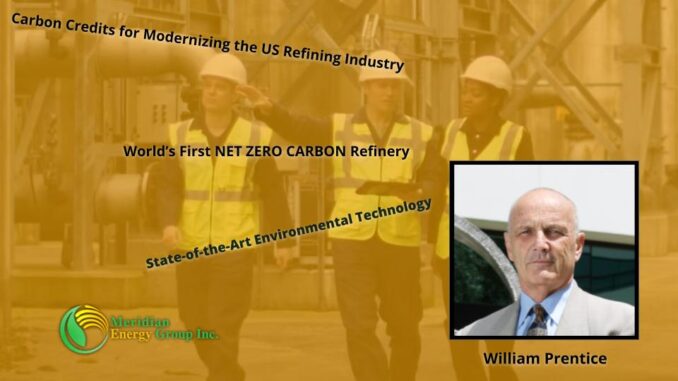

William Prentice, CEO of Meridian Energy Group, spoke with Jason Spiess, founder of The Crude Life, about the Davis Refinery in North Dakota’s Bakken region — the first new greenfield refinery to be built from the ground up in the United States in more than 50 years.
Prentice described the Davis project as a true “greenfield” refinery, designed from a blank sheet of paper around the high-quality Bakken crude.
“When you start with a blank sheet of paper and you start in the Bakken with arguably the best crude oil in the world to process, it’s pretty easy to design a process around that that will be clean and very, very efficient,” he said.
The facility will be compact — more “hamburger stand than grandfather’s refinery” — and is engineered to be the industry’s first fully digital refinery. A digital twin will enable real-time simulation, emissions monitoring, safety optimization, and operator training. By shortening pipe runs, tightening the plot plan, and incorporating recent technological advances, the design dramatically reduces fugitive emissions compared with traditional sprawling refineries.
A recent process change — co-processing local vegetable oil with Bakken crude and capturing excess hydrogen — will make Davis a net-zero carbon refinery, producing primarily diesel and gasoline with no heavy residual product.
The refinery will also generate renewable diesel and, at the Texas and Oklahoma sites, sustainable aviation fuel (SAF) blends.
Overcoming a Decade of Hurdles
Prentice candidly recounted the project’s challenges: unexpected opposition from environmental groups and park advocates concerned about proximity to Theodore Roosevelt National Park (3.5 miles away). Meridian proved no visual impact by raising balloons and kites at the site and demonstrating Earth’s curvature. Extensive litigation, COVID disruptions, and federal permitting delays under the previous administration slowed progress, but Prentice noted a markedly improved regulatory environment in the past year as policymakers recognize the need for smarter, cleaner fossil-fuel infrastructure.
Local politics and optics also played a role too.
Prentice discussed how the project’s rigorous state-level permitting in North Dakota and planned sites in Texas and Oklahoma demonstrated that “favorably disposed to energy does not mean getting away with murder.” The North Dakota Department of Environmental Quality required proof that every process was commercially proven elsewhere.

Expansion Plans: Texas and Oklahoma
Meridian is now finalizing engineering for Davis and negotiating a new site for the Permian Basin refinery in Texas. A third refinery in Cushing, Oklahoma, will process a blend of Permian and Bakken crudes.
Each facility will follow the Davis model: smaller scale (roughly 5–10 times smaller than major Gulf Coast refineries), state-permitted, and optimized for low emissions and quick time-to-market.
Annual revenue per plant is projected at approximately $1.8 billion once operational.
Financing Update
Meridian remains privately held and raises capital through periodic private placements to avoid dilution. A new round for final Davis engineering is expected to launch at the end of April.
Once the lump-sum contract price is finalized (anticipated in 3–4 months), project financing of roughly $1.2 billion for the Davis entity will be provided by institutional investors and bank debt. Meridian will retain management and operating control.
Broader Industry Implications
Both men framed the Davis Refinery as part of a paradigm shift in refining — moving away from massive coastal complexes toward localized, efficient “micro” facilities that cut transportation emissions and costs. Prentice emphasized that the intellectual property developed (digital design, emissions modeling, closed-loop water systems) will be applied across future projects and could extend into related energy infrastructure such as data-center power.
Spiess drew parallels to disruptive changes he witnessed in print media and the aviation industry’s adoption of digital tools, noting that real innovation often faces skepticism until it proves itself in operation.
Prentice agreed: “Building a new project and taking a look at what we’ve done… everybody’s gonna have to adopt a new set of best practices.”
Looking Ahead
Construction on Davis is now visible on the horizon. Prentice expressed eagerness to move from permitting and litigation to actual operations, confident the plant will exceed its already stringent environmental promises. Texas and Oklahoma projects will follow roughly 1.5–2 years later.
The interview closed on a cultural note, with both reflecting on Spiess’ upcoming project – Route 66 Americana Archive – which sparked conversation of the legacy of mobility, opportunity, and the internal-combustion engine’s role in shaping modern America — a fitting reminder that today’s energy innovations continue that same spirit of practical progress.
To learn more about Meridian Energy Group, click here
To learn more about investing in the Davis Refinery, click here
The Crude Life Content Network
Primary Website
Follow on YouTube
Follow on Facebook
- The Crude Life Facebook Page
- Eagle Ford Texas Facebook Page
- Bakken.com Facebook Page
- Haynesville Facebook Page
- Marcellus Facebook Page
- Niobrarachalk Facebook Page
- PermianShale Facebook Page
Follow on LinkedIn
- The Crude Life LinkedIn
- The Founder of The Crude Life – Jason Spiess LinkedIn
The Crude Life has been a trusted brand pioneering energy content for 15 years — from the very first podcast in 2011 to today’s full-spectrum content company producing podcasts, video interviews, print features, radio news, social media campaigns, Substack editorials, live events and more.
Trusted Interviews. Industry Experts.


