
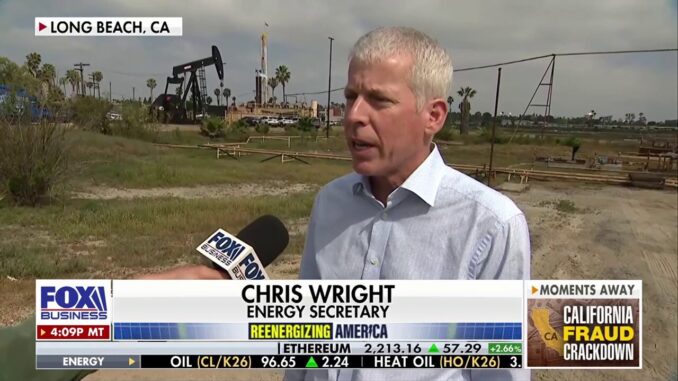
In a pointed message aimed squarely at Governor Gavin Newsom’s administration, U.S. Energy Secretary Chris Wright visited a Synergy Oil & Gas production site here on April 8, spotlighting how California’s extreme environmental rules are blocking American energy production, killing jobs, and inflating costs for families and businesses.
Standing amid idle oil jack pumps near coastal wetlands, Wright didn’t mince words: overly restrictive regulations and reliance on imported energy are making everything more expensive while driving energy-intensive industries out of the state.
“When you make energy expensive by importing it and putting ridiculous regulations on it, you not only make it more expensive to pay your bills, but you make it so businesses that consume energy aren’t going to locate in your state,” Wright declared.
His visit comes as the Trump administration ramps up its legal and policy fight against California’s one-size-fits-all approach to energy — a battle that could determine whether the Golden State doubles down on imports and high prices or returns to the domestic production that once powered its economy.
A Deal for Wetlands — Blocked by Bureaucracy
The Synergy site perfectly illustrates the absurdity. Last year, Long Beach struck what should have been a win-win agreement with the company: Synergy would restore 154 acres of retired oil field into the Los Cerritos Wetlands — one of the largest open-space expansions in the area in decades — in exchange for limited new drilling rights on a smaller parcel and an 8.5% revenue share for the city to fund coastal infrastructure.
Yet California’s setback law, enacted nearly a year ago, has torpedoed the plan. The measure bans new oil wells within 0.6 miles of homes, schools, and other populated areas — even on private land and portions of federally authorized leases. As a result, Synergy’s facility, which has the infrastructure to produce up to 6,000 barrels of oil per day, is throttled down to just 100 barrels.
“What I’m trying to do is save 35 employees, and I’m trying to produce the oil we own,” Synergy CEO John McKeown told Wright during the visit.
Long Beach Councilmember Kristina Duggan, who helped broker the original deal, was blunt about the lost opportunity: “We have wells off the coast of Long Beach on our oil island where we can’t drill new wells, and it is so far from sensitive areas. … We rely on oil production for revenue in Long Beach.”
Setbacks Designed “To Kill the Industry”
Wright pulled no punches on the law’s true intent. “The setback in California has absolutely nothing to do with public health,” he said. “These setbacks get set at the number that will kill the industry.”
The Trump administration agrees — and is acting. The Justice Department sued California earlier this year, arguing the setback rule unconstitutionally interferes with federal oversight of public lands under the Mineral Leasing Act and Federal Land Policy and Management Act. A federal judge recently denied a preliminary injunction to pause enforcement, but the core lawsuit continues. Environmental groups like Earthjustice and the Center for Biological Diversity are now trying to insert themselves into the case.
California’s Self-Inflicted Energy Crisis
The human and economic costs are mounting. California already boasts the nation’s highest gasoline prices, a gap that has only widened amid global market turbulence. The state has shuttered refineries and lost nearly 20% of its refining capacity in recent months, forcing greater reliance on imported crude and gasoline.
Newsom’s office tried to deflect, with spokesperson Anthony Martinez blaming the White House and past U.S. actions involving Iran for price spikes. Yet the facts on the ground show California’s own policies — from aggressive setbacks to permitting delays — are a major driver of higher costs and reduced supply.
Wright’s visit is part of a broader federal strategy to restore energy dominance: invoking the Defense Production Act for shuttered infrastructure, expanding domestic leasing, and challenging state rules that prioritize ideology over reliable, affordable energy.
For California families paying premium prices at the pump and businesses eyeing relocation, the message from Washington is clear: burdensome regulations that block even environmentally beneficial deals aren’t protecting the public — they’re punishing it. The Trump administration’s willingness to fight back offers a rare glimmer of hope that common-sense production could finally return to the nation’s most populous state.
The Crude Life Content Network
Primary Website
Follow on YouTube
Follow on Facebook
- The Crude Life Facebook Page
- Eagle Ford Texas Facebook Page
- Bakken.com Facebook Page
- Haynesville Facebook Page
- Marcellus Facebook Page
- Niobrarachalk Facebook Page
- PermianShale Facebook Page
Follow on LinkedIn
- The Crude Life LinkedIn
- The Founder of The Crude Life – Jason Spiess LinkedIn
The Crude Life has been a trusted brand pioneering energy content for 15 years — from the very first podcast in 2011 to today’s full-spectrum content company producing podcasts, video interviews, print features, radio news, social media campaigns, Substack editorials, live events and more.
Trusted Interviews. Industry Experts.


