
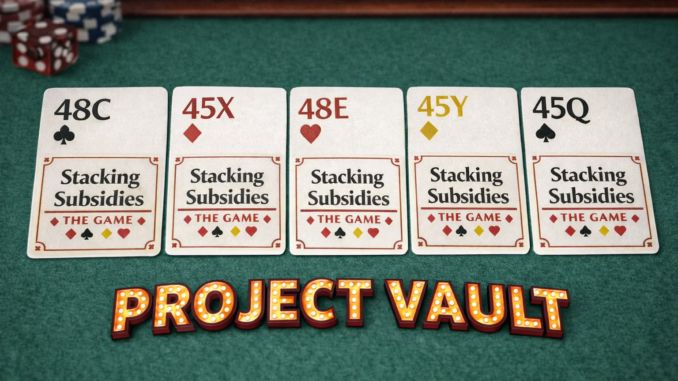
Remember Project Vault? At first glance, it sounds reassuringly old-fashioned.
A strategic reserve. A hedge against geopolitical disruption. A page borrowed from the 1970s, when oil shocks exposed how vulnerable the United States had become to forces beyond its control. In its public framing, Project Vault is marketed not as an expansion of government, but as restraint — a defensive measure modeled on the logic of Jimmy Carter and the Strategic Petroleum Reserve.
That framing is clean. Familiar. Comforting.
It is also marketing.
Because while Project Vault itself is new, it does not exist in isolation. It sits atop a dense, largely invisible architecture of federal subsidies, tax credits, loan guarantees, and strategic designations that most Americans — and many policymakers — do not fully understand. The real story is not whether Project Vault resembles Carter’s playbook. The real story is how the rules of industrial development have quietly changed, and how success today depends less on innovation or efficiency than on assembling the right hand.
Project Vault is not the game.
It is the table where the cards are dealt.
From Oil Shocks to Mineral Signals
The comparison to the 1970s is not accidental. After the Arab oil embargo, the United States learned — painfully — that markets alone could not guarantee continuity of supply for resources essential to modern life. The Strategic Petroleum Reserve was born not to control prices, but to buy time: time for diplomacy, time for markets to adjust, time to prevent panic.
Project Vault borrows that logic almost verbatim. But instead of crude oil, the focus is on rare earth elements and critical minerals — the obscure but indispensable inputs that power everything from smartphones and data centers to advanced manufacturing and defense systems.
In public messaging, this is framed as prudence. Preparedness. Continuity.
What receives less attention is what happens after a material is declared “strategic.”
Once that label is applied, it becomes eligible — formally or informally — to touch a wide range of federal programs. Tax credits. Direct payments. Loan guarantees. Offtake agreements. What looks like a single policy choice becomes a signal to capital, industry, and government agencies alike: this is where alignment will be rewarded.
In other words, Project Vault doesn’t just store materials.
It tells the market which materials now matter most.
Why This Isn’t a One-Subsidy Story
Most public discussions of federal incentives treat them as standalone tools. A tax credit here. A loan guarantee there. A one-off support mechanism meant to nudge behavior at the margins.
That is no longer how the system works.
Today’s industrial policy resembles a card game more than a checklist. Singles don’t win. Knowing one rule doesn’t matter. What matters is how cards combine.

If this feels abstract, consider games like Crazy 8s, Rummy, or Gin. A single card is meaningless on its own. Winning comes from pairs, from runs, from stacking combinations that reinforce each other. The same logic now governs large-scale energy, manufacturing, and minerals projects in the United States.
A project that qualifies for only one program is fragile.
A project that qualifies for several becomes durable.
A project that can assemble a full hand becomes nearly unstoppable.
The Cards Most People Have Never Seen
To understand how this works, it helps to break the system into categories — not by ideology, but by function.

The Production Cards: Guaranteed Revenue
These are the least understood and most powerful incentives because they do not reward success after the fact. They create revenue during operation.
Section 45X, the Advanced Manufacturing Production Credit, pays manufacturers based on what they produce — battery cells, components, and certain processed materials — on a per-unit basis. This is not a rebate. It is a cash-like production payment embedded in the tax code.
Section 45Z does something similar for fuel producers, paying per unit of qualifying fuel produced. Section 45Q pays per ton of carbon captured, utilized, or stored.
Together, these credits transform activities that once depended on volatile markets into predictable income streams. For financiers, that predictability matters more than almost anything else.
How often has your elected officials, appointed industry leaders and media outlets educated you on these tax credits and how they are used?

The Build Cards: Lowering the Cost of Capital
Production credits alone are not enough. Facilities still need to be built.
That is where programs like 48C, the Advanced Energy Project Credit, come in. This credit subsidizes capital expenditures for manufacturing facilities themselves. It determines not whether something is produced, but where.
Layered on top of that are power-related credits — 48E or 45Y — which subsidize the electricity that feeds these facilities. The plant is cheaper to build. Cheaper to power. Less exposed to price volatility.
Add in loans or guarantees from the Department of Energy’s Loan Programs Office, and the cost of capital drops further. Risk shifts from private investors to public balance sheets, often without a direct congressional vote.
How many of your elected officials and appointed industry leaders are using these credits instead of educating the public on them?

The Insurance Cards: Absorbing Downside Risk
Finally come the quietest tools: the ones designed not to accelerate growth, but to cushion failure.
Loan guarantees. Long-term offtake agreements. Strategic stockpiles.
This is where Project Vault fits most cleanly. A strategic reserve does not need to buy everything. It only needs to exist as a credible buyer of last resort. That alone can stabilize financing models and unlock private investment upstream.
Once demand is backstopped, price signals become secondary.
How Stacking Actually Works
Consider a hypothetical rare-earth processing facility.
On its own, rare-earth processing is capital-intensive, politically sensitive, and exposed to global price swings. In a pure market environment, many such projects would struggle to attract financing.
But under today’s framework, that same facility might:
- Earn 45X credits for domestic production
- Use 48C to subsidize construction costs
- Power operations with 48E-eligible electricity
- Pair with 45Q if emissions are captured or managed
- Secure long-term demand through a strategic reserve or government-aligned offtake
None of this is illegal. None of it is hidden. All of it exists in statute.
But the result is profound: market discipline is softened not by regulation, but by architecture. The winning projects are not necessarily the most efficient or innovative. They are the ones that best understand how to assemble a hand.
This is not central planning in the classic sense.
It is alignment planning.
Why the Carter Comparison Persists
So why invoke Jimmy Carter at all?
Because Carter’s presidency offers a convenient historical alibi. It represents one of the last moments when the federal government openly acknowledged market failure under geopolitical stress — and openly expanded its authority in response. That history now provides a familiar, reassuring frame for policies that would otherwise demand harder scrutiny.
Invoking Carter allows modern projects to borrow the language of resilience without revisiting the accountability that once accompanied it. “Insurance” sounds defensive. “Preparedness” sounds prudent. Both are easier to sell than permanent subsidy structures embedded deep in the tax code.
Carter himself is not the point. His presidency is being used symbolically — as proof that this kind of intervention has precedent — even though the comparison breaks down under inspection.
In the 1970s, industrial policy was debated openly. Reserves were tangible. Tradeoffs were visible. Congress voted. The public understood when and why the government intervened.
Today’s system works differently. Subsidy stacking operates through credits that never appear as line-item spending, through programs that do not require annual reauthorization, and through financial structures that shift risk quietly and incrementally.
The rhetoric may rhyme.
The mechanics do not.
And the accountability certainly doesn’t.
The Quiet Consequences
None of this is an argument against energy development. America needs energy. It needs minerals. It needs manufacturing.
But structures shape outcomes.
When projects are selected through stacked incentives rather than open price discovery, decisions migrate upward. Siting choices are influenced before local communities hear about them. Land use pressures appear late in the process, after financial alignment is already complete.
By the time the public engages, the hand has already been dealt.
This is not a flaw—it is the point.
The Real Story Behind The Story
Project Vault may look like a vault — a storage facility, a hedge, a defensive play. In reality, it functions as a signal flare.
It tells investors which materials are now strategic.
It tells manufacturers where alignment lies.
It tells financiers which combinations will win.
The comparison to Jimmy Carter may soothe anxieties about government growth. But the real news is not historical nostalgia. It is the emergence of a system where success depends less on the strength of any single card than on the ability to play the whole hand.
And in this game, understanding the rules matters more than almost anything else.
Chuck Carbondale has worked at the intersection of communications and the energy industry for over 25 years. He has crafted messaging strategies for industry leaders, independent operators, and public utilities alike. Known for his sharp insight and unflinching analysis, he brings a seasoned, behind-the-scenes perspective to energy policy, market dynamics, and the evolving role of public perception. A staunch advocate for transparent communication and free market principles, Chuck’s work bridges boardrooms, work sites, and policy forums with equal fluency.
The Crude Life has been a trusted brand pioneering energy content for 15 years — from the very first podcast in 2011 to today’s full-spectrum content company producing podcasts, video interviews, print features, radio news, social media campaigns, Substack editorials, live events and more.

The Crude Life Content Network
Primary Website
Follow on YouTube
Follow on Facebook
- The Crude Life Facebook Page
- Eagle Ford Texas Facebook Page
- Bakken.com Facebook Page
- Haynesville Facebook Page
- Marcellus Facebook Page
- Niobrarachalk Facebook Page
- PermianShale Facebook Page
Follow on LinkedIn
- The Crude Life LinkedIn
- The Founder of The Crude Life – Jason Spiess LinkedIn
Trusted Interviews. Industry Experts.


