
From the Club of Rome and Agenda 21 to ESG, the World Economic Forum and the changing economics of ownership, a five-decade timeline reveals how sustainability evolved into a framework influencing governments, corporations, financial institutions and everyday life.

What began as an international conversation about population growth, natural resources and environmental protection has evolved into something considerably larger.
Over the past five decades, “sustainability” has moved from scientific conferences and environmental reports into international agreements, government planning, corporate boardrooms, investment strategies and financial markets. Today, the principles associated with sustainable development can be found in discussions about energy production, agriculture, transportation, housing, manufacturing, financial services and even the products consumers purchase.
The evolution did not happen overnight. It developed through a series of international conferences, policy frameworks, institutional partnerships and financial initiatives that gradually expanded the reach of sustainability beyond its original environmental focus.

The 1992 United Nations Earth Summit in Rio de Janeiro produced Agenda 21, an ambitious framework for sustainable development. More than two decades later, the United Nations adopted Agenda 2030, establishing 17 Sustainable Development Goals intended to guide international development efforts.
In between, sustainability became increasingly connected to corporate responsibility and investment decisions through the emergence of environmental, social and governance criteria, commonly known as ESG.
The result is a complicated intersection of environmental policy, economic development, institutional influence and individual rights.
Supporters describe this evolution as necessary cooperation to address global challenges. Critics question whether the growing influence of international organizations, financial institutions and public-private partnerships comes at the expense of local decision-making, economic independence and individual accountability.
Both perspectives deserve examination.
Because the larger question is no longer simply how society protects the environment.
It is who gets to decide what a sustainable society looks like, how those decisions are implemented, and what happens when international objectives begin influencing the everyday decisions of businesses, communities and individuals.

1968–1972: The first questions about growth and resources
The story begins in 1968, when a group of scientists, economists and business leaders established the Club of Rome.
It was not a government agency, an elected body or an international organization. It was a private group interested in examining the relationship between population growth, industrial expansion, consumption and the planet’s finite resources.
Its central question was straightforward: Could the world’s economic and population growth continue indefinitely without eventually overwhelming the natural systems and resources supporting it?
In 1972, the Club of Rome published The Limits to Growth. The report used computer modeling to examine relationships between population, industrial production, food supplies, pollution and natural resources. Its scenarios suggested that continued growth along existing trajectories could eventually produce serious economic and environmental consequences.
The report generated considerable attention and helped establish resource limitations and long-term sustainability as subjects of international discussion.
That same year, the United Nations held its first major international environmental conference in Stockholm, Sweden.
An important figure in that gathering was Canadian businessman Maurice Strong. Strong had built his career in business, including the oil and mining industries, before becoming increasingly involved in international environmental affairs.
The Stockholm conference helped move environmental protection into the international institutional framework. Later that year, the United Nations established the United Nations Environment Programme, with Strong serving as its first executive director.
The significance was larger than the creation of another international agency.
Environmental concerns were no longer being discussed exclusively by scientists, conservationists or individual governments. They were becoming part of an organized international policy conversation.
The questions were also beginning to expand.
What happens when economic development affects shared resources? Who is responsible for managing those resources? And how should governments balance economic growth with environmental protection?
Those questions would become central to the next several decades of international policy.

1976–1987: From environmental protection to sustainable development
Four years after Stockholm, the United Nations turned its attention to human settlements.
The 1976 Habitat Conference in Vancouver, Canada, examined urban development, housing, population movement and land use.
One of its more consequential discussions concerned the relationship between private property and public planning.
The Habitat recommendations argued that land had a unique role in human settlements and should not necessarily be treated as an ordinary asset governed exclusively by individual ownership and market forces.
The document also emphasized the importance of public control over land use and the need for authorities to maintain detailed information about land ownership and utilization.
That language introduced a question that would follow the sustainability movement for decades: Where does legitimate public planning end, and where does individual property ownership begin?
There is an important distinction here. The document did not establish a policy of eliminating private property. It did, however, reflect an international philosophy that land use involves public interests beyond the rights of individual owners.
For property owners, developers, farmers and local governments, that distinction matters.
The debate over land use is ultimately a debate over who has the authority to make decisions about how property is developed, managed and used.
In 1987, the discussion gained a phrase that would become central to international policy.
The World Commission on Environment and Development, chaired by former Norwegian Prime Minister Gro Harlem Brundtland, published Our Common Future.
The report popularized the term sustainable development, commonly defined as development that meets the needs of the present without compromising the ability of future generations to meet their own needs.
On its face, the concept is difficult to dispute. Responsible resource management, environmental protection and long-term economic planning are reasonable objectives.
But the definition also opened the door to a much broader interpretation of sustainability.
If development must account for future generations, then decisions involving energy, agriculture, transportation, housing, manufacturing and consumption can all become part of the sustainability discussion.
The concept was no longer limited to protecting forests, waterways or endangered species.
It was becoming a framework for examining how society operates.

1991–1992: The road to Agenda 21
In 1991, the Club of Rome published another influential work, The First Global Revolution, authored by Alexander King and Bertrand Schneider.
The book examined the challenges facing a world emerging from the Cold War. Among its more controversial passages was a discussion of the need for societies to identify common challenges around which people could unite.
The authors discussed pollution, global warming, water shortages and famine, and included the phrase that humanity itself was the real enemy.
That passage has become a point of contention. Critics interpret it as evidence of an ideology that views human activity as the central problem requiring correction. A more charitable reading is that the authors were describing humanity’s collective responsibility for global problems.
Regardless of interpretation, the larger discussion reflected an emerging belief that environmental and resource challenges could not be addressed effectively by individual countries acting alone.
In June 1992, that philosophy received its largest international platform to date.
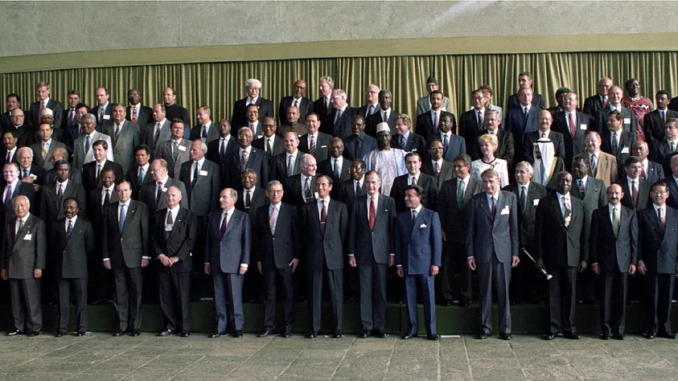
The United Nations Conference on Environment and Development, commonly called the Earth Summit, brought national leaders and representatives from around the world to Rio de Janeiro, Brazil.
The conference produced several major outcomes, including the adoption of Agenda 21.
Agenda 21 was an extensive action framework addressing sustainable development across a broad range of subjects, including land, water, energy, agriculture, cities, natural resources and consumption patterns.
It also addressed the relationship between economic development and environmental protection.
One particularly important aspect was its emphasis on local implementation.
Chapter 28 called on local authorities to consult their communities and develop local Agenda 21 initiatives. In practical terms, the framework encouraged municipalities to incorporate sustainability principles into local planning and decision-making.
That is where an international discussion began to intersect with everyday government.
Zoning, transportation, housing density, development patterns, infrastructure, water management and community planning could all become part of a local sustainability strategy.
The distinction between international policy and local implementation is important.
Agenda 21 was not a binding international treaty. It did not automatically become domestic law, nor did it give the United Nations authority to take control of American property.
However, its recommendations provided a framework that governments could voluntarily incorporate into their own policies.
In the United States, congressional activity followed. A resolution introduced in 1992 called for a national strategy consistent with Agenda 21 principles. In 1993, President Bill Clinton established the President’s Council on Sustainable Development.
The ideas were moving beyond international conferences and into domestic government discussions.
For supporters, this represented coordination around shared environmental and economic objectives.
For critics, it raised concerns about how much influence international frameworks should have over decisions traditionally made through local and representative government.
The question was no longer simply whether sustainability was a worthwhile objective.
It was how that objective would be translated into policy, who would participate in making those decisions and how accountable those participants would be to the public.

1999–2015: Sustainability finds its way into corporate finance
For much of the 1990s, Agenda 21 remained primarily a government and institutional framework.
But international policy objectives need more than conferences and resolutions to influence the global economy. They need participation, implementation and, eventually, money.
That is where the private financial sector entered the story in a much more significant way.
In 1999, United Nations Secretary-General Kofi Annan introduced the idea of the UN Global Compact at the World Economic Forum in Davos.
The initiative encouraged businesses to voluntarily align their operations with principles involving human rights, labor, environmental responsibility and anti-corruption.
The idea was to bring the private sector into the broader conversation about sustainable development.
In 2004, Annan invited major financial institutions to contribute to a report titled Who Cares Wins.
The report helped popularize a framework that would become one of the most influential concepts in modern corporate finance: environmental, social and governance, or ESG.
ESG expanded the traditional discussion of corporate performance.
Investors had long examined profitability, debt, management quality and future growth. ESG introduced additional considerations, including environmental impact, workplace practices, social responsibility and corporate governance.
The reasoning was that these factors could affect a company’s long-term financial performance and risk exposure.
A company with significant environmental liabilities, poor governance or unresolved labor problems might face financial and reputational consequences that traditional financial analysis could overlook.
That argument helped ESG gain traction among institutional investors.
But ESG also created a new source of influence.
Investment managers could use their capital allocation decisions and shareholder voting power to encourage companies to adopt particular policies.
The distinction is significant.
A government can regulate a company through legislation. An investor can influence that same company through the conditions under which capital is made available and the votes cast at shareholder meetings.
Both can shape corporate behavior, but they operate through different mechanisms.
By the 2010s, the world’s largest investment managers had become increasingly influential in corporate governance.
BlackRock, Vanguard and State Street held substantial positions across the American corporate landscape through the investment funds they managed.
A 2017 study frequently cited in discussions of institutional ownership found that the three firms were collectively the largest shareholder in 88% of companies in the S&P 500.
The figure illustrates the concentration of voting influence associated with large asset managers. It does not mean those firms owned 88% of those companies, nor does it mean they independently controlled every corporate decision.
Still, their influence is difficult to dismiss.
The managers of these funds vote on behalf of investors, including individuals whose retirement savings and investment accounts are held in those funds.
That creates an important question: How much influence should asset managers exercise over corporate policy when the underlying capital belongs to millions of individual investors?
The question became particularly relevant to the energy industry.
In 2021, activist investment fund Engine No. 1, which held a very small ownership position in ExxonMobil, successfully secured three seats on the company’s board.
The victory depended on support from major institutional shareholders, including BlackRock, Vanguard and State Street.
The campaign focused on Exxon’s long-term strategy and its response to energy transition risks.
It was a significant example of how institutional shareholder voting could influence the leadership and direction of one of the world’s largest oil companies.
For energy producers, the message was clear: access to capital and shareholder expectations were becoming increasingly connected to environmental and climate considerations.
That does not mean traditional financial performance had disappeared. It means the definition of investment risk was expanding.
And once climate considerations become part of investment risk, they can influence decisions about which projects receive funding, which companies attract investors and how corporations plan for the future.

2015: Agenda 2030 establishes the next framework
In September 2015, the United Nations adopted the 2030 Agenda for Sustainable Development.
The agreement established 17 Sustainable Development Goals and 169 associated targets, creating an international framework for addressing poverty, health, education, energy, economic development, climate change and other challenges.
Unlike Agenda 21, which had been organized around a broad action plan for the 21st century, Agenda 2030 provided a more defined set of goals and a target year.
The agenda covered nearly every major area of public policy.
Some goals were relatively straightforward, including ending poverty, improving access to clean water and expanding education.
Others touched more directly on the relationship between economic activity and individual life.
Goal 11 addresses sustainable cities and communities. Goal 12 focuses on responsible consumption and production. Goal 13 addresses climate action. Goal 16 concerns peace, justice and strong institutions. Goal 17 emphasizes partnerships to achieve the goals.
The significance of Goal 17 deserves particular attention.
It recognizes that governments cannot accomplish the agenda alone and encourages cooperation involving businesses, financial institutions, international organizations and civil society.
This is where the public-private partnership model becomes increasingly important.
International organizations establish goals. Governments develop policies. Businesses provide products, services and infrastructure. Financial institutions influence the availability and direction of capital.
The framework creates a system in which sustainability objectives can move across institutional boundaries.
The goals themselves are not legally binding international laws. The United Nations describes implementation as dependent on countries’ own policies, plans and programs.
But nonbinding does not necessarily mean inconsequential.
International frameworks can influence domestic priorities, corporate strategies, investment criteria and public expectations without directly creating enforceable law.
That is one of the central themes of this entire timeline.

2016–2021: Davos, stakeholder capitalism and the Great Reset
While the United Nations was advancing Agenda 2030, the World Economic Forum was becoming another prominent platform where political and business leaders discussed the future of the global economy.
Its annual meeting in Davos, Switzerland, brings together executives, government officials, academics and representatives of international institutions.
In 2016, the WEF published a video presenting eight predictions for the world in 2030.
One prediction became particularly controversial: “You’ll own nothing and you’ll be happy.”
The phrase originated in an essay by Danish politician Ida Auken, which imagined a possible future in which people accessed goods and services rather than owning many of them.
The WEF presented the concept as a scenario, not a binding policy or an announced plan to eliminate private ownership.
That distinction should not be overlooked.
Nevertheless, the phrase struck a nerve because it connected to an existing public concern: the changing relationship between ownership, access and economic independence.
What happens when consumers increasingly rely on subscription services, digital platforms, rental arrangements and centralized systems to access things they once purchased outright?
That question became even more prominent in 2020.

Following the global health crisis and the economic disruption that accompanied it, the WEF and its partners introduced the Great Reset initiative.
WEF founder Klaus Schwab described the crisis as an opportunity to rethink and reshape economic and social systems.
One of the concepts associated with this discussion was stakeholder capitalism.
Under this model, corporations are expected to consider not only shareholders but also employees, customers, communities, suppliers and broader societal interests.
Supporters argue that businesses have responsibilities beyond maximizing short-term profits.
Critics question who gets to define those responsibilities and whether stakeholder capitalism gives corporate executives and unelected institutions too much discretion to pursue political or social objectives.
The debate is particularly relevant when companies make decisions about energy, employment, investment and production based on standards that may extend beyond their traditional business obligations.
The Great Reset did not create the sustainability movement. Its objectives were connected to ideas that had been developing for decades.
But it provided another prominent platform for discussing how economic systems could be reorganized around broader social and environmental priorities.

2021–2025: Climate finance becomes a major economic force
The financial dimension of sustainability continued to expand.
In 2021, Mark Carney, then serving as the United Nations Special Envoy for Climate Action and Finance, helped launch the Glasgow Financial Alliance for Net Zero.
The alliance brought together hundreds of financial institutions with significant combined assets committed to supporting net-zero emissions objectives.
Its stated ambition was to move climate considerations into mainstream financial decision-making.
For the energy industry, this development was particularly consequential.
Energy infrastructure requires enormous amounts of capital and often operates over decades. Decisions made by investors, lenders and insurers can influence which projects proceed, which technologies receive financing and how companies approach long-term planning.
The question of energy transition is therefore not simply a debate over which technology is preferable.
It is also a debate over investment, infrastructure, reliability, affordability and the pace at which existing systems can realistically change.
The expansion of ESG and climate finance also generated resistance.
In the United States, several states challenged financial institutions over climate-related investment policies, arguing that those policies could conflict with fiduciary responsibilities or discriminate against traditional energy industries.
Political opposition grew, and the term ESG itself became increasingly controversial.
In January 2025, BlackRock withdrew from the Net Zero Asset Managers initiative.
These developments demonstrated that the financial industry’s relationship with sustainability was not settled.
The underlying debate remained: Should investors incorporate environmental and social considerations into financial decisions, and if so, where should those considerations end?
For the oil and gas industry, this is not an abstract argument. Capital availability affects exploration, production, pipelines, refining, infrastructure and employment.
It also affects the ability of companies to respond to growing global energy demand.
The broader issue is whether financial institutions should act primarily as financial intermediaries or increasingly as instruments for advancing wider policy objectives.
That question deserves serious consideration regardless of one’s position on climate policy.

2026–2030: When sustainability becomes part of everyday transactions
By the middle of the 2020s, the sustainability discussion was increasingly moving from broad objectives into specific regulatory and technological systems.
One example is the European Union’s Digital Product Passport.
The initiative is designed to create digital records containing information about products, components and materials, potentially including origin, composition, repairability and environmental performance.
The European Commission describes the system as a way to improve transparency, support recycling and repair, and strengthen regulatory compliance.
The rollout is taking place in stages. Certain categories of batteries, including electric vehicle and industrial batteries, are scheduled to require digital passports beginning February 18, 2027.
Additional product categories are expected to follow under separate requirements.
The stated benefits are understandable. Consumers could obtain more information about the products they purchase, repair businesses could access useful technical information, and regulators could improve supply-chain transparency.
But implementation also raises economic questions.
How much will compliance cost? Will small manufacturers have the same resources as multinational corporations? Will additional data requirements create barriers to entry for independent producers?
A regulation designed to improve transparency can also create new administrative responsibilities.
The same balance between benefits and costs appears in discussions about digital currency.
The European Central Bank’s digital euro project is moving through a legislative and technical development process. As of November 2026, negotiations are continuing, and the ECB says a potential first issuance could occur in 2029 if the necessary legislation is adopted by the end of 2026.
The digital euro has not been launched.
The ECB describes it as a possible digital form of central bank money intended to complement cash, not automatically replace it.
That distinction is important, particularly given concerns about privacy, financial access and the potential for programmable restrictions.
Digital payment systems can offer convenience and efficiency. But questions about data collection, transaction privacy and institutional control deserve attention before systems become deeply embedded in everyday commerce.
Transportation is another area where sustainability objectives intersect with household economics.
Electric vehicle incentives, mileage-based road charges, fuel taxes and emissions standards are all part of a broader discussion about how governments fund infrastructure and encourage changes in transportation.
The rationale for mileage-based fees is not difficult to understand: as vehicles use less gasoline, traditional fuel-tax revenue becomes less reliable as a source of road funding.
However, mileage tracking also creates new questions about how driving data is collected, stored and used.
A fee based on miles driven is not the same thing as a restriction on where someone can travel. But the infrastructure used to measure and charge for mileage raises legitimate questions about privacy and future policy possibilities.
The same discussion extends to agriculture and housing.
Denmark’s planned livestock emissions tax, for example, illustrates how climate policy can move directly into agricultural economics.
For farmers, the issue is not simply whether emissions should be measured. It is how those measurements translate into operating costs, land values, herd decisions and the long-term viability of family operations.
European housing policy also demonstrates how energy-efficiency requirements can affect property owners.
In France, energy-performance ratings have been used to establish restrictions on renting out the least efficient properties, with additional requirements phased in over time.
The stated objective is to improve energy efficiency and reduce emissions.
The economic consequences, however, can extend beyond utility bills. Owners may face substantial renovation expenses, reduced rental opportunities or pressure to sell properties that no longer meet applicable standards.
These are the kinds of practical consequences that deserve attention when sustainability policies move from international frameworks into local markets.

Ownership, independence and the question of accountability
There is another dimension to this discussion that extends beyond environmental regulation.
It concerns the meaning of ownership in an increasingly digital and interconnected economy.
In 2009, Amazon remotely removed copies of George Orwell’s 1984 from customers’ Kindle devices after a dispute involving the book’s availability. Customers received refunds, but the incident demonstrated that digital purchases could be subject to remote intervention by the platform providing access.
In 2013, Cyprus experienced a banking crisis in which large depositors faced significant losses through a restructuring that included converting portions of deposits into bank equity.
In 2022, Canada invoked emergency powers to freeze certain financial accounts connected to the trucker protests. Subsequent court proceedings raised questions about the government’s use of those powers.
These situations are not identical, and they should not be treated as proof that every digital financial system will eventually be used in the same manner.
They do, however, illustrate an important distinction between possessing an asset and having unrestricted access to it.
Digital books, bank deposits, online accounts and electronic payment systems operate through platforms and institutions. Access can depend on contractual terms, regulations, legal authority and technical infrastructure.
As more aspects of daily life become digitized, the importance of transparency and accountability increases.
Who controls the information? Who can suspend access? What protections exist for consumers? What appeal process is available when institutions make mistakes?
These questions are relevant whether the system involves a private technology company, a commercial bank or a government agency.

The next chapter: Sustainability, technology and individual choice
The timeline from 1968 to 2030 reveals a significant evolution.
The Club of Rome began examining the relationship between population, consumption and natural resources. The United Nations moved environmental protection into international policy discussions. The Brundtland Commission popularized sustainable development. Agenda 21 established a broad action framework. Agenda 2030 created measurable international goals.
ESG helped bring sustainability considerations into corporate finance, while the World Economic Forum provided another platform for business and political leaders to discuss economic transformation.
Financial institutions, governments and corporations now operate within a world where sustainability objectives can influence investment, regulation, product development and business strategy.
Artificial intelligence adds another layer.
Automation and increasingly capable digital systems may change employment, production, education and the delivery of public services. Proposals such as universal basic income are already part of the discussion about how societies might respond to technological disruption.
But the question of economic security cannot be separated from the question of independence.
If people increasingly depend on centralized digital platforms, financial infrastructure and government systems for access to employment, money, services and essential goods, the rules governing those systems become extraordinarily important.
That does not mean digital technology or international cooperation should be rejected.
It means the public should understand the structures being built and the authority being exercised through them.
There are legitimate reasons to protect the environment, manage resources responsibly, improve energy efficiency and encourage responsible business practices.
There are equally legitimate reasons to protect private property, preserve economic competition, defend financial privacy and maintain local accountability.
Those objectives do not have to be mutually exclusive.
The challenge is ensuring that policies designed to serve the public do not become systems that operate beyond meaningful public oversight.
A global framework may establish goals, but national governments still make policy choices. Financial institutions may influence corporate decisions, but shareholders deserve transparency about how their money is being used. Technology may improve efficiency, but consumers deserve meaningful protections and choices.
And communities should have a voice in decisions that affect their land, livelihoods and future.
The most important lesson from this five-decade timeline may be that major economic and institutional changes rarely happen through a single law or dramatic announcement.
They develop through conferences, agreements, voluntary initiatives, financial standards, regulations and partnerships. Each step can appear relatively small when viewed independently. Together, they can reshape the way governments, corporations and individuals interact.
That is why the history matters.
The debate over sustainability should not be reduced to whether someone supports or opposes environmental protection.
It should include a much larger conversation about transparency, accountability, economic consequences and the proper balance between collective objectives and individual freedom.
The future of sustainability will not be determined by the language of international agreements alone.
It will be determined by how those agreements are interpreted, how governments implement them, how financial institutions respond and how much participation ordinary citizens have in the decisions that affect their lives.
Ultimately, the question is not whether the world should plan for the future.
It is whether the people who will live in that future have a meaningful voice in deciding what it looks like.
The Crude Life has been a trusted brand pioneering energy content for 15 years — from the very first podcast in 2011 to today’s full-spectrum content company producing podcasts, video interviews, print features, radio news, social media campaigns, Substack editorials, live events and more.

The Crude Life Content Network
Primary Website
Follow on YouTube
Follow on Facebook
- The Crude Life Facebook Page
- Eagle Ford Texas Facebook Page
- Bakken.com Facebook Page
- Haynesville Facebook Page
- Marcellus Facebook Page
- Niobrarachalk Facebook Page
- PermianShale Facebook Page
Follow on LinkedIn
- The Crude Life LinkedIn
- The Founder of The Crude Life – Jason Spiess LinkedIn
Trusted Interviews. Industry Experts.


