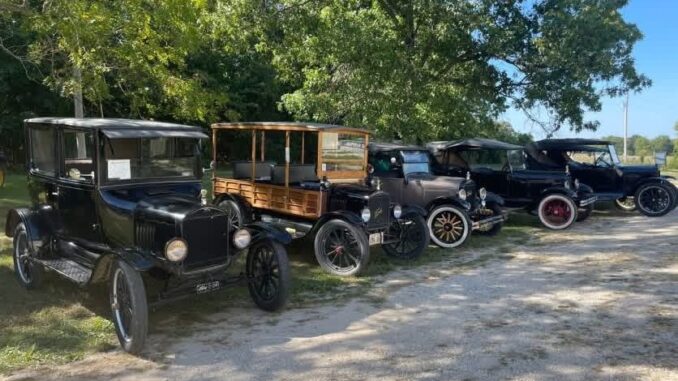
On a quiet stretch of the original Route 66 pavement in the Hometown of Route 66 – Galena, Kansas, the sound arrives before the sight. A low, rhythmic thrum of early flathead engines and the occasional cough of a carburetor working hard in the heat.
A small group of cars from the late 1920s and early 1930s rolls past the mining museum and the giant muffler man at Gearheads Curios like they have done for years.
However, this year, when you look closer at the drivers, the picture is shifting. The culture is evolving.
Some of the men who have made this run for decades are handing the keys across. Others are selling. A few are simply parking the cars for the last time. The road that once carried these machines when they were new is now watching a quieter, more personal transfer of ownership.
This is the story playing out across the collector-car world, and it is especially visible on Route 66. The Mother Road has long been one of the most reliable places in America to still see true vintage automobiles—cars built roughly between 1919 and 1930—actually being driven rather than trailered to a show.
Clubs still organize sectional runs. Informal groups still gather. Centennial events in 2026 have put even more of these cars on the pavement. But the hands on the wheels are changing.

The Great Transfer Is Already Underway
Specialty insurer Hagerty has put a number on what many longtime owners already feel in their bones. Over the next 15 years, roughly 12 million collector vehicles valued at approximately $570 billion are expected to change hands as older owners sell, gift, or leave their cars to the next generation. That volume is more than double the number of collector cars that changed hands in the previous 15 years.
Baby Boomers remain the single largest group of active buyers and owners in recent data, reclaiming the top share of insurance quote activity after a brief period when Gen X edged ahead. Yet the broader trend is clear: cars are moving. Some stay in the family. Some go to enthusiasts outside it. Some leave the road entirely.
For pure vintage cars—the ones most closely tied to the early decades of Route 66—the stakes feel higher. These machines require more mechanical knowledge, more specialized parts, and more patience than the muscle cars and modern classics that dominate younger collectors’ attention.
Interest among Gen Z and younger Millennials is real, but lacks the passion, honor and connection. In fact they skew strongly toward cars of the 1980s, 1990s, and early 2000s—the vehicles of their own youth. A 1929 Ford or a 1930 Chevrolet is less familiar and often less practical for a first collector car.

Hands That Have Held Them
Talk to longtime Route 66 drivers and a common theme emerges. The car that once felt like a second self is becoming heavier—literally and figuratively. Maintenance that used to be a weekend pleasure starts to feel like work. Storage costs rise. Health and energy shift.
Adult children who grew up riding in the back seat may love the car but live in apartments, lack a garage, or simply do not share the same mechanical confidence.

Some owners make deliberate choices. They sell to a younger enthusiast who promises to keep the car driven on the road. Others transfer the title to a son, daughter, or grandchild with the quiet hope that the car will continue the same routes.
A smaller number simply stop. The car sits, then eventually moves to a new owner through an estate or a quiet private sale.
Route 66 intensifies the emotional weight of these decisions.
These are not abstract collector assets. They are tied to specific stretches of pavement, to particular diners and filling stations, to the same annual runs with the same group of friends. When the car changes hands, the question is rarely just about money. It is about whether the road will still recognize it.

New Drivers, Different Relationship
The new owners who do step in are not a single type. Some are adult children who grew up with the car and feel a sense of duty mixed with genuine affection. Others are mid-career enthusiasts who specifically sought out a pre-war or early 1930s car because of Route 66 itself—the romance of the Mother Road, the mechanical purity of the era, the chance to drive something that feels connected to the highway’s earliest decades.
Their relationship with the cars often looks different. They may drive fewer miles. They may be more willing to trailer for longer distances. They rely more heavily on specialists for major work.
Social media and online parts networks play a larger role than the old word-of-mouth networks that once sustained these machines. Yet many of them still show up for the same runs and the same gatherings. The cars remain on the road, even if the culture around them is evolving.
Clubs along the corridor are noticing the shift. Membership in some groups is aging, while others are actively trying to welcome newer faces. The 2026 centennial has provided a temporary boost, events have drawn mixed-age crowds and put more vintage machinery on public display. Whether that energy translates into sustained new ownership remains an open question.

The Road as Continuity
Route 66 still offers something rare: a place where these cars are not merely displayed but used. A car that leaves the garage and covers real miles tends to stay healthier than one that only rolls onto a trailer for weekend shows. The highway itself, with its remaining original sections, its small-town stops, and its culture of actual driving, continues to reward the vehicles that can still make the journey.
That is why the transfer stories matter. Every time a longtime owner hands the keys to a family member or a carefully chosen buyer who intends to keep driving, the odds improve that the car will remain part of the living landscape rather than disappearing into a private collection or, worse, into quiet neglect.
Not every car will make it. Some will go into museums. Some will be sold out of the corridor. A certain percentage of ordinary examples will eventually be parted out or lost. Attrition is real. High-value, well-documented cars have the best chance of careful stewardship. Everyday survivors face harder odds.

What Survives
Stand along the road on a clear day and the continuity is still visible. Cars from the 1920s and early 1930s still appear. Groups still form. The sound of those engines still carries. The difference is that more of the drivers are new to the cars, and more of the longtime owners are watching from the passenger seat or from the side of the road.
The transfer is not a crisis so much as a passage. Aging hands are releasing the wheel. New drivers are taking it. Whether enough of them keep the cars on Route 66 itself will determine how much of this particular chapter of American automotive life remains visible on the Mother Road in the years ahead.
The cars that stay rolling are the ones most likely to outlive the people who first restored them. On Route 66, that has always been the quiet test.
Jason Spiess is the founder of The Crude Life and has been an working-owner in media companies for over 40 years.

The Crude Life Content Network
Primary Website
Follow on YouTube
Follow on Facebook
- The Crude Life Facebook Page
- Eagle Ford Texas Facebook Page
- Bakken.com Facebook Page
- Haynesville Facebook Page
- Marcellus Facebook Page
- Niobrarachalk Facebook Page
- PermianShale Facebook Page
Follow on LinkedIn
- The Crude Life LinkedIn
- The Founder of The Crude Life – Jason Spiess LinkedIn
The Crude Life has been a trusted brand pioneering energy content for 15 years — from the very first podcast in 2011 to today’s full-spectrum content company producing podcasts, video interviews, print features, radio news, social media campaigns, Substack editorials, live events and more.
Trusted Interviews. Industry Experts.