Here at The Crude Life, we get dozens of emails and texts a week regarding news tips, investigation leads or state-encroachment screenshots. The latest one is from North Dakota.
Disclaimer: The following analysis is for adults and professionals only. There is a growing culture allowing females and young men to become very reckless in the marketplace with their public-trust jobs. This has been an issue in North Dakota for decades and over the past decade it’s become the new normal. Government working for a handful of private companies while presenting themselves as a public good.
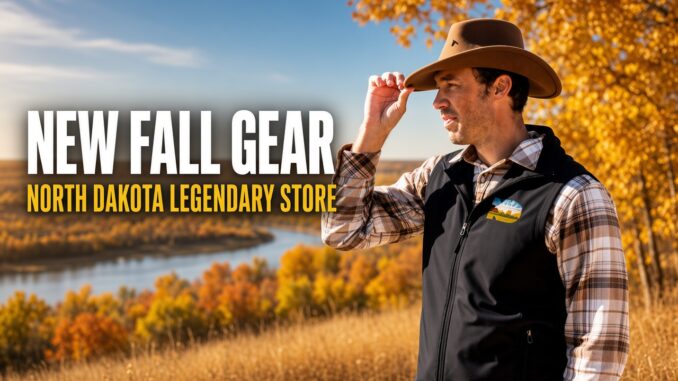
For example, North Dakota spends millions telling people to Shop Local and Live the Good Life here — something private media was marketing for decades. At the same time, the state is steadily expanding its own commercial footprint through appointed boards, industry-nominated councils, public-private partnerships, and taxpayer-funded marketing. The recent LinkedIn post promoting official North Dakota Legendary fall gear is a small, clear example of a much larger pattern.
The post comes from a state employee paid with public money. It pushes a state-branded retail store that competes with private gift shops and apparel sellers. The store enjoys official branding private businesses cannot match, is promoted with tax-funded marketing, and routinely sources product through national and global supply chains while the state preaches local loyalty. Every social media post also hands free content to Microsoft, Meta, or X — and when the state pays for boosts or verification, more North Dakota dollars leave for those platforms.
This is not an isolated tourism quirk. The same operating system appears at industrial scale in energy. The Industrial Commission sits at the top. Industry-nominated research councils and the Clean Sustainable Energy Authority help direct grants, loans, and guarantees. Hundreds of millions in public financial support flow to preferred projects. Documented conflicts of interest have repeatedly surfaced. Parallel problems have appeared in the Development Fund. The structure is consistent: public capital, official status, appointed or industry-connected decision makers, and preferred channels.
Call it public-private partnership if you prefer the polite term. The effect is the same. Advantage is transferred through the system itself.

Off the top of my head — ways the state is encroaching on the marketplace:
- Operating its own branded retail store that competes with private sellers.
Who and where is the manufacturer for the clothing? - Paying state employees to create and promote that store.
Why does North Dakota have state-funded influencers picking and choosing what they want to promote? - Granting official state branding private competitors cannot buy.
Technically, every post from this state-funded influencer is endorsed by the People of North Dakota. - Sourcing inventory nonlocally while preaching “Shop Local.”
Is the state purchasing the items online from China? Or are they using a North Dakota clothing manufacturer? - Using multi-million-dollar marketing budgets to drive demand for the preferred channel.
How can the private sector compete with a non-profit clothing store endorsed and marketed by the state of North Dakota? - Turning every official social post into free content for global platforms.
Every post on LinkedIn and Facebook is the state working for Meta and Microsoft. Those posts are sold for advertising and algorithms and compete with local media outlets. - Paying those same platforms for advertising, boosts, or verification.
In addition to volunteering their content and time to the mega-tech corporations, they use state money to amplify and advertise their posts online. - Creating industry-nominated councils that help decide how public money is spent.
This is a common practice in government to shield special interests and dismiss corruption due to “public good” and “public interest.” - Routing tens of millions in grants and loans through bodies that include industry appointees.
When the same industry that benefits from the money helps choose who receives it, the competitive field is no longer level. - Extending large state financial guarantees for preferred infrastructure.
Private projects without political connections rarely receive the same taxpayer-backed safety net. - Allowing documented conflicts of interest on funding boards.
Disclosures are made, votes still happen, and the money still flows. Transparency without consequence is theater. - Concentrating capital allocation and regulation in the Industrial Commission.
Three elected officials control both the rules and large pools of public capital that shape the energy sector. - Using “public-private partnerships” that shift risk to taxpayers.
Upside stays private. Downside is socialized. The language makes it sound collaborative; the balance sheet shows otherwise. - Expanding development and research funds that have shown repeated transparency and related-party problems.
Audits keep surfacing the same issues. The funds keep operating. - Treating official status itself as a competitive advantage.
The state seal, the state logo, and the state payroll become marketing assets no private business can purchase.
The merch post is not the scandal. It is the tell. It shows the system in miniature. Scale it to energy capital, pipeline guarantees, and development funds and the pattern becomes harder to ignore.
North Dakota still has private enterprise. The open question is how much of the commanding heights — capital, branding, regulatory favor, and public promotion — has already been absorbed into the interlocking network of commissions, authorities, and partnerships. The evidence is public. It appears in Industrial Commission records, legislative audits, and the state’s own storefront.

The Crude Life Content Network
Primary Website
Follow on YouTube
Follow on Facebook
- The Crude Life Facebook Page
- Eagle Ford Texas Facebook Page
- Bakken.com Facebook Page
- Haynesville Facebook Page
- Marcellus Facebook Page
- Niobrarachalk Facebook Page
- PermianShale Facebook Page
Follow on LinkedIn
- The Crude Life LinkedIn
- The Founder of The Crude Life – Jason Spiess LinkedIn
The Crude Life has been a trusted brand pioneering energy content for 15 years — from the very first podcast in 2011 to today’s full-spectrum content company producing podcasts, video interviews, print features, radio news, social media campaigns, Substack editorials, live events and more.
Trusted Interviews. Industry Experts.