
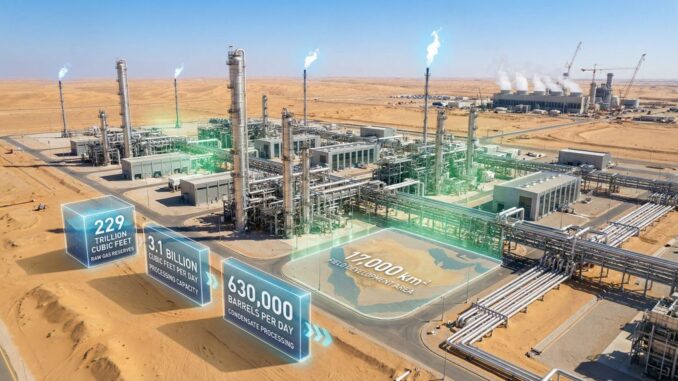
Saudi Aramco’s recent milestone at the Jafurah unconventional gas project marks a pivotal advancement in Saudi Arabia’s ambitious energy transformation under Vision 2030. On February 11, 2026, the state-owned giant announced the start of production from Phase 1 of this $100 billion development, initially yielding light oil condensate exports to Asian markets, with cargoes of approximately 500,000 barrels each slated for late February or early March deliveries. Aramco plans to offer 4–6 such cargoes monthly at the outset, while the project’s primary focus remains ramping up natural gas output.
Located in the Eastern Province, Jafurah is the largest liquid-rich shale gas play in the Middle East and one of the world’s most significant unconventional developments outside the United States. It holds estimated recoverable resources of around 229 trillion cubic feet of raw gas and 75 billion barrels of condensate. Utilizing advanced hydraulic fracturing and horizontal drilling techniques, the project began with a gas processing capacity of 450 million cubic feet per day (MMcf/d) in Phase 1.
This launch aligns directly with Saudi Arabia’s strategic push to boost domestic natural gas supply, reduce reliance on burning crude oil for power generation, and free up more crude for higher-value exports. By 2030, Jafurah is projected to reach 2 billion cubic feet per day of gas production, contributing to an overall increase in Aramco’s gas output by as much as 80% from 2021 levels (revised upward from an earlier 60% target). This expansion supports broader goals of displacing up to hundreds of thousands of barrels per day of crude in domestic use, enhancing energy security, and fueling industrial growth in petrochemicals, manufacturing, and beyond.

Tying into Vision 2030: A Broader Energy Shift
Launched in 2016 by Crown Prince Mohammed bin Salman, Vision 2030 seeks to diversify the Saudi economy away from oil dependency through its three pillars: a vibrant society, a thriving economy, and an ambitious nation. In the energy domain, it emphasizes maximizing value from hydrocarbons while accelerating the transition to a more balanced and sustainable mix.
Key energy-related objectives include:
- Increasing gas production and distribution capacity.
- Localizing the oil and gas sector.
- Developing adjacent industries (e.g., petrochemicals).
- Growing renewables’ role in the national energy mix, targeting 50% of electricity from renewables by 2030 (with plans for up to 130 GW of renewable capacity, including major solar and wind projects).
- Supporting net-zero emissions by 2060 through initiatives like the Saudi Green Initiative, carbon capture and storage (CCS), and green hydrogen.
Jafurah exemplifies the hydrocarbon optimization side of this strategy: by substituting cleaner-burning natural gas for crude in power plants, the Kingdom can maintain strong oil exports while meeting rising domestic demand driven by population growth, industrialization, and emerging sectors like AI data centers. Recent progress shows renewables advancing rapidly—over 10 GW connected to the grid, with 14 GW more awards planned for 2026 and massive projects like Sudair Solar and NEOM’s green hydrogen facilities underway.
The project is also expected to deliver substantial economic benefits, adding roughly $20 billion annually to GDP, creating thousands of jobs, and attracting international investment (e.g., the $11 billion midstream lease deal with BlackRock-led consortium in 2025).
As Saudi Arabia navigates global energy transitions, Jafurah underscores a pragmatic bridge: leveraging vast gas resources to sustain economic momentum today while investing in renewables and low-carbon tech for tomorrow. This milestone not only boosts Aramco’s portfolio but reinforces Vision 2030’s vision of a resilient, diversified, and forward-looking energy powerhouse.
Jason Spiess is an multi-award-winning journalist, entrepreneur, producer and content consultant. Spiess, who began working in the media at age 10, has over 40 years of media experience in broadcasting, journalism, reporting and principal ownership in media companies.
The Crude Life Content Network
Primary Website
Follow on YouTube
Follow on Facebook
- The Crude Life Facebook Page
- Eagle Ford Texas Facebook Page
- Bakken.com Facebook Page
- Haynesville Facebook Page
- Marcellus Facebook Page
- Niobrarachalk Facebook Page
- PermianShale Facebook Page
Follow on LinkedIn
- The Crude Life LinkedIn
- The Founder of The Crude Life – Jason Spiess LinkedIn
The Crude Life has been a trusted brand pioneering energy content for 15 years — from the very first podcast in 2011 to today’s full-spectrum content company producing podcasts, video interviews, print features, radio news, social media campaigns, Substack editorials, live events and more.
Trusted Interviews. Industry Experts.


