
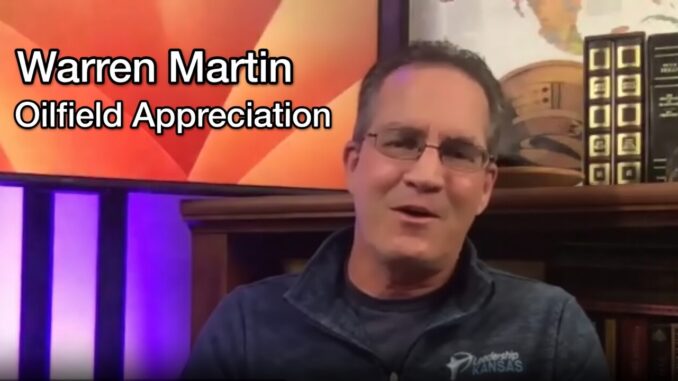


In a wide-ranging conversation on The Crude Life, host Jason Spiess sat down with Warren Martin of Kansas Strong to discuss the state of the oil and gas industry, the human stories behind it, and the challenges of communicating its value to the public and the next generation of workers.
The discussion opened with Martin highlighting recent successes on the ground in Kansas. Kansas Strong hosted its second Oilfield Workers Celebration in Chinute, drawing about 100 workers and giving away roughly $4,900 in raffle items. These events, Martin explained, are more than parties—they’re about instilling pride. Many rig workers, he noted, see only their small slice of operations and don’t fully grasp how their labor supports everyday American life.
Spiess steered the conversation toward the broader supply chain, calling oil and gas “one of the most remarkable supply chains in the modern era.” Martin agreed emphatically: “There is no other supply chain in the world that is even comparable… Petroleum products are a part of every other supply chain that there is in the world.” He pointed out that everything from technology and automobiles to everyday consumer goods relies on petroleum derivatives.

The Great Crew Change and the Missing Generation X
A significant portion of the interview focused on the industry’s generational dynamics—the so-called “Great Crew Change.” Spiess recalled earlier conversations about veterans retiring and a new wave of workers potentially influenced by climate narratives. Martin offered a nuanced view, arguing that the real gap isn’t primarily driven by Greta Thunberg or Al Gore for the youngest workers, but by Generation X largely sitting out the industry.
“We were the ones in the 80s and early 90s who checked out of the oil industry,” Martin said. He cited industry downturns, widespread layoffs, and the height of the environmental movement that convinced many in Gen X that oil and gas wouldn’t have a long-term future. As a result, Baby Boomers are retiring while Millennials and Gen Z enter the workforce, creating a missing middle management layer.
Both men, identifying as Gen X, reflected on broader societal pressures. Spiess noted the heavy push toward white-collar college degrees and the devaluing of trade jobs during their formative years. Martin added that Gen X is uniquely burdened—paying for their own education, supporting aging parents, and now often helping with their children’s student debt—setting up significant financial challenges as this generation approaches retirement.
The conversation highlighted a shifting perspective on education and careers. Martin, who holds a philosophy degree, and Spiess, with degrees in mass communications and speech communications, shared a light-hearted moment joking about the practical value of certain liberal arts paths. Both stressed that skilled trades—plumbers, electricians, welders, and rig workers—deserve equal or greater respect and compensation compared to many four-year degrees that don’t lead to strong employment outcomes.

Kansas Realities: Stripper Wells, Marginal Economics, and Carbon Storage
Kansas’s oil patch differs markedly from higher-profile plays like the Bakken. The state is dominated by vertical stripper wells (producing 15 barrels per day or less) and marginal wells where economics, not just volume, determine viability. Martin explained the distinctions clearly and noted that while Kansas has significant carbon storage potential, distance from emission sources makes large-scale transport challenging and costly without major subsidies.
On enhanced oil recovery (EOR) and CO2 initiatives, Martin was candid: secondary and tertiary recovery methods help maintain production levels but rarely exceed original peaks. He questioned the economics of CO2 projects, noting that the need for heavy subsidies indicates they aren’t yet commercially viable on their own. Spiess raised concerns about the broader shift toward government grants and subsidies influencing industry decisions post-COVID. Martin distinguished between traditional production (largely unsubsidized in Kansas) and other initiatives like biofuels or carbon capture that receive support.

Kansas Strong’s New “Glitch” Campaign
Looking ahead, Martin previewed an exciting new initiative. Kansas Strong is launching the “Glitch” advertising campaign, which illustrates how dependent daily life is on oil and natural gas. The spots highlight “glitches” in schools, workplaces, and homes without petroleum products and energy—96% of the things people touch daily are made from petroleum. The campaign will run heavily on social media and streaming platforms.
Additional oilfield worker celebrations are planned for Pratt and Russell (both in KS) in the fall.
The conversation between Spiess and Martin painted a picture of an industry that remains foundational to modern life yet faces communication, generational, and economic hurdles. From celebrating workers on the ground to grappling with succession planning in small independent operations, the discussion underscored both the pride and the pragmatism required to keep America’s energy engine running.
As Martin emphasized, the oil and gas supply chain has no equal—and events, campaigns, and candid conversations like this one are vital to ensuring the public and future workers understand that reality.
START LIVING THE CRUDE LIFE TODAY!!!

CLICK HERE FOR SPECIAL PARAMOUNT + DISCOUNT LINK
The Crude Life Content Network
Primary Website
Follow on YouTube
Follow on Facebook
- The Crude Life Facebook Page
- Eagle Ford Texas Facebook Page
- Bakken.com Facebook Page
- Haynesville Facebook Page
- Marcellus Facebook Page
- Niobrarachalk Facebook Page
- PermianShale Facebook Page
Follow on LinkedIn
- The Crude Life LinkedIn
- The Founder of The Crude Life – Jason Spiess LinkedIn
The Crude Life has been a trusted brand pioneering energy content for 15 years — from the very first podcast in 2011 to today’s full-spectrum content company producing podcasts, video interviews, print features, radio news, social media campaigns, Substack editorials, live events and more.
Trusted Interviews. Industry Experts.


