
Rumors of an impending motor oil shortage have swept across social media and local news outlets in recent days, sparking concern among drivers already grappling with elevated gas prices. What began as a single post on X has evolved into widespread discussion, with automotive shops, dealerships, and major manufacturers issuing quiet warnings. While bare shelves may not materialize immediately, higher prices at the service bay appear all but certain heading into the peak driving season of summer 2026.
The spark came from Costa Cap, owner of Costa Oil, a fast-growing oil change chain and rival to national players like Jiffy Lube. In his widely shared post, Cap stated that Mobil and Shell had informed major retailers like Costco and Walmart that they had no packaged product to ship, with bare shelves possible in the motor oil aisles within weeks.
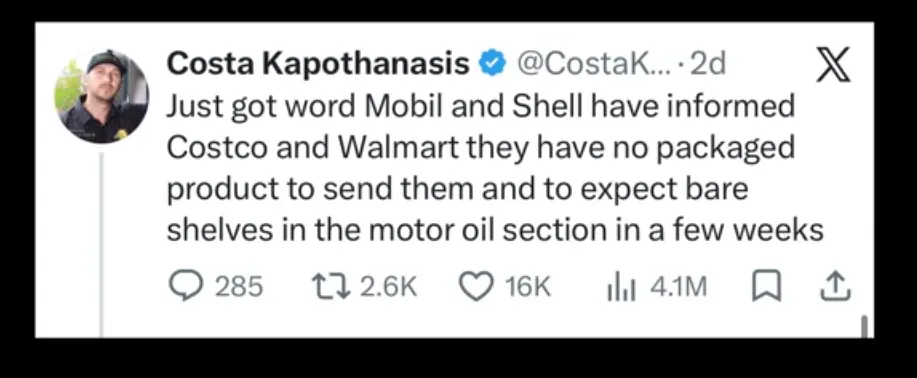
Cap is no anonymous online voice; his company operates primarily in the Mid-Atlantic, sponsors racing teams, and deals directly in high volumes of lubricants.
Retailers and consumers have reported mixed experiences so far. Some locations show thinning stock, while others appear adequately supplied. However, deeper cracks in the supply chain are emerging.

Price Tripling and Real-World Impacts
One of the clearest signals comes from the price side. Cap reported that the cost of passenger vehicle lubricants to many independent retailers has nearly tripled in recent weeks. A typical mom-and-pop shop that previously paid around $10 per gallon for popular 0W-20 synthetic oil is now facing bills closer to $25 per gallon. Maintaining margins would push a standard oil change toward $150—a figure that sounds extreme but aligns with emerging anecdotes.
One automotive content creator recently paid $130 for an oil change and filter on a Volkswagen GTI (plus $50 for a tire rotation), up significantly from the $80–$90 range he had come to expect over years of ownership. Dealership visits that once totaled $120–$130 can now approach $180. Similar reports are surfacing from independent shops.
In Las Vegas, local media visited an auto service center where owner Jimmy Lodge confirmed his supplier warned of rising prices due to shortages in base oils and additives for full synthetics. While he is absorbing some costs for now to protect customers, he expects to pass on a dollar or two increase soon. Lodge advised drivers to stay current on maintenance to avoid bigger problems down the line.

Manufacturer Responses and Technical Service Bulletins
The concern has reached OEM level. Toyota issued a Parts and Accessories News Today bulletin dated April 30, warning dealerships of ongoing shortages of ultra-thin 0W-8 and 0W-16 oils, linked to disruptions in the petrochemical market. Dealers are instructed to temporarily substitute slightly thicker oils—0W-16 for some 0W-8 applications and 0W-20 for certain 0W-16 services—for one service interval only. Affected models include newer hybrids and efficiency-focused vehicles such as the 2025+ Camry, Corolla Hybrid, Crown Hybrid, Grand Highlander Hybrid, and Yaris Cross.
This is not entirely unprecedented; Toyota issued similar guidance during earlier pandemic-related parts shortages. Still, the move has reignited debates among enthusiasts about the trade-offs of ultra-low-viscosity oils engineered for maximum fuel economy.
General Motors is also in focus. GM’s Dexos specification relies heavily on Group III base oils, the category most exposed to current disruptions. The Independent Lubricant Manufacturers Association (ILMA) has reportedly met with the U.S. Department of Energy and appealed to GM for temporary formulation flexibility.
The Geopolitical and Supply Chain Roots
The underlying issue traces back to the Strait of Hormuz and regional instability involving Iran. Nearly 45% of U.S. Group III base oil imports originate from the Persian Gulf region, either directly or via production facilities now offline. South Korea, which supplies about 30% of U.S. Group III imports, relies heavily on crude from the same area; any pivot to alternative sources is expected to yield less base oil.
U.S. domestic refiners cannot quickly close the gap. New capacity from Chevron and ExxonMobil is not slated to come online until next year. Group III base stocks are critical for modern synthetic motor oils, with roughly 60% directed toward automotive use.

Outlook: No Panic, But Prepare for Higher Costs
Most observers do not expect a consumer-level run on motor oil comparable to past shortages of consumer goods. Only a small percentage of drivers (perhaps 5–10%) change their own oil, primarily enthusiasts. The broader impact will likely show up at service counters rather than retail shelves in the immediate term.
Experts and shop owners recommend getting scheduled maintenance done sooner rather than later to avoid peak summer pricing. While relief could arrive if geopolitical tensions ease, supply chain analysts suggest disruptions could persist into next year without significant changes.
The situation remains fluid. More manufacturers are expected to issue guidance in coming weeks. Drivers should monitor their vehicles’ specific requirements, consider manufacturer-approved substitutes where allowed, and budget for potentially higher service costs. In an era of thin-margin, high-efficiency engines, even modest disruptions in the lubricant supply chain are being felt quickly at the gas pump and the service bay.
Stay vigilant, maintain your vehicle, and avoid panic buying—prudence, not hoarding, appears to be the wiser course this summer.
START LIVING THE CRUDE LIFE TODAY!!!

CLICK HERE FOR SPECIAL PARAMOUNT + DISCOUNT LINK
The Crude Life Content Network
Primary Website
Follow on YouTube
Follow on Facebook
- The Crude Life Facebook Page
- Eagle Ford Texas Facebook Page
- Bakken.com Facebook Page
- Haynesville Facebook Page
- Marcellus Facebook Page
- Niobrarachalk Facebook Page
- PermianShale Facebook Page
Follow on LinkedIn
- The Crude Life LinkedIn
- The Founder of The Crude Life – Jason Spiess LinkedIn
The Crude Life has been a trusted brand pioneering energy content for 15 years — from the very first podcast in 2011 to today’s full-spectrum content company producing podcasts, video interviews, print features, radio news, social media campaigns, Substack editorials, live events and more.
Trusted Interviews. Industry Experts.


