
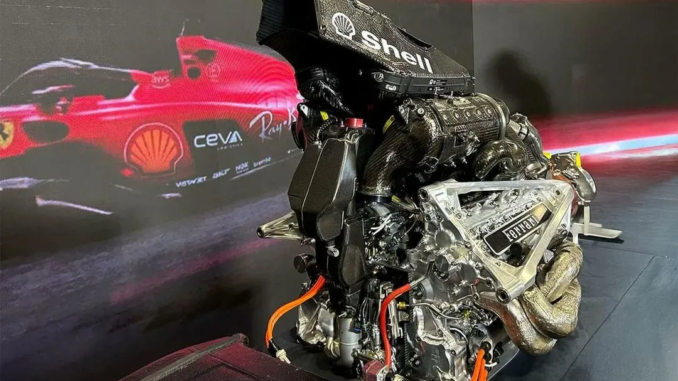
After three races of the new Formula 1 era, Scuderia Ferrari sits second in the constructors’ championship, yet the team’s leadership and drivers have been candid: the gap to championship leader Mercedes is defined primarily by power unit performance.
With straight-line speed and energy deployment clearly favoring the silver cars at Suzuka, Ferrari is now navigating one of the strictest power unit development windows in recent F1 history. The second power unit allocation — scheduled between the Canadian and Spanish Grands Prix — will deliver no performance gain. The long-awaited “boosted” Internal Combustion Engine (ICE) upgrade has been pushed to the third power unit, with a targeted introduction in July.
Regulatory Reality Checks Development Timelines
The 2026 regulations introduced a heavily revised power unit architecture, shifting toward a near 50/50 split between internal combustion and electrical power while mandating advanced sustainable fuels. To control costs and prevent runaway development, the FIA imposed tight homologation rules and limited in-season changes.
The Additional Development and Upgrade Opportunities (ADUO) mechanism was built precisely for scenarios like this. Performance is assessed periodically (originally after six, twelve, and eighteen races, with adjustments due to calendar changes). Manufacturers showing a deficit of 2–4% against the benchmark may receive one upgrade package; those more than 4% behind can access two, along with extra dyno hours.
Ferrari is believed to be close to the threshold that would unlock these opportunities, with discussions between the FIA, teams, and power unit manufacturers continuing after the upcoming Miami and Monaco rounds. A formal decision on expanded ADUO scope is expected soon.
For Ferrari’s powertrain engineers, the timeline pressure is real. Introducing a significantly revised ICE component requires months of dyno validation, materials testing, reliability sign-off, and FIA homologation. Even with the new boosted combustion concept showing strong results on the test bench, the team has opted for caution rather than risk a costly failure that could consume one of the season’s only three permitted power units.
Strategic Implications for Suppliers and Partners
This delay carries clear messages for the broader F1 supply chain:
- Reliability remains non-negotiable. The second power unit must focus on durability and consistency rather than headline performance gains, placing heavy emphasis on component suppliers who can deliver proven, high-cycle-life parts under the new sustainable fuel chemistry.
- Software and calibration become critical stop-gaps. Until the physical ICE upgrade arrives, Ferrari will lean on incremental software optimizations, energy management strategies, and chassis-side aerodynamic tweaks to close the gap. Partners specializing in control systems, sensors, and hybrid integration will see increased demand for rapid iteration.
- ADUO as a business lever. The mechanism is already influencing investment decisions. Suppliers aligned with manufacturers near the performance edge may benefit from accelerated development programs if extra testing hours are granted. Conversely, teams and suppliers that over-commit to speculative upgrades risk burning through budget cap headroom without guaranteed track advantage.
Industry observers note that the 2026 regulations were designed to promote convergence rather than dominance. Mercedes’ early advantage validates the technical direction, but Ferrari’s methodical approach — prioritizing a robust third-unit introduction — reflects long-term engineering maturity over short-term headlines.
What the July Window Means
A debut around the British, Belgian, or Hungarian Grand Prix would position the upgraded Ferrari power unit for the second half of the season, traditionally the period where championships are decided. By then, roughly one-third of the 2026 campaign will have passed, meaning any performance uplift must deliver immediate, reliable gains to influence the constructors’ battle.
For power unit manufacturers, this episode highlights the tension at the heart of the new rules: balancing innovation with cost control and fairness. As ADUO discussions progress, the outcome could set important precedents for how performance parity is managed across the 2026–2030 homologation cycle.
Ferrari’s message from Maranello is measured but clear. The Prancing Horse is not panicking — it is preparing. When the new boosted ICE finally lights up on track, the expectation is that the performance delta will narrow significantly, rewarding the patience and discipline invested in the development process.
In the high-stakes world of Formula 1 powertrains, sometimes the smartest business decision is knowing exactly when — and with which allocation — to deploy your strongest technology.
The Crude Life Content Network
Primary Website
Follow on YouTube
Follow on Facebook
- The Crude Life Facebook Page
- Eagle Ford Texas Facebook Page
- Bakken.com Facebook Page
- Haynesville Facebook Page
- Marcellus Facebook Page
- Niobrarachalk Facebook Page
- PermianShale Facebook Page
Follow on LinkedIn
- The Crude Life LinkedIn
- The Founder of The Crude Life – Jason Spiess LinkedIn
The Crude Life has been a trusted brand pioneering energy content for 15 years — from the very first podcast in 2011 to today’s full-spectrum content company producing podcasts, video interviews, print features, radio news, social media campaigns, Substack editorials, live events and more.
Trusted Interviews. Industry Experts.


