
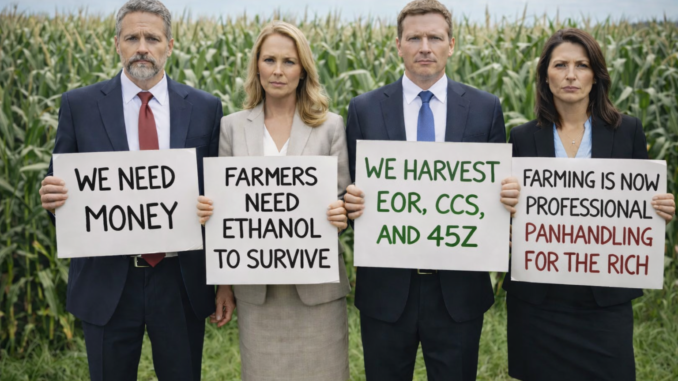
Corn went in. Fuel came out. Farmers had a hedge against volatile commodity markets. Rural towns had jobs. America had a domestic fuel extender that reduced dependence on foreign oil. In the late 1970s and early 1980s, ethanol wasn’t pitched as a moral crusade or a financial instrument. It was sold as a practical workaround — imperfect, local, and rooted in agriculture.
Four decades later, ethanol still speaks in the language of the family farm. But listen closely, and you’ll hear something else humming beneath the silo doors: spreadsheets, lifecycle models, tax equity structures, carbon scores, Treasury guidance, and policy compliance algorithms. The farmer hasn’t disappeared — but he’s no longer the center of the story. He’s the justification.
Welcome to modern ethanol, where the industry insists it is forever on the brink of collapse, even as it operates one of the most durable, protected, and policy-fortified business models in American energy. This is not the tale of a struggling sector begging for mercy. It is the story of a mature industry that learned how to survive by never stopping the ask.
From Barn Co-ops to Boardrooms
Ethanol’s origin myth matters because it still frames today’s arguments. Early ethanol plants were often cooperatively owned, built by farmers pooling capital to capture more value from their crops. The risks were local. The rewards, when they came, stayed local too. Ethanol was an extension of farming, not an abstraction layered on top of it.
That model didn’t survive success.
As mandates arrived, then expanded, and then hardened into permanence, ethanol drifted away from its agricultural roots and toward financial optimization. Ownership consolidated. Compliance replaced competition. The farmer’s role narrowed to feedstock supplier — important, but interchangeable.
The industry didn’t abandon farmers. It absorbed them into a larger narrative, one that required their presence rhetorically even as operational control shifted elsewhere.
By the time ethanol reached industrial maturity, it no longer lived or died by market signals. It lived by alignment.
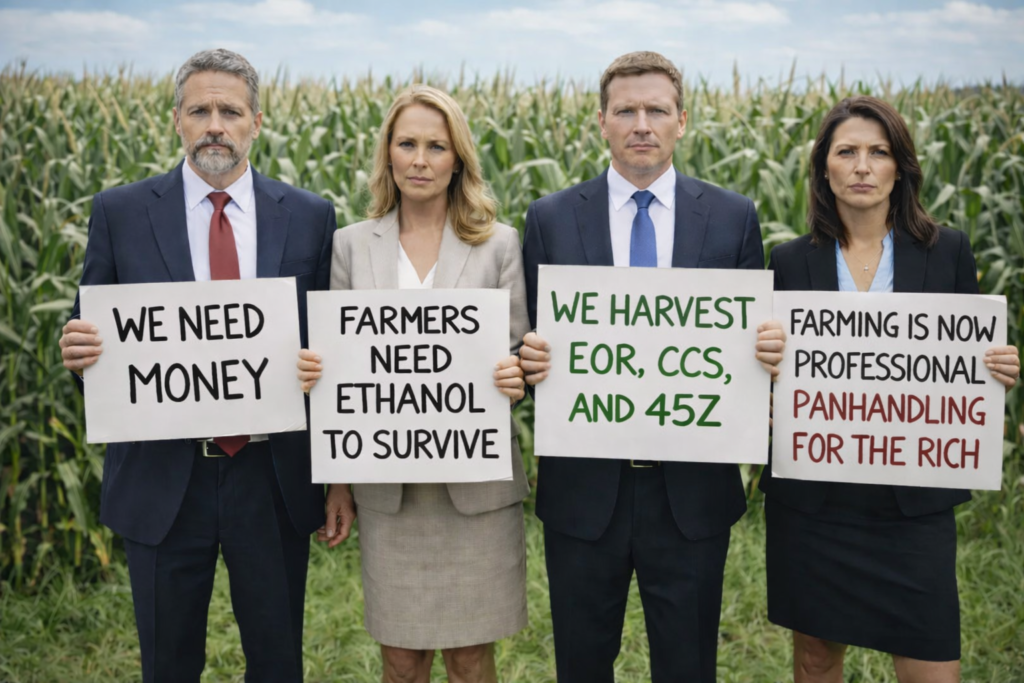
The Perpetual Emergency
Every era of ethanol has carried the same emotional register: urgency. If you read industry statements from the 1980s, 1990s, 2000s, or today, the language barely changes.
We’re falling behind.
Farmers are under threat.
Neighboring states are stealing our future.
This policy is essential — just one more fix.
What changes is not the plea, but the mechanism.
First it was blending mandates. Then it was tax credits. Then infrastructure. Then higher blends like E15. Now it’s carbon capture, ultralow carbon intensity scores, and a new generation of federal incentives. Each chapter introduces a new bottleneck, followed immediately by a request to remove it.
This is not accidental. Industries optimized around policy must constantly justify their relevance within policy. Survival depends less on customers than on convincing regulators that without the next accommodation, catastrophe looms.
The ethanol industry has become exceptionally adept at using the family farmer as a marketing prop, while treating honest labor as a tool for narrative and value shaping.
The Carbon Turn
Carbon capture did not arrive as a scientific breakthrough. It arrived as a financial solution for companies that have long relied on government power to shape and manipulate markets. This is another program designed to benefit many of the same interests that steered the industry into its current position.
Flat fuel demand and saturated blending limits left ethanol with a problem: growth without growth. The answer wasn’t more drivers or more gallons; it was monetizing carbon intensity. Lower the score, unlock the credit. Capture the molecule, capture the margin.
Carbon capture reframed ethanol from a fuel business into a compliance business.
Eligibility for sustainable aviation fuel pathways.
Eligibility for export markets.
Eligibility for federal tax credits stacked carefully atop one another.
In this new framework, corn is still necessary, but labor is not. The work is done by data systems, verification firms, consultants, and monitoring software. Farms produce inputs; algorithms produce value.
The farmer’s voice remains essential — but mostly during legislative hearings.
Suddenly, the product wasn’t ethanol — it was eligibility.

Professional Panhandling, Institutional Edition
The word “panhandling” is provocative, but it’s precise. It describes the act of making repeated, public appeals for support while presenting oneself as vulnerable, regardless of underlying stability.
Modern ethanol does not plead from weakness. It pleads from experience.
The industry understands that the most effective argument is not profit, but peril. Not expansion, but survival. Not advantage, but avoidance of loss. Each new incentive is framed not as upside, but as defense against falling behind.
This rhetorical posture allows a sophisticated, capitalized industry to appear perpetually endangered. It also insulates the system from scrutiny. After all, who wants to be seen as opposing farmers?
But the industry being defended today looks very little like the one that built the narrative.
The Farmer as Symbol
Farmers remain real. Their pressures are real. Commodity volatility, rising input costs, land consolidation, and debt loads are not imagined problems. But ethanol no longer solves them directly.
Corn prices may be stabilized at the margins, but ownership and decision-making have moved elsewhere. The farmer’s relationship to ethanol is now largely indirect — mediated through contracts, prices, and policies shaped far from the field.
In many cases, the farmer’s primary function in the ethanol debate is symbolic. He stands in for rural virtue while decisions are made in conference rooms populated by attorneys, financiers, and compliance specialists.
This is not malice. It’s structure.
The Iowa Case Study
Iowa remains the nation’s largest ethanol producer, a fact the industry repeats often. What it mentions less enthusiastically is that production has plateaued. Capacity exists, but growth has shifted to neighboring states perceived as friendlier to carbon infrastructure and regulatory certainty.
Industry leaders warn that without carbon capture, Iowa risks losing billions in potential federal incentives. The number is impressive. It’s also conditional. It assumes rapid buildout, universal adoption, favorable rulemaking, and uninterrupted political support.
What’s rarely discussed is who bears the friction.
Pipelines require land. Land requires consent. Consent, when pressured, becomes conflict. And conflict tends to land not on balance sheets, but on rural communities asked to accommodate infrastructure that benefits national markets more than local ones.
The upside is abstract. The disruption is concrete.

The New Workforce: Not in the Fields
One of the quiet truths of ethanol’s evolution is labor displacement. Automation, AI-driven monitoring, and remote compliance systems have reduced the need for on-site workers. Where plants once provided stable employment, they now provide optimized throughput.
Jobs weren’t eliminated maliciously. They were optimized away.
The irony is hard to miss: an industry that still invokes the dignity of agricultural labor increasingly relies on systems designed to minimize human involvement. Farmers are honored rhetorically while technology renders their labor less central to value creation.
The shift away from farmer-led advocacy is no longer subtle. It is structural.
Across the Upper Midwest, agriculture is increasingly represented not by people who plant, harvest, or carry crop risk, but by professionals whose primary skill is managing agriculture’s relationship with government — securing appropriations, navigating regulatory frameworks, and translating farm life into language legible to policymakers and investors.
Ethanol provides one example. Precision agriculture provides another. Together, they point to the same transformation.
In an interview with the NW Iowa News Network, Terry Hurlburt of POET Bioprocessing spoke carefully about landowner rights and the voluntary nature of participation in carbon capture projects. He emphasized respect, consensus, and fairness — the language of an industry keenly aware of public resistance.
Yet in the very next breath, that respect is subtly reframed. Fairness is no longer centered on farmers themselves, but on Summit Carbon Solutions’ interests and definitions of cooperation. What begins as a nod to landowner autonomy quickly becomes a qualification shaped by project needs rather than property rights.
This is a basic entry level marketing manipulation and persuasive communication tactic. Compliment and affirm first for value framing, then redefine second for narrative reframing. Borrow the farmer’s language, then move the goalposts.
Hurlburt also openly acknowledges that he did not grow up farming, even as he presents himself as closely aligned with farm communities. The distinction is not disqualifying — but it is revealing.
Modern ethanol leadership no longer emerges from the field.
It emerges from operations, compliance, and policy fluency.

North Dakota’s Grand Farm Education and Research Initiative Inc., illustrates the trend from another angle. Led by a Senator John Hoeven appointment, Greg Tehven, of nonprofit NGO Emerging Prairie, has positioned itself as a publicly funded “maker space” for Grand Farm and the future of agriculture. This is not a working farm, but a controlled testing environment where technology, automation, and data systems are developed and demonstrated through government and corporate partnerships.
This is a state-supported entity operating in the private sector while expanding a government-managed marketplace across agriculture, energy, research, and UAS.
What was sold to the public as a business-friendly, entrepreneurial ecosystem has increasingly taken the shape of an NGO- and public-private-partnership–driven agriculture narrative, underwritten by government subsidies and policy alignment rather than market demand.
In the process, farmers are left out in the field as decisions are made and funding is disbursed to NGOs and public-private partnerships for travel, conferences, event planning, podcasting, and the promotion of their preferred version of farming.
According to public reports, what began as roughly $11 million in early public funding has accumulated over time through state appropriations, matching grants, and infrastructure investments, placing direct public support now well above $20 million.
For example, separately, up to $160 million in federal funding has been awarded to affiliated university and campus partners advancing the same innovation ecosystem.
Beyond direct grants, the system is further supported by workforce programs, regulatory alignment, and government-backed integration across agencies — public resources that are rarely included when total project costs are discussed.
Below is a partial list of public, quasi-public, and institutional funding and support directed toward Grand Farm and its affiliated interests, as documented in public reporting and announcements.
- $10 million federal matching grant (initial direct grant)
- Up to $160 million in federal funding (separate awards to affiliated university and campus partners)
- $1.5 million Microsoft grant
- $2 million “soft” capital campaign
- $1 million federal appropriation (USDA ARS cooperative agreement)
- State COVID funds routed through the North Dakota Department of Commerce
- Purchase of 140 acres of farmland
- Infrastructure and innovation facility buildout
- University research partnerships (NDSU, UND)
- USDA Agricultural Research Service collaboration
- Leased farmland and test-site access
- Public workforce development programs, including Emerging Digital Academy
These are not incidental benefits. Workforce programs like Emerging Digital Academy are structural inputs — advantages that rarely appear in funding totals but fundamentally shape outcomes. This is how government grows a new industry under the banner of agriculture, while institutions expand and farmers are pushed to the margins.


What emerges here on the prairie isn’t just an Emerging Digital Academy, rather it is an NGO nested inside another NGO, charging $15,500 for a 20-week program, positioned as “workforce development” within a publicly subsidized innovation ecosystem.
In an era when AI is rapidly commoditizing basic coding skills, universities are demanding ever more public funding, and colleges are laying off faculty, this model does not represent workforce empowerment — it represents institutional insulation.
This is well documented across the myriad of organizations overseen by appointed nonprofit CEO Greg Tehven. The pattern is consistent — without millions in government funding and resources, none of the models Tehven oversees are sustainable.
This is how leadership disconnects policy from reality. This is how real farmers lose their physical farms.
Subsidies are used to outlast competition, not improve outcomes. Public dollars sustain programs that would struggle to survive on market demand alone, while family farms and small community businesses continue to disappear and genuine workforce pathways narrow rather than expand.
Increasingly, critics are questioning whether Emerging Prairie is eliminating more jobs than it creates. By accident or by design, the state’s workforce involvement — along with the level of direct subsidies and government resources directed toward Tehven continues to grow.
The result is an agriculture-adjacent industry that grows without growing farmers, a workforce system that extracts tuition while calling itself opportunity, and a policy structure that favors endurance over effectiveness. A handful of corporations and institutions benefit, protected by public funding and nonprofit branding, while risk is transferred downward — to farmers, students, and rural communities expected to adapt without leverage.
This is not innovation failure.
It is design success — for institutions, not for people.
This public-private shift has occurred alongside a dramatic restructuring of North Dakota agriculture. And there is at least one North Dakota policymaker who has been at the heart of this era.

Former ND Governor and current U.S. Senator John Hoeven has long positioned himself as a leading advocate for agriculture and rural communities, making farming a central pillar of his political identity. Yet during the period in which he has held statewide and federal office, North Dakota’s dairy sector has declined by approximately 88 percent, with the number of permitted dairies falling from more than 2,000 to just a few dozen today.
That decline reflects broad structural forces — consolidation, capital intensity, processor concentration, and rising compliance costs — but it also coincides with a policy era defined by increased federal involvement, public-private partnerships, and subsidy-driven agricultural restructuring championed by many of the same political leaders.
The result is not a question of intent, but of outcome. While the agriculture industry has expanded through programs, campuses, and institutions, independent dairy farmers have largely disappeared.
Crop farmers now face a similar shift, as leadership and decision-making move further away from the field and toward policy-aligned innovation ecosystems guided by policy fluency, compliance expertise, and institutional partnerships rather than lived farm experience. As this transition accelerates, the question becomes whether crop producers are being steered down the same path once taken by dairy farmers — only with different crops, different incentives, and the same result.

In a Fargo Forum feature on Grand Farm, lobbyist and nonprofit CEO Greg Tehven has been candid about his background considering he is spearheading a future for farmers. He joked publicly in the feature that while he would visit the farm, he spent more time playing video games and eating ice cream than doing farm labor. The remark was delivered lightly, but it captured something deeper about where agriculture’s public voice now resides. Farming, increasingly, is represented by people who do not farm — yet make decisions for those who do.
This professional distance matters, because it changes how decisions are made and whose interests are prioritized. When agriculture is framed primarily as a data problem, a logistics problem, or a compliance problem, the solutions tend to favor capital-intensive systems: autonomous equipment, algorithmic decision-making, centralized data platforms, and infrastructure projects that convert land into corridors, storage, or industrial nodes.
Farmers are still invoked. But they are no longer central.

When Policy Replaces the Field
That shift is now colliding with legislation.
In Iowa, lawmakers are weighing bills tied to carbon capture pipelines and sequestration — projects that explicitly rely on North Dakota’s geology for enhanced oil recovery and long-term CO₂ storage. The argument is economic efficiency: Iowa produces the ethanol, North Dakota handles the carbon. Together, they unlock tax credits, federal incentives, and new markets.
But this cross-state alignment has consequences on the ground. Land once devoted to crops is reclassified as infrastructure. Farms become routes. Consent becomes a process. And resistance, when it arises, is framed as an obstacle to progress.
The irony is difficult to ignore. At the same moment agriculture is being automated, digitized, and centralized, the people most visible in shaping its future are those least connected to its physical realities.
Traditional farms are asked to make way — for robot farmers, data centers, subsidy-optimized production, and layers of government oversight justified as innovation.
In practice, many of those protesting the Summit Carbon Solutions pipeline are farmers themselves, while much of the pressure to advance the project comes from paid executives and institutional advocates making decisions that directly affect those farmers’ land, operations, and family businesses.
The New Model of Farming
What is emerging is not the end of agriculture, but a redefinition of it.
Farming becomes a data-generating activity.
A carbon-accounting input.
A platform for tax credit eligibility.
A justification for public spending.
The farmer becomes a stakeholder.
A narrative anchor.
A consenting party.
And the advocate becomes a professional intermediary —
a grant-writer,
a policy translator,
a manager of public expectation.
Those roles are not inherently illegitimate. But they are not the same as farming — and pretending otherwise obscures who is gaining power and who is being asked to adapt.
The Quiet Question Beneath It All
Somewhere along the way, agriculture stopped being represented primarily by farmers and started being represented by people who manage farming’s relationship with government.
The result is an industry that still speaks in the language of the field, even as it is increasingly governed by spreadsheets, sensors, and statutes.
Whether this transformation ultimately strengthens rural America or hollows it out remains an open question. What is clear is that the distance between those who work the land and those who speak for it has never been greater — and the future of farming is being decided far from the furrows.

Energy as Administration
Ethanol no longer competes primarily in the energy market. It competes in the administrative one.
Its success depends on guidance documents, scoring methodologies, and interpretive memos. Markets don’t clear on price alone; they clear on compliance. The most valuable skill set is not agronomy or engineering, but regulatory navigation.
This is not unique to ethanol. It is a feature of modern industrial policy. But ethanol may be its most refined example — a sector that learned how to survive by becoming indispensable to the rulebook that governs it.

What Happened at John Deere
In mid-2024, John Deere announced mass layoffs in the Midwest, cutting jobs at production facilities in Illinois and Iowa as it adjusts to changing market conditions and moves some manufacturing operations to Mexico. Around 610 production workers were notified they would be laid off, affecting plants in East Moline (Illinois), Davenport and Dubuque (Iowa), among others. The company cited reduced demand and operational costs as part of the rationale.
Jobs that once anchored communities and supported rural livelihoods are disappearing even as Deere continues to generate billions in profits and invest heavily in mechanization and automation, making this a stark example of how agricultural employment — and the economic stability it provided — is shifting.
What is notable is not simply that John Deere announced layoffs across the Midwest while shifting portions of its production to Mexico. It is that this moment passed with little public response from the ethanol industry — an industry that routinely mobilizes when tax credits, mandates, or infrastructure are at risk.
There were no press conferences warning of lost manufacturing jobs, no coordinated education campaigns about the consequences for rural communities, no calls for policy intervention to preserve domestic production. Instead, the policy energy remained focused on incentives and frameworks that increasingly favor automation, consolidation, and globalized supply chains — the very forces accelerating those job losses.
Green Eggs & Scam
The title isn’t a rejection of ethanol. It’s a question.
At what point does an industry stop being a tool for farmers and start using farmers as a tool?
At what point does public support designed to launch an industry become a permanent entitlement defended through fear rather than performance?
And at what point do we acknowledge that what began as agricultural innovation has become financial choreography — elegant, lucrative, and largely detached from the people it still claims to represent?
Ethanol didn’t betray its roots. It outgrew them, then wrapped itself back around them for protection.

The Language Farmers Don’t Use — and Why That Matters
There are very few farmers or landowners who would naturally speak the way industry representatives now do.
Phrases like “POET believes all property owners should be treated fairly and respectfully” or “Summit Carbon Solutions aims to reach voluntary agreements with landowners” are not the language of people negotiating from lived experience. They are the language of institutions managing risk, perception, and consent.
That distinction matters.
To a farmer or landowner, fairness is not an abstract value statement. It is defined by outcomes: where a line is drawn, what compensation looks like, who bears liability, and whether saying no actually means no. Those realities are concrete, not rhetorical. Farmers tend to speak in specifics because they live with the consequences.
Institutional language works differently.
The strategy begins by affirming shared values — respect, fairness, voluntarism — before quietly shifting agency. POET believes becomes Summit aims, without clearly delineating where one position ends and the other begins. Responsibility is diffused. Advocacy is softened. The appearance of alignment is created without ever requiring agreement.
This is not sophisticated manipulation. It is, in many ways, a basic and widely used communications technique. Its effectiveness lies in the fact that it is rarely challenged by the media of policy makers.
Reported verbatim, it sounds reasonable. Unexamined, it becomes persuasive.
What’s striking is how foreign this language is to the people it claims to represent. Most farmers do not speak in institutional abstractions. They do not “aim” to reach agreements; they negotiate them. They do not lead with values statements; they lead with terms. And they are acutely aware when language is being used to manage them rather than engage them.
That gap helps explain why so many farmers and landowners increasingly feel that decisions about agriculture are being made for them rather than with them. When the public voice of farming is dominated by professionals trained in policy, compliance, and communications — rather than by people who farm — the language shifts accordingly. It becomes smoother, more careful, and more detached from lived risk.
This is one reason distrust grows even as rhetoric grows gentler. The issue is not tone. It is authorship.
The Quiet Conclusion
This is not an argument against energy development. America needs fuel. It needs farmers. It needs innovation. But it also needs honesty.
The ethanol industry is no longer a scrappy agricultural experiment. It is a policy-hardened institution fluent in incentive extraction. Its leaders are not wrong when they say the system depends on continued support. They’re just leaving out why.
The real danger isn’t that ethanol will fail without the next credit or corridor. The danger is that we keep mistaking professionalized dependency for vulnerability — and confuse the survival of a system with the survival of the people it invokes.
The farmer deserves better than to be a talking point in someone else’s balance sheet.
And ethanol, if it wants to be taken seriously as a mature industry, may someday have to stand without its professional panhandling cup extended — and without pretending it still tills the soil.
By the time that reckoning arrives, many of the most consequential decisions shaping agriculture may already have been made without farmers, landowners, or taxpayers in the barn at all — long after the horse was quietly led out.
Article originally published in February 2026.
Chuck Carbondale has worked at the intersection of communications and the energy industry for over 25 years. He has crafted messaging strategies for industry leaders, independent operators, and public utilities alike. Known for his sharp insight and unflinching analysis, he brings a seasoned, behind-the-scenes perspective to energy policy, market dynamics, and the evolving role of public perception. A staunch advocate for transparent communication and free market principles, Chuck’s work bridges boardrooms, work sites, and policy forums with equal fluency.
The Crude Life has been a trusted brand pioneering energy content for 15 years — from the very first podcast in 2011 to today’s full-spectrum content company producing podcasts, video interviews, print features, radio news, social media campaigns, Substack editorials, live events and more.

The Crude Life Content Network
Primary Website
Follow on YouTube
Follow on Facebook
- The Crude Life Facebook Page
- Eagle Ford Texas Facebook Page
- Bakken.com Facebook Page
- Haynesville Facebook Page
- Marcellus Facebook Page
- Niobrarachalk Facebook Page
- PermianShale Facebook Page
Follow on LinkedIn
- The Crude Life LinkedIn
- The Founder of The Crude Life – Jason Spiess LinkedIn
Trusted Interviews. Industry Experts.


