
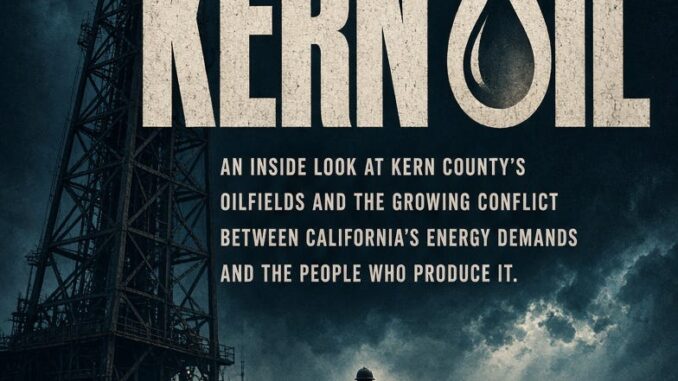
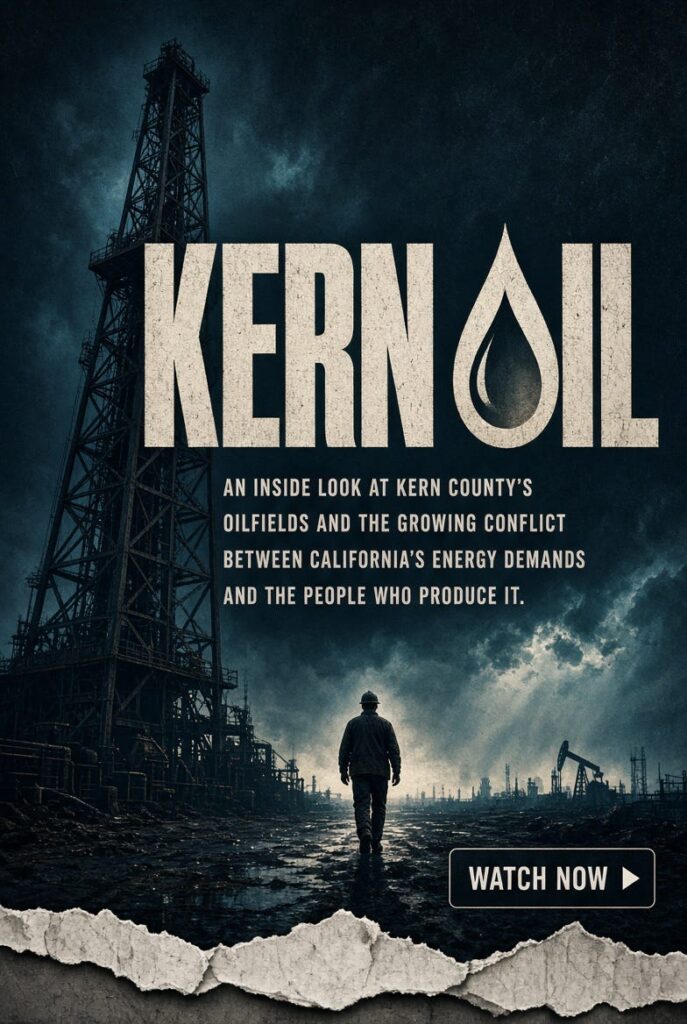
For oil and gas professionals who spend their days navigating permits, production targets, and policy headwinds, Kern Oil is more than just another documentary. It is a ground-level look at what happens when regulation, politics, and human lives collide in one of America’s most important oil-producing regions.
Directed by Rickey Bird Jr., a third-generation Kern County roughneck, the 2026 film runs nearly two hours and centers on the communities that have powered California for generations. Its core premise is straightforward and pointed: while California continues to consume roughly 1.8 million barrels of oil every day, state policies have steadily restricted in-state production. Kern County, which still accounts for about 70 percent of the state’s remaining output and directly employs tens of thousands of people, has borne the brunt of that shift.
The Human Cost Is the Story
Bird does not begin with charts or talking points. He begins with people. The film includes interviews with company leaders, field workers, small business owners, immigrants who found opportunity in the oilfields, and formerly incarcerated individuals who rebuilt their lives through industry jobs. Most powerfully, it confronts the personal toll. Bird’s own father, unable to find steady work after decades in the fields, died by suicide in 2022. That loss is not treated as an isolated tragedy. It is presented as part of a broader pattern of economic and psychological strain that has settled over towns like Taft and Bakersfield.
For professionals who manage workforces, this section lands with particular force. It is a reminder that “just find another job” is not a sufficient answer when an entire regional economy has been structured around oil for more than a century.
Policy, Production, and the Import Paradox
The documentary makes clear the gap between rhetoric and reality. California still needs oil—for transportation fuels, plastics, chemicals, and even components used in renewable energy technologies—yet it increasingly imports those barrels from overseas. The film argues that this approach exports both jobs and environmental accountability while California’s own, heavily regulated production declines.
Industry viewers will recognize the operational frustration. Bird walks through the layers of red tape that have made new drilling extraordinarily difficult. The film arrives at a moment when those hurdles have begun to shift. Senate Bill 237, which took effect in 2026, validated Kern County’s long-fought local permitting ordinance and created a clearer path for up to 2,000 new wells per year under the county’s environmental review. Health protection zones under SB 1137 still impose a 3,200-foot setback from sensitive receptors, and idle-well rules continue to tighten. But the pure paralysis that defined the previous decade has eased.
Kern Oil does not claim these changes solve everything. It simply shows why the previous status quo was unsustainable for the people who live and work in Kern County.
Why Oil and Gas Professionals Should Watch
Most industry documentaries fall into one of two categories: promotional pieces that feel staged, or critical films that reduce complex systems to villains and victims. Kern Oil largely avoids both. It is unapologetically sympathetic to the workforce and critical of policies that treat oilfield communities as collateral damage. At the same time, it is rooted in the lived experience of people who still show up for work every day.
For professionals, the film offers three practical values:
It humanizes the abstract. Numbers about production declines and import volumes become concrete when attached to specific families, businesses, and towns.
It provides a clear case study in regulatory overreach and its secondary effects. The long legal battle over Kern County’s permitting ordinance, the repeated court setbacks, and the eventual legislative intervention with SB 237 form a useful timeline for anyone tracking energy policy in restrictive jurisdictions.
It reinforces a message the industry often struggles to communicate effectively: oil remains foundational to modern life, and the cleanest, most tightly regulated barrels are often the ones produced under U.S. rules.
Bird’s stated goal is simple—to give voice to communities that have felt ignored while decisions about their future were made elsewhere. For oil and gas professionals, the value is equally straightforward. Understanding the human and political dimensions of these debates is no longer optional. It is part of the job.
Kern Oil is currently available to rent or buy on Amazon. For anyone whose work touches California production, workforce issues, or the broader conversation about domestic energy, it is worth the time.
Jason Spiess is the founder of The Crude Life and has been an working-owner in media companies for over 40 years.

The Crude Life Content Network
Primary Website
Follow on YouTube
Follow on Facebook
- The Crude Life Facebook Page
- Eagle Ford Texas Facebook Page
- Bakken.com Facebook Page
- Haynesville Facebook Page
- Marcellus Facebook Page
- Niobrarachalk Facebook Page
- PermianShale Facebook Page
Follow on LinkedIn
- The Crude Life LinkedIn
- The Founder of The Crude Life – Jason Spiess LinkedIn
The Crude Life has been a trusted brand pioneering energy content for 15 years — from the very first podcast in 2011 to today’s full-spectrum content company producing podcasts, video interviews, print features, radio news, social media campaigns, Substack editorials, live events and more.
Trusted Interviews. Industry Experts.


