A little over a decade ago, Lynn Helms—then North Dakota’s top oil and gas regulator—stood before an industry audience and declared that the Bakken would affect “our grandchildren’s grandchildren.” The remark was not casual boosterism. It was the logical extension of a dual role written into state law: the same official charged with regulating the industry was also charged with fostering, encouraging, and promoting its development.
That arrangement was deliberate. When the Department of Mineral Resources was structured, promotion and regulation were fused. Critics later tried to separate the two functions and failed. The result was a regulator who could, and did, speak in the language of permanent abundance while simultaneously writing the rules.
Senator John Hoeven amplified the message and called the Bakken a “Forever Boom.” He and other state leaders framed North Dakota as open for business—a business-friendly jurisdiction where private capital could pursue a multi-generational resource under clear rules and a supportive state. That framing was only partly true. In practice, the system favored those with institutional access, political alignment, and public support. The public face was free-market opportunity. The operating reality was a model in which public assistance and preferred relationships increasingly determined who could advance.
A decade later the production numbers still look impressive—roughly 1.1 million barrels per day. That is not trivial. It remains one of the most important tight-oil resources in the United States. Yet the story of how that production is sustained—and how the industry proposes to extract the next increment—reveals a deeper fracture inside American oil and gas.
One side continues to operate under market discipline: private capital, private risk, private returns. The other has become deeply embedded in a public-private architecture of research grants, matching funds, targeted tax preferences, and coordinated pilot programs. In North Dakota this second model is no longer peripheral. It is becoming the governing logic for the next phase of the play.
The easy growth phase is over. Sweet spots have been drilled. Primary recovery remains stubbornly in the single digits to low teens. The next chapter is no longer being written primarily by private capital chasing private returns. It is being structured around enhanced oil recovery, carbon dioxide injection, research consortia, matching grants, tax credits, and potential federal loan guarantees. The same institutional network that once sold the Forever Boom is now organizing the public-private machinery required to extract the next increment.
Call it the New Energy Order. Critics, with much justification, call it a grifter and grafter economy.
The volume is still large. The governance model is what has shifted.
The Resource Reality
Primary recovery in the Bakken has never escaped the 5–15 percent range, most often cited in the 8–12 percent band. Early optimism about estimated ultimate recoveries frequently outran actual well performance. Higher initial production rates from denser completions often came with steeper terminal declines. Sweet spots are increasingly drilled. Production has plateaued relative to its peak growth years.
The industry’s answer is enhanced oil recovery—CO₂, rich gas, surfactants, huff-and-puff. The technical case is real: laboratory and early pilot work show incremental oil can be mobilized. The commercial case has not yet been proven at scale in this rock. That gap is where public money enters.

The Public-Private Machine
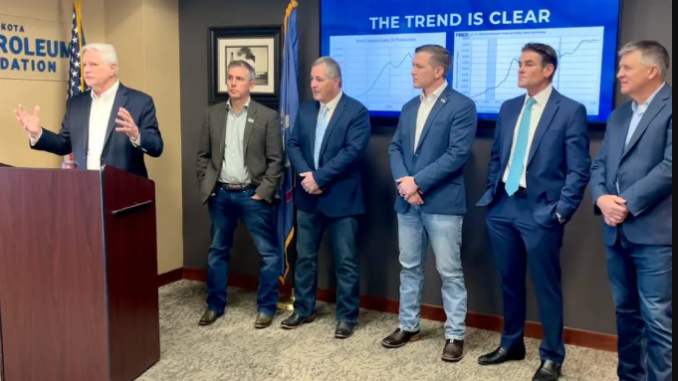
“Crack the Code 2.0” and its predecessors illustrate the model. Roughly $157 million in Phase 1 combines federal DOE dollars, state Oil and Gas Research Program grants (themselves funded by production and extraction taxes), and industry matching capital. The state Industrial Commission awards the grants.
The Energy & Environmental Research Center at the University of North Dakota functions as the coordinating hub. Operators run the pilots. The same institutional network is already preparing Phase 2—field-scale testing involving up to 200 wells and potential federal loan guarantees measured in hundreds of millions.
Layer on permanent stripper-well tax treatment that is more generous than in peer states, the 45Q credit for CO₂ used in EOR, and ongoing cooperative agreements with DOE, and the picture is clear: the effort to raise recovery factors is being socialized. Private capital remains essential, but public risk absorption and political prioritization have become structural.
This is not unique to oil. It is, however, increasingly the operating system for mature or technically difficult resources. When pure market signals are insufficient, the response is not to accept lower recovery or redeploy capital elsewhere. The response is another grant round, another pilot program, another press conference announcing the next phase.

Gatekeepers and Concentrated Power
Public-private partnerships concentrate decision rights. In North Dakota the Industrial Commission, the research program, EERC leadership, and a relatively small set of large operators sit at the intersection of funding, permitting, data sharing, and narrative.
The state and the nonprofit organizations says this concentration creates efficiency—shared learning, coordinated field tests. That’s only a slice of it.
It also creates gatekeepers. Ruthless gatekeepers who do not adhere to free market policies, rather undermine the basic principles of it.
For example, who receives the next matching grant? Which injection strategy is prioritized? Which service companies and technology providers are pulled into the preferred supply chain? These choices are not made solely by market tests. They pass through political and institutional filters.
According to public records, women make up roughly 11% of North Dakota’s broader oil and gas extraction workforce, but the share drops to the low single digits—often cited below 2%—in hands-on rig and field roles. The more visible presence of women is concentrated in office, compliance and networking positions.

The North Dakota Petroleum Council, as the primary industry association, is a central participant in this architecture. It advocates for the funding, participates in the public announcements, and has itself received state research and outreach support. Whether that role is legitimate industry representation or a form of institutionalized preference is the core of the current debate.
Critics argue the arrangement favors incumbents, creates soft barriers for independent operators and pure-market service providers, and turns the political calendar—legislative sessions, grant deadlines, federal appropriation cycles—into the real business cycle. Supporters counter that the remaining oil-in-place is too large, the tax base too important, and the technical risk too high for private capital alone.
Both claims contain truth. The institutional design, however, is not neutral.

A Fractured Industry
The American oil and gas sector is no longer monolithic. One culture still believes capital allocation should be governed by price, cost, and recoverable reserves under private risk. Another has adapted to a world of industrial policy, tax credits, research consortia, and political sponsorship. In the Bakken the second culture is ascendant for the next chapter of the play.
This is not a claim that the Bakken collapses without government money tomorrow. Current production is still largely the product of earlier private investment. It is a claim that the increment—the effort to move recovery from the teens toward something meaningfully higher—has been structured as a public-private enterprise. Remove the matching grants, the targeted credits, and the coordinated institutional support, and the pace and scale of that effort change.
Whether this model represents prudent resource stewardship or a slow conversion of a market industry into a managed, grant-dependent system is the question North Dakota—and the broader industry—must answer. The volume numbers remain impressive. The governance model is what has shifted.

The Crude Life Content Network
Primary Website
Follow on YouTube
Follow on Facebook
- The Crude Life Facebook Page
- Eagle Ford Texas Facebook Page
- Bakken.com Facebook Page
- Haynesville Facebook Page
- Marcellus Facebook Page
- Niobrarachalk Facebook Page
- PermianShale Facebook Page
Follow on LinkedIn
- The Crude Life LinkedIn
- The Founder of The Crude Life – Jason Spiess LinkedIn
The Crude Life has been a trusted brand pioneering energy content for 15 years — from the very first podcast in 2011 to today’s full-spectrum content company producing podcasts, video interviews, print features, radio news, social media campaigns, Substack editorials, live events and more.
Trusted Interviews. Industry Experts.

