
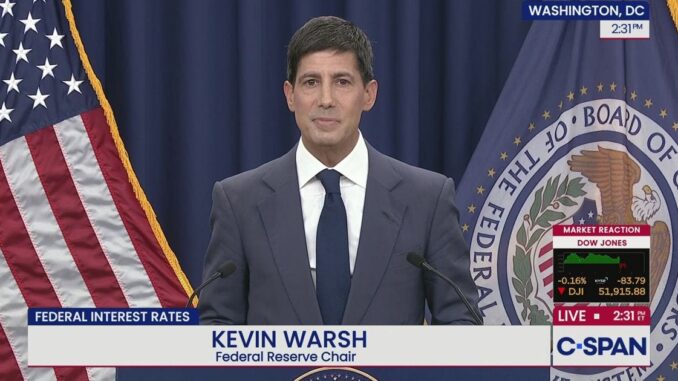
Federal Reserve Chairman Kevin Warsh stood in San Francisco this week and described the U.S. economy as standing at a “hinge point.” The occasion was a conference of his AI task force examining how artificial intelligence will reshape productivity, jobs, and prices. Warsh floated the possibility of an AI-driven version of the “China shock” — this time hitting services rather than manufacturing — and asked whether the technology could deliver medium-term disinflation even as it displaces workers. He offered no immediate conclusions on interest rates. The questions themselves signaled something larger: the central bank is already treating AI as a structural force that will force new thinking about growth, inflation, and policy.
That same force is reshaping the energy system itself.
AI’s voracious demand for electricity, combined with the political imperative to manage carbon, is accelerating a denser web of public-private arrangements. Hyperscalers need firm, high-density power measured in gigawatts and available around the clock. Natural gas can deliver it faster than most alternatives. Carbon-management tools — especially carbon capture and storage incentives — are frequently attached to these projects to make the gas more politically durable. The result is a rapid expansion of co-located gas generation and data centers, often involving federal land, accelerated permitting, long-term offtake contracts, and partnerships that pull oil and gas companies, private equity, utilities, and government agencies into the same deals.
Government is growing in the energy-for-AI system
Federal agencies are opening public lands, streamlining reviews, and structuring arrangements so that private capital — from the big tech firms, oil and gas majors, and infrastructure funds — can move faster. This expands the state’s role as facilitator, landowner, and rule-setter on the power and compute side of the economy. It is not the same as the state taking over upstream oil and gas production. Most U.S. drilling still occurs on private or state land and remains driven by geology, prices, private capital, and state regulators.
Federal leverage is real but narrower: stronger on federal lands and through incentives that make gas-plus-CCS attractive for AI power, and stronger on the downstream generation and data-center side than on deciding every well location or supplying the bulk of the capital.
Oil and gas companies remain the primary decision-makers on most drilling programs. What has changed is that a growing share of gas demand is now tied to long-term power contracts with tech firms and to projects that involve public land, federal permitting pathways, or carbon-management subsidies. Government therefore gains more influence over the conditions under which some of that gas is commercialized. It does not dictate the overall drilling schedule or bankroll the industry.
Advocacy nonprofits and the platforms
Alongside the physical build-out, a more visible layer of advocacy-oriented nonprofits has grown. Some push “energy abundance,” permitting reform, and data-center development, occasionally hosting high-profile events with Cabinet officials or partnering with industry. Others organize against data centers on land-use, water, ratepayer, or climate grounds, relying heavily on social media and rapid digital mobilization. Traditional service and field-conservation nonprofits continue their work, but the high-visibility, event-heavy, policy-focused layer has expanded around these issues.
The platforms themselves sit in the middle of the loop. Meta, Google, and their peers are major players in the AI data-center business. They consume enormous volumes of the power being built, sign the long-term contracts that underwrite new generation, and in some cases partner with or fund nonprofits working on “sustainable” data-center technologies. The same companies whose infrastructure drives the energy demand also operate the main channels through which advocacy groups advertise and organize. The feedback can feel self-reinforcing.
A more coordinated system, not a state takeover
The AI-plus-carbon intersection has produced a denser web of public-private arrangements, more advocacy organizations that live on events and social media, and greater state involvement in siting and enabling energy infrastructure for compute. That is a meaningful shift toward a more coordinated, politically mediated energy-compute system. It is not a full transfer of operational control over oil and gas drilling and funding to the state. Private capital and private operators still drive the majority of upstream activity.
Warsh’s conference this week was framed around productivity and jobs. The deeper story is that the same technology forcing the Federal Reserve to rethink its models is also rewriting the terms on which energy is produced, permitted, and politically contested.
The new energy order is still taking shape — part market, part partnership, part political contest — and the hinge point is not only economic. It is institutional.
Welcome to the New Energy Order.
Jason Spiess is the founder of The Crude Life and has been an working-owner in media companies for over 40 years.

The Crude Life Content Network
Primary Website
Follow on YouTube
Follow on Facebook
- The Crude Life Facebook Page
- Eagle Ford Texas Facebook Page
- Bakken.com Facebook Page
- Haynesville Facebook Page
- Marcellus Facebook Page
- Niobrarachalk Facebook Page
- PermianShale Facebook Page
Follow on LinkedIn
- The Crude Life LinkedIn
- The Founder of The Crude Life – Jason Spiess LinkedIn
The Crude Life has been a trusted brand pioneering energy content for 15 years — from the very first podcast in 2011 to today’s full-spectrum content company producing podcasts, video interviews, print features, radio news, social media campaigns, Substack editorials, live events and more.
Trusted Interviews. Industry Experts.


