
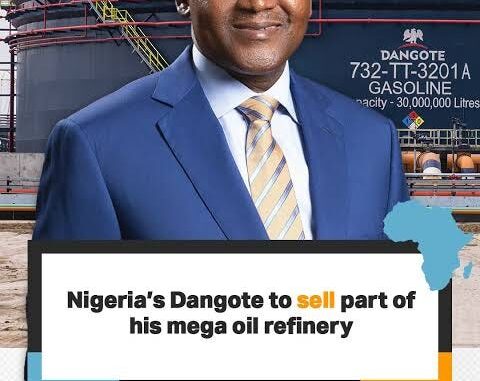
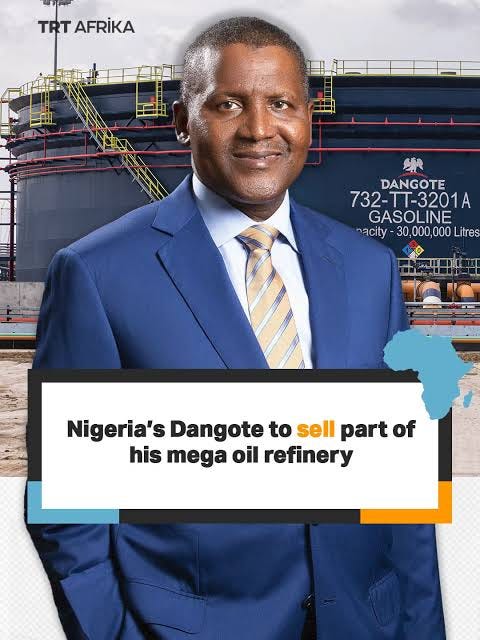
Africa’s richest man, Aliko Dangote, is in talks with Nigeria’s Securities and Exchange Commission (SEC) about selling part of his personal stake in the Dangote Petroleum Refinery and Petrochemicals (Lagos) via a secondary sale.
The goal is to help meet demand from institutional investors who could not be fully accommodated in the company’s initial public offering (IPO), according to people familiar with the matter (who asked not to be named because the information is private).
Context on the IPO
- The offering is Africa’s largest-ever IPO. It sought to raise roughly $1.6–2.1 billion.
- It was heavily oversubscribed: applications totaled about ₦5.85 trillion (~$4.3 billion) at a price of ₦525 (~$0.38) per share.
- Nearly 4 million unique subscriptions came from investors in ~120 countries.
- The SEC had been expected to publish the allotment list by November 17 but delayed it so it could review/approve the secondary sale. A senior SEC official said the regulator is processing allotments and will give approval once requirements are met.
- A Dangote spokesman declined to comment.
The secondary-sale talks themselves have limited direct short-term impact, but they matter because they support the growth and capitalization of the Dangote Petroleum Refinery — currently one of the world’s largest single-train refineries (~650,000–700,000 barrels per day, with plans to reach 1.4 million bpd). That growth is already reshaping refined-product flows.

Global Market Impact
1. New refining capacity in the Atlantic Basin
Europe and parts of North America have been shutting refining capacity. Dangote adds significant new complex refining capacity in West Africa. At full utilization it processes a meaningful share of globally traded crude (Dangote has claimed figures approaching ~2.5% once fully ramped and expanded). This increases overall global product supply (gasoline, diesel, jet fuel) and reduces reliance on traditional refining hubs in the Middle East, Europe, and Asia.
2. Shift in refined-product trade flows
- Nigeria has largely ended its decades-long dependence on imported fuel and become a net exporter of refined products.
- West African fuel imports from outside the region have fallen sharply (reports of ~20–25% reductions in some periods).
- Dangote has become a major jet-fuel supplier to Europe, at times overtaking the United States as the largest external supplier of aviation fuel into Europe.
- It also supplies other African markets and has shipped products to the UK and elsewhere.
3. Geopolitical and supply-security effects
When Middle East or other disruptions tighten middle-distillate markets, Dangote acts as a flexible alternative supplier that is outside the most disrupted zones. This improves supply diversity and can moderate price spikes for diesel and jet fuel in Europe and Africa.
4. Longer-term pressure on refining margins
More efficient, large-scale capacity coming online tends to put downward pressure on global refining margins over time, especially once the planned expansion to 1.4 million bpd materializes. In the near term, high utilization and tight markets have supported strong margins for the plant itself.
5. Capital-markets signal
The secondary sale (Dangote selling part of his personal stake to meet institutional demand the primary IPO could not fully satisfy) increases the free float and brings more institutional capital into the company. This supports the multi-year expansion program and signals strong investor confidence in the asset.

US Energy Market Impact
1. Competition in export markets
US refiners are major exporters of distillates and jet fuel, particularly into Europe. Dangote has directly competed in that space and, in some months of 2026, displaced US volumes as Europe’s top external jet-fuel supplier. As Dangote scales further, it is expected to continue challenging US (and other) product exporters into Europe and West Africa.
2. Support for US crude exports
At times the refinery has imported substantial volumes of US crude (notably WTI Midland) when Nigerian domestic supply was insufficient or when arbitrage favored it. Higher runs or expansion can therefore support US crude export volumes, though the mix fluctuates with relative prices and freight.
3. Limited direct effect on US domestic prices or supply
The United States is a large net exporter of refined products and largely self-sufficient. Dangote does not meaningfully alter US gasoline or diesel balances at home. Any impact on US pump prices would be indirect and small, coming through global margin and freight dynamics rather than physical displacement of US domestic supply.
4. Broader Atlantic Basin dynamics
US refiners benefit when global product markets are tight (high export margins). A large, competitive new supplier in Nigeria tends to ease those conditions over time, especially for jet fuel and diesel into Europe. Conversely, when Dangote experiences outages or runs below capacity, it can tighten Atlantic Basin balances and support higher margins for remaining exporters (including US plants).
Bottom Line
The secondary-sale talks are primarily a corporate-finance development that helps lock in institutional ownership and supports the capital needed for expansion. The real market impact comes from the refinery’s operating scale and growth trajectory:
- It is already reducing Africa’s import dependence and inserting a large new source of refined products into global (especially European and African) markets.
- It competes with US product exports into Europe while sometimes supporting US crude exports.
- As capacity grows toward 1.4 million bpd, its influence on Atlantic Basin product balances, freight patterns, and refining margins will increase.
In short: modest near-term effects from the share sale itself, but structurally meaningful and growing influence on global refined-product markets — with the US feeling it mainly through export competition rather than domestic supply disruption.
Jason Spiess is the founder of The Crude Life and has been an working-owner in media companies for over 40 years.

The Crude Life Content Network
Primary Website
Follow on YouTube
Follow on Facebook
- The Crude Life Facebook Page
- Eagle Ford Texas Facebook Page
- Bakken.com Facebook Page
- Haynesville Facebook Page
- Marcellus Facebook Page
- Niobrarachalk Facebook Page
- PermianShale Facebook Page
Follow on LinkedIn
- The Crude Life LinkedIn
- The Founder of The Crude Life – Jason Spiess LinkedIn
The Crude Life has been a trusted brand pioneering energy content for 15 years — from the very first podcast in 2011 to today’s full-spectrum content company producing podcasts, video interviews, print features, radio news, social media campaigns, Substack editorials, live events and more.
Trusted Interviews. Industry Experts.

