
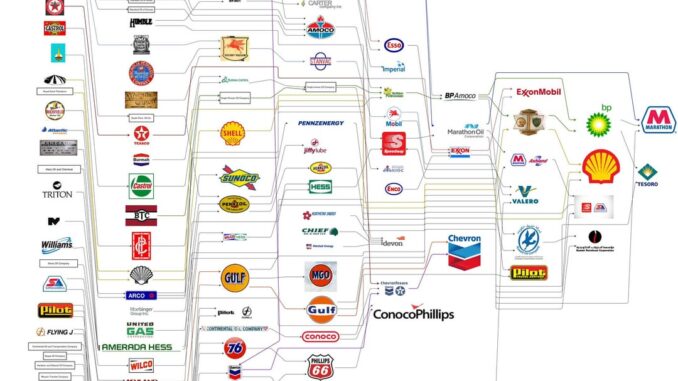
In 1911, the U.S. Supreme Court delivered one of the most consequential antitrust rulings in American history. Standard Oil, the sprawling empire built by John D. Rockefeller, was ordered dissolved. What had been a near-total domination of the U.S. oil industry—controlling refining, pipelines, and marketing—was broken into 34 independent companies. The stock was distributed to shareholders; no cash changed hands. The trust that had once seemed invincible was gone.
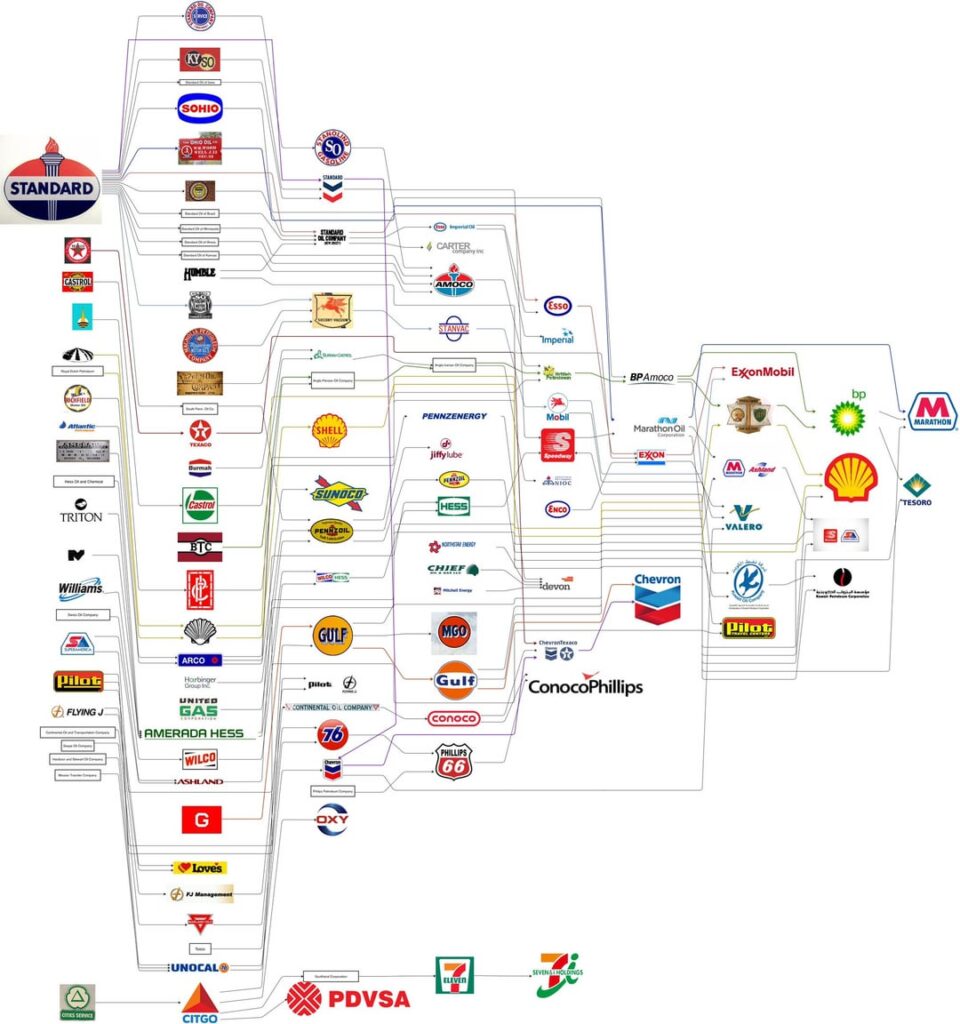
More than a century later, the fragments of that empire sit inside some of the world’s largest energy companies. ExxonMobil, Chevron, BP, ConocoPhillips, Marathon Petroleum, and Phillips 66 all trace significant lineage back to the 1911 spin-offs. Their combined market value in early October 2026 exceeded $1.5 trillion. The story of how the pieces recombined is a century-long lesson in the limits of forced deconcentration and the enduring logic of scale in the oil business.

The Empire and Its Dissolution
By the early 20th century, Standard Oil of New Jersey functioned as the holding company for a vertically integrated system that refined the majority of American crude and controlled critical transportation and marketing networks. Competitors and progressive reformers, amplified by Ida Tarbell’s investigative reporting, portrayed it as a classic monopoly. In 1911 the Supreme Court agreed, ordering the company to divest its major holdings.
The largest successors included:
- Standard Oil of New Jersey (the former parent, later Exxon)
- Standard Oil of New York (later Mobil)
- Standard Oil of California (later Chevron)
- Standard Oil of Indiana (later Amoco)
- Standard Oil of Ohio (Sohio)
- Continental Oil Company (Conoco lineage)
- The Ohio Oil Company (Marathon lineage)
- Atlantic Refining (ARCO lineage)
Contemporary capital-stock figures and early market quotations provide only rough proxies for their 1911–12 values—estimates on the order of tens of millions of dollars each. The aggregate capitalization of the post-breakup companies was measured in the low hundreds of millions. The old combined enterprise had briefly approached or exceeded a billion-dollar valuation in trading just before the split fully took effect. These were large businesses by the standards of the day, but they were no longer a single coordinated trust.
Rebuilding Scale
Independence did not mean isolation. The successor companies retained the technical expertise, cash flows, and brand recognition of the old system. Over the following decades they expanded geographically, integrated upstream and downstream, and competed aggressively with one another and with new entrants such as Texaco and Gulf.
By the mid-20th century the industry had settled into a structure of large, integrated majors. The “Seven Sisters” dominated international oil. Several of those Sisters—or the American companies that later joined their ranks—carried Standard Oil DNA. Standard Oil of New Jersey became Exxon. Standard Oil of New York became Mobil. Standard Oil of California became Chevron. Standard Oil of Indiana became Amoco. Standard Oil of Ohio became Sohio.
The pattern of consolidation accelerated in the late 20th century as oil prices gyrated, capital intensity rose, and global competition intensified.
- In 1987 British Petroleum completed its acquisition of the remaining stake in Sohio for roughly $7.9 billion.
- In 1998 BP acquired Amoco in a stock transaction valued at approximately $48.2 billion, creating one of the first true supermajors.
- In 1999 Exxon and Mobil—the two largest direct descendants of the original trust—merged in a deal valued at about $81 billion, forming ExxonMobil.
Other lineages followed parallel paths. Continental Oil evolved into Conoco, later merged with Phillips Petroleum to form ConocoPhillips, which in 2012 spun off its downstream operations as Phillips 66. The Ohio Oil Company became Marathon Oil; its refining and marketing business was later separated as Marathon Petroleum. Atlantic Refining merged into ARCO, which was acquired by BP; the ARCO brand and certain assets later moved into the Marathon Petroleum orbit.
The Landscape in 2026
By October 1, 2026, the major publicly traded descendants stood as follows (approximate market capitalizations):
- ExxonMobil: ~$663–674 billion
- Chevron: ~$400–410 billion
- ConocoPhillips: ~$153 billion
- Marathon Petroleum: ~$118 billion
- BP: ~$114–116 billion
- Phillips 66: ~$105 billion
These companies are not simple reconstitutions of the 1911 pieces. They have absorbed non-Standard assets, expanded globally, diversified into natural gas and chemicals, and, in some cases, begun investing in lower-carbon energy. Yet the continuity is unmistakable. The forced breakup of 1911 did not permanently atomize the industry. It created a set of strong regional and functional competitors that, over decades of organic growth and strategic mergers, reassembled into a smaller number of global-scale firms.
What the Century Reveals
The Standard Oil story is often told as a triumph of antitrust enforcement. In important respects it was: the 1911 decree ended the most extreme form of coordinated control and opened space for new competitors. Rockefeller himself, paradoxically, grew richer as the separate companies were revalued upward by the market.
Yet the longer arc shows the limits of structural remedies in capital-intensive, scale-sensitive industries. Oil exploration, refining, logistics, and marketing reward size. Companies that can spread risk across geographies, integrate the value chain, and fund multi-decade projects tend to prevail. The pieces of Standard Oil did not remain 34 independent regional players. They consolidated, modernized, and globalized.
Today’s energy majors operate under far stricter regulatory, environmental, and competitive constraints than Rockefeller’s trust ever faced. They also face new pressures—energy transition, climate policy, and competition from national oil companies. The corporate family tree that began with the 1911 dissolution remains one of the clearest illustrations of how industrial structure evolves: not in a single dramatic rupture, but through generations of adaptation, merger, and reinvention. The monopoly was broken. The industry’s preference for scale endured.
The Crude Life Content Network
Primary Website
Follow on YouTube
Follow on Facebook
- The Crude Life Facebook Page
- Eagle Ford Texas Facebook Page
- Bakken.com Facebook Page
- Haynesville Facebook Page
- Marcellus Facebook Page
- Niobrarachalk Facebook Page
- PermianShale Facebook Page
Follow on LinkedIn
- The Crude Life LinkedIn
- The Founder of The Crude Life – Jason Spiess LinkedIn
The Crude Life has been a trusted brand pioneering energy content for 15 years — from the very first podcast in 2011 to today’s full-spectrum content company producing podcasts, video interviews, print features, radio news, social media campaigns, Substack editorials, live events and more.
Trusted Interviews. Industry Experts.


