
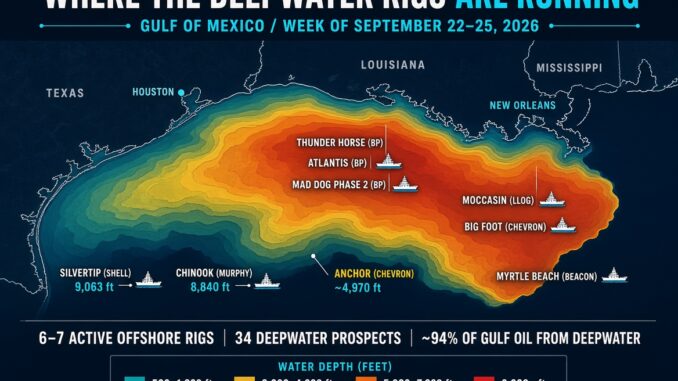
While U.S. land drilling remains a story of hundreds of active rotary rigs spread across Texas, New Mexico, Oklahoma, and other states, deepwater drilling operates on an entirely different scale. A handful of specialized floating vessels working in thousands of feet of water continue to deliver a large share of the nation’s offshore oil and a meaningful portion of total U.S. crude supply.
Deepwater Is Not the Same as Offshore
Offshore drilling is the broad category covering any oil and gas activity conducted from platforms, jack-up rigs, or floating vessels in the ocean. It includes both shallow-water (shelf) operations, typically in less than 500–1,000 feet of water, and deepwater activity.
Deepwater generally refers to water depths greater than 1,000 feet (BSEE often tracks activity above 500 feet). Ultra-deepwater usually means depths beyond 5,000–7,500 feet. In the U.S. Gulf of Mexico (also called the Gulf of America in some recent official references), nearly all current exploratory and development drilling falls into the deepwater or ultra-deepwater category. Shallow-water activity has largely declined as older shelf fields mature and operators focus capital on higher-volume deepwater projects.
Current Activity Snapshot
Baker Hughes data for late September 2026 showed the Gulf of Mexico offshore rotary rig count in the single digits — six as of the week of September 25, following levels around seven earlier in the month. This is well below the mid-teens counts common in 2023–2024 and a fraction of the 100-plus active Gulf rigs seen in the early 2000s.
The more detailed picture comes from the Bureau of Safety and Environmental Enforcement (BSEE) Deepwater Activity Weekly Report. The September 22, 2026 edition listed 34 deepwater prospects with active drilling or workover operations. Water depths ranged from roughly 600 feet to more than 9,000 feet.
Notable examples from that report include:
- Shell at Silvertip (Alaminos Canyon 815) in 9,063 feet of water using the Transocean Deepwater Poseidon
- Murphy at Chinook (Walker Ridge 469) in 8,840 feet with the Transocean Deepwater Proteus
- BP at Atlantis and Thunder Horse, plus Mad Dog Phase 2
- Chevron at Anchor (Green Canyon 807) with the Deepwater Titan, plus Big Foot and Jack
- LLOG at Moccasin and other Keathley Canyon locations with Seadrill vessels
- Beacon, Anadarko/Occidental, Eni, and others working prospects in Green Canyon, Mississippi Canyon, and Walker Ridge
High-spec ultra-deepwater drillships from Transocean, Diamond Offshore, Seadrill, and others dominate the active fleet. Some listings involve coil-tubing, wireline, or hydraulic workover units rather than full rotary drilling.
Production Reality: Efficiency Over Volume of Rigs
The low rig count does not equal low output. Deepwater wells already account for roughly 94% of Gulf of Mexico crude oil production and about 80% of its natural gas.
Gulf of Mexico crude production has been supported by a wave of new deepwater projects that came online in 2025 and continue to ramp in 2026. The U.S. Energy Information Administration has noted gains of around 0.2 million barrels per day (10%) in the first half of 2026 versus the same period in 2025, driven largely by new floating production units and subsea tie-backs such as Shenandoah and Ballymore. Forecasts point to further modest growth for the full year, potentially pushing Gulf output toward or above 1.9–2.0 million barrels per day, even as the number of active drilling rigs remains low.
This decoupling of rig count from production reflects decades of technological progress: longer-reach wells, higher-pressure equipment, better reservoir imaging, standardized subsea systems, and more productive individual wells. One modern deepwater well can deliver volumes that once required multiple shallower wells.
Outlook
Capital continues to flow toward deepwater. Major operators maintain multi-year programs, and new lease sales under recent legislation are intended to provide a more predictable inventory of future opportunities. At the same time, the industry faces the usual Gulf challenges — hurricane risk, high project costs, and the long lead times inherent in deepwater developments.
Shelf activity is expected to remain minimal. Deepwater will continue to dominate both investment and production in the federal Gulf for the foreseeable future.
In short, the U.S. deepwater story in late 2026 is one of concentration and efficiency rather than sheer numbers of rigs. A small fleet of sophisticated vessels working in extreme water depths keeps delivering a large share of America’s offshore energy.
The Crude Life is a sponsor and supporter of the Route 66 Americana Archive. Click here for more Route 66 stories, features and interviews.
The Crude Life Content Network
Primary Website
Follow on YouTube
Follow on Facebook
- The Crude Life Facebook Page
- Eagle Ford Texas Facebook Page
- Bakken.com Facebook Page
- Haynesville Facebook Page
- Marcellus Facebook Page
- Niobrarachalk Facebook Page
- PermianShale Facebook Page
Follow on LinkedIn
- The Crude Life LinkedIn
- The Founder of The Crude Life – Jason Spiess LinkedIn
The Crude Life has been a trusted brand pioneering energy content for 15 years — from the very first podcast in 2011 to today’s full-spectrum content company producing podcasts, video interviews, print features, radio news, social media campaigns, Substack editorials, live events and more.
Trusted Interviews. Industry Experts.


