
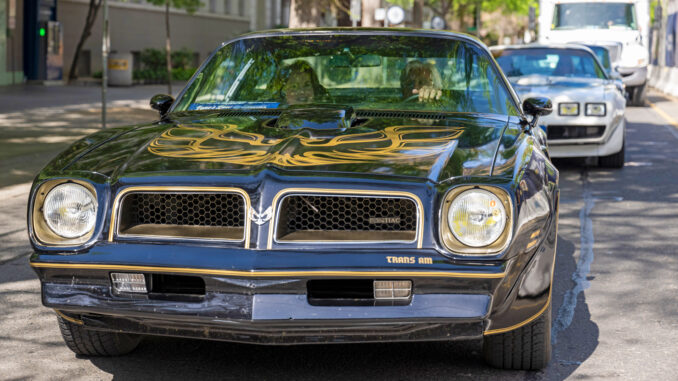
Jay Leno got his driveway back on September 16. That’s the short version of what happened when Governor Gavin Newsom signed Senate Bill 1392 — “Leno’s Law” — at Leno’s Burbank garage, exempting classic collector vehicles from model years 1976 to 1985 from California’s smog checks.
The exemption phases in starting January 1, 2028, building on the state’s existing pre-1976 exemption, and it comes with conditions: qualifying cars have to be preserved and used primarily for car shows, parades, exhibitions, and charitable events rather than daily transportation, and owners need collector insurance or annual mileage under 1,000.
Backed by Leno himself and the Specialty Equipment Market Association, the bill had failed in an earlier form before this version made it through with bipartisan support.
It’s a win for classic car owners, and it’s being covered that way — Leno’s name attached to a piece of legislation tends to make sure of that. But strip away the celebrity wrapper and what’s left is a state government drawing a hard line around what a classic car is legally allowed to be: not transportation, but a preserved object, driven sparingly, for approved occasions.
That line runs closer to home than Burbank, at least from where the Frequency 66 studio sits. Walk a few blocks from 601 Main in Galena, Kansas, and you land at 520 South Main — the corner of Route 66 and the old Jefferson Highway.

It’s easy to miss that Galena was ever a crossroads in the first place; Route 66 gets all the neon and the nostalgia. But the Jefferson Highway was there first, dedicated in 1915 as the “Pine to Palm” route, running north-south from Winnipeg, Manitoba down through Minnesota, Iowa, Missouri, Kansas, Oklahoma, Texas, and Louisiana to New Orleans — a full two decades before Route 66 existed as a designation.
The two roads crossed paths at that same Galena intersection, and for a stretch of history, a traveler heading north out of this stretch of southeast Kansas wasn’t choosing between two different trips. They were choosing a direction on the same map.
Follow that Jefferson Highway thread north out of Galena today, and it eventually lands in Minnesota — my home state, and, as it happens, the site of the other classic car bill worth watching this year.
State Representative Meg Luger-Nikolai’s House File 3865, introduced March 2, 2026, is largely an administrative cleanup of Minnesota’s collector-vehicle registration rules. But one section would limit collector-class vehicles to use “solely as a collector’s item,” which several outlets covering the bill have read as restricting road use to daylight hours on Saturdays and Sundays, or to club activities and events.
Worth being precise here: that restriction isn’t spelled out in plain language in the bill text. Multiple outlets covering HF 3865 note the weekday and nighttime limits are inferred by omission rather than explicitly stated — the bill defines what qualifies as permitted use, and everything outside that definition is presumed prohibited.
As of this writing, HF 3865 has been stuck in the Transportation Finance and Policy Committee since early March, and its path forward is genuinely uncertain — this is a proposed rule, not settled law, and it may simply stall.
Put next to Leno’s Law, Minnesota’s approach isn’t a mirror image — it’s the other side of the same coin. California’s is a carrot: comply with limited-use conditions, get relief from an expensive emissions burden.
Minnesota’s is closer to a fence around a benefit that already exists — collector plates already carry reduced fees and an existing “not for general transportation” standard, and HF 3865 would tighten what that standard means in practice.
Both bills, different as their mechanics are, rest on the same underlying premise: that a classic car is not really a car anymore, in the eyes of the state, so much as a licensed cultural artifact. And that’s worth sitting with for a minute at a Route 66-and-Jefferson-Highway corner like Galena’s, because this isn’t really a two-state story. Every state that old road touched — Iowa, Missouri, Kansas, Oklahoma, Texas, Louisiana, Minnesota, and on up into Manitoba — has its own statehouse, its own committee calendar, and its own answer eventually coming for the same question California and Minnesota are wrestling with now.
The Mother Road crosses a dozen of these old auto trails along its length, and every one of those crossings is a reminder that the politics of classic cars won’t stay contained to the two states making headlines this year.
Think about what actually happens on the Mother Road on a given weekend. A car club rolls through a town for a cruise night. A Sunday-afternoon caravan stops at a diner that’s been feeding travelers since the 1950s. A restored pickup sits parked outside a filling station turned photo-op, drawing a crowd simply because it’s there and it’s real and somebody drove it in.
None of that survives if the vehicles behind it get legislated into a narrower and narrower box — used only for “official exhibition,” only during “collector club activities,” only within hours a statehouse committee decides are acceptable.

There’s an argument on the other side worth taking seriously, and it’s not really about spite toward hobbyists. Regulators pushing these restrictions frame them as closing a loophole — making sure collector registration, with its lower fees and relaxed requirements, isn’t being used as a workaround for daily driving a car that hasn’t met modern safety or emissions standards.
That’s a legitimate administrative concern, separate from any hostility to the cars themselves. Where it gets complicated is in the execution: a bill that regulates by omission, leaving owners and even law enforcement to infer what’s permitted, creates exactly the kind of uncertainty that erodes a hobby quietly, without ever needing a headline vote to ban anything outright.
For a road that survives economically on the very activity these bills touch — car shows, parades, the leisurely detour that brings a family into a small Route 66 town for lunch and a look — the stakes aren’t abstract. A classic car that can only leave the garage two days a week, in daylight, for sanctioned events, is a car that shows up less often at the roadside attractions and diners counting on that traffic.
Multiply that across enough owners and enough states, and the Mother Road doesn’t lose a law. It loses a texture — the unplanned Tuesday pass-through, the parked-outside-the-café Buick that becomes the reason someone pulls over.
Neither bill is finished business. California’s is signed but not yet in effect. Minnesota’s may never leave committee. But stand at that Galena corner long enough, and you start to wonder less about California or Minnesota specifically, and more about which of the other old road’s namesake states — Iowa, Missouri, Oklahoma, Texas, Louisiana — picks up the next version of this fight.
The Crude Life is a sponsor and supporter of the Route 66 Americana Archive. Click here for more Route 66 stories, features and interviews.
The Crude Life Content Network
Primary Website
Follow on YouTube
Follow on Facebook
- The Crude Life Facebook Page
- Eagle Ford Texas Facebook Page
- Bakken.com Facebook Page
- Haynesville Facebook Page
- Marcellus Facebook Page
- Niobrarachalk Facebook Page
- PermianShale Facebook Page
Follow on LinkedIn
- The Crude Life LinkedIn
- The Founder of The Crude Life – Jason Spiess LinkedIn
The Crude Life has been a trusted brand pioneering energy content for 15 years — from the very first podcast in 2011 to today’s full-spectrum content company producing podcasts, video interviews, print features, radio news, social media campaigns, Substack editorials, live events and more.
Trusted Interviews. Industry Experts.


