
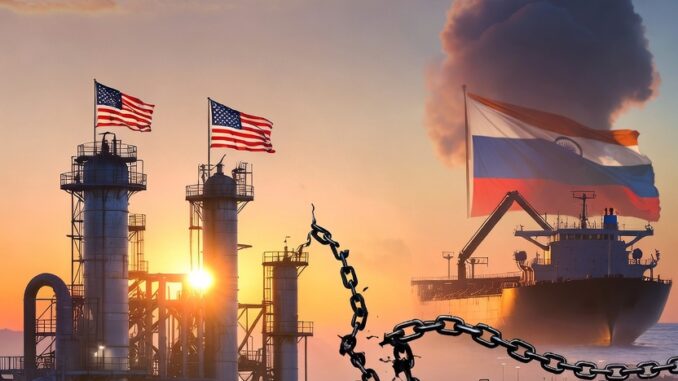
As gas prices spike toward record highs in California amid a punishing spring heat wave, a quiet but damning reality has emerged: a growing share of the fuel filling California tanks is refined from Russian crude oil — processed halfway around the world in India and shipped across the Pacific.
This isn’t some shadowy black-market scheme. It’s the direct result of California’s aggressive anti-refining policies, which have shuttered or idled nearly 20% of the state’s domestic refining capacity in under a year. While U.S. sanctions aim to starve Russia’s war machine, a sanctions loophole combined with homegrown refinery closures is funneling American dollars straight to Moscow.
This isn’t just a California problem. It’s a national security failure that prioritizes ideology over American energy dominance — at a time when the United States produces more oil and natural gas than any other nation on Earth and remains a net energy exporter.
The Refinery Exodus: Policy-Driven, Not Market-Driven
In late 2025, Phillips 66 permanently closed its massive Los Angeles-area refinery complex, eliminating roughly 139,000 barrels per day of capacity. This April, Valero Energy is idling its Benicia refinery in the Bay Area — another 145,000–170,000 barrels per day — citing California’s “hostile” regulatory environment, skyrocketing compliance costs, and shrinking in-state demand from aggressive electric-vehicle mandates and efficiency standards.
These aren’t marginal plants. Together, they represent 17–20% of California’s total refining capacity, dropping the state from 14 operating refineries at the start of 2024 to just 11 by the end of 2026. California once boasted 23 refineries in 2000 and was a top U.S. oil producer. Today it accounts for less than 2% of national crude output, with over 60% of the crude fed to its remaining refineries coming from foreign sources.
The state’s unique CARB reformulated gasoline standards — the strictest and most expensive in the nation — make it nearly impossible for most out-of-state or foreign refiners to compete without massive investment. No major pipelines connect California to the vast refining heartland in Texas and the Gulf Coast. The result? An “energy island” forced to rely on tankers from Asia and the Middle East.
Russian Oil, Indian Refineries, American Pumps
Enter India’s giant Jamnagar refinery complex, operated by Reliance Industries. India has become one of the world’s largest buyers of discounted Russian crude since the 2022 Ukraine invasion. Even as the U.S. Treasury issues short-term waivers to manage global supply shocks from Middle East tensions (including the recent U.S.-Iran conflict and Strait of Hormuz disruptions), Russian barrels keep flowing into Indian refineries.
Once refined into gasoline and blending components, those products are legally shipped to California ports like Long Beach. The sanctions loophole is clear: the U.S. bans direct imports of Russian crude or refined products, but fuel processed in a third country is fair game. Shipping data shows repeated tanker deliveries from Jamnagar to California in 2025 and early 2026, helping fill gaps left by the Martinez refinery fire and the latest closures.
California consumers — and the American economy that depends on stable West Coast fuel supplies — are unknowingly subsidizing Russia’s economy while U.S. policy claims to isolate it. Meanwhile, domestic U.S. refineries in Texas, Louisiana, and the Midwest sit ready to ramp up, but California’s regulatory thicket and isolation keep them sidelined.
The Real Costs to American Energy Security
This shift creates multiple, compounding threats to the United States:
- Geopolitical Vulnerability and Funding Adversaries: Every barrel of Russian-origin gasoline imported via India sends revenue straight to the Kremlin. At a time of heightened global tensions — from Ukraine to the Middle East — America is effectively outsourcing energy security to foreign refiners who happily buy cheap Russian crude. California’s import dependence now exceeds 70% for certain fuels, exposing the state (and national supply chains) to tanker disruptions, chokepoints like the Strait of Hormuz, and foreign policy whims.
- Price Volatility and Economic Pain: Refinery closures have already driven California gas prices higher than the national average, with spikes hitting $6 per gallon in some areas. Imports are more expensive and slower to respond to shocks than local refining. The loss of domestic capacity reduces the buffer against global events, forcing reliance on volatile tanker markets. This isn’t just bad for California drivers — it ripples through agriculture, trucking, military logistics, and manufacturing across the West.
- Lost American Jobs and Industrial Base: Each shuttered refinery means hundreds of high-paying union jobs gone, plus knock-on effects for suppliers, pipelines, and port workers. Meanwhile, Gulf Coast refineries — modern, efficient, and operating under far more reasonable rules — export record volumes of gasoline and diesel to the world. Why weaken our own refining powerhouse to import from abroad?
- National Security Risk: The Pentagon and critical infrastructure rely on stable domestic fuel supplies. California’s policies have turned a once-self-reliant energy state into a net importer dependent on foreign supply chains. As the U.S. Department of Energy has noted, this directly threatens national security.
America doesn’t lack refining capacity or crude oil — we have both in abundance outside California. What we lack is the political will in Sacramento to stop punishing American energy producers while rewarding foreign ones.
Time for an “American Refineries First” Strategy
The solution is straightforward: prioritize U.S. energy infrastructure over ideological timelines for a fossil-free future. Close the refining loophole in sanctions so Russian crude can’t be laundered through third countries and sold back to Americans. Streamline permitting for domestic refinery upgrades and expansions. Repeal the regulatory barriers that make California’s fuel uniquely expensive and incompatible with the rest of the national market. And recognize that a strong domestic refining sector isn’t the enemy of the energy transition — it’s the reliable bridge that prevents blackouts, price shocks, and geopolitical blackmail.
California’s experiment in rapid refinery phase-out has delivered exactly what critics warned: higher prices, greater foreign dependence, and ironic support for the very adversaries U.S. sanctions target. The rest of America shouldn’t pay the price.
The United States is an energy superpower. It’s time our policies reflected that reality — starting with putting American refineries first.
The Crude Life Content Network
Primary Website
Follow on YouTube
Follow on Facebook
- The Crude Life Facebook Page
- Eagle Ford Texas Facebook Page
- Bakken.com Facebook Page
- Haynesville Facebook Page
- Marcellus Facebook Page
- Niobrarachalk Facebook Page
- PermianShale Facebook Page
Follow on LinkedIn
- The Crude Life LinkedIn
- The Founder of The Crude Life – Jason Spiess LinkedIn
The Crude Life has been a trusted brand pioneering energy content for 15 years — from the very first podcast in 2011 to today’s full-spectrum content company producing podcasts, video interviews, print features, radio news, social media campaigns, Substack editorials, live events and more.
Trusted Interviews. Industry Experts.


