
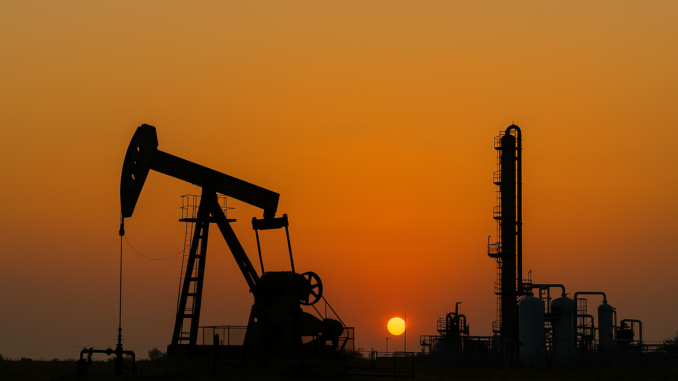
North Dakota Monitor reporter Jacob Orledge joined Craig Blumenshine, producer and host of Prairie Public’s Main Street, to discuss why the Bakken isn’t seeing a surge in new drilling, even as oil prices hover around $100 a barrel
Global oil markets have been thrown into upheaval by the ongoing conflict in Iran, pushing crude prices to around $100 a barrel. For North Dakota — a state where oil and gas accounts for what some estimates put at more than half of all tax revenue — that might sound like cause for celebration. But as Orlich explained, the picture on the ground is more complicated than the price tag suggests.
Drilling Rigs Aren’t Responding to Higher Prices
Despite the spike in oil prices, active drilling rigs in North Dakota remain in the mid-20s — far below what historical patterns would predict at this price level. Orlich pointed to a timing problem as one key reason: most major oil companies had already finalized and publicly released their 2025 drilling budgets in February, just weeks before the Middle East conflict began disrupting supply. Changing those budgets mid-year is not a simple pivot, particularly for publicly traded companies accountable to shareholders. State regulators don’t expect significant budget revisions until 2027 at the earliest.
There’s also the matter of uncertainty. Much of the current price increase reflects a geopolitical risk premium — meaning if the conflict resolves or the situation changes, prices could fall quickly. Drilling a well is a capital-intensive, long-term investment, and companies are reluctant to commit millions of dollars based on a price spike that may not last.
A More Disciplined Industry
North Dakota Department of Mineral Resources Director Nathan Anderson has described a broader shift in how oil companies approach the Bakken: they’ve become more disciplined with capital. Rather than chasing every price increase with a surge in drilling activity, many of the largest operators — now predominantly large, publicly traded companies following consolidation and mergers over the past several years — are focused on using existing production as a cash generator rather than treating the Bakken as a growth play.
North Dakota has been producing roughly 1.1 million barrels of oil per day for over a year, and that level is expected to hold steady. Orlich suggested this stabilization, while imperfect, represents a departure from the boom-and-bust cycles the state has historically experienced.
Privately owned companies, which have more flexibility than their publicly traded counterparts, may eventually increase drilling if high prices appear durable — but that remains an open question.
Restarting Idle Wells Instead of Drilling New Ones
Rather than drilling new wells, operators are taking a more cost-effective route: reactivating wells that were shut in during the recent period of historically low oil prices. The number of workover rigs — equipment used to restart and maintain inactive wells — rose from 110 to 125, a 13% increase. This allows producers to capitalize on higher prices without the multi-million-dollar expense of drilling from scratch.
What It Means for State Revenue
North Dakota is almost certainly collecting more tax revenue as a result of higher oil prices, even without a drilling surge. However, the full picture won’t be immediately clear — production data is always released on a lag, and April’s briefings were still covering February’s numbers. The first monthly data reflecting the conflict’s impact is expected to be released the following month. State government is anticipating an increase in revenue that it hopes will help meet existing forecast projections.
The Strait of Hormuz Factor
One of the most consequential variables, Orlich noted, is how long the Strait of Hormuz remains closed. The maritime chokepoint is the transit route for nearly 20% of the world’s oil supply, and its prolonged closure would keep global supply constrained and prices elevated. The longer the disruption, the more likely high prices are to persist — and the more likely companies are to eventually respond with increased investment.
Why U.S. Oil Prices Rise Even When We’re a Net Exporter
Orlich also addressed a common point of confusion: why do American consumers feel the pinch at the gas pump when the U.S. produces so much of its own oil? The answer is that oil is a global commodity — it flows to wherever it can fetch the highest price.
North Dakota crude, if it can earn more on the international market, will be exported rather than refined domestically, which puts upward pressure on prices at home. Additionally, many refineries on the U.S. coasts are physically configured to process specific grades of crude oil, some of which they import from countries like Saudi Arabia.
Those supply chains have been directly disrupted by the conflict.
Jacob Orlich’s reporting is available at NorthDakotaMonitor.com
Craig Blumenshine is available at Prairie Public
The Crude Life Content Network
Primary Website
Follow on YouTube
Follow on Facebook
- The Crude Life Facebook Page
- Eagle Ford Texas Facebook Page
- Bakken.com Facebook Page
- Haynesville Facebook Page
- Marcellus Facebook Page
- Niobrarachalk Facebook Page
- PermianShale Facebook Page
Follow on LinkedIn
- The Crude Life LinkedIn
- The Founder of The Crude Life – Jason Spiess LinkedIn
The Crude Life has been a trusted brand pioneering energy content for 15 years — from the very first podcast in 2011 to today’s full-spectrum content company producing podcasts, video interviews, print features, radio news, social media campaigns, Substack editorials, live events and more.
Trusted Interviews. Industry Experts.


