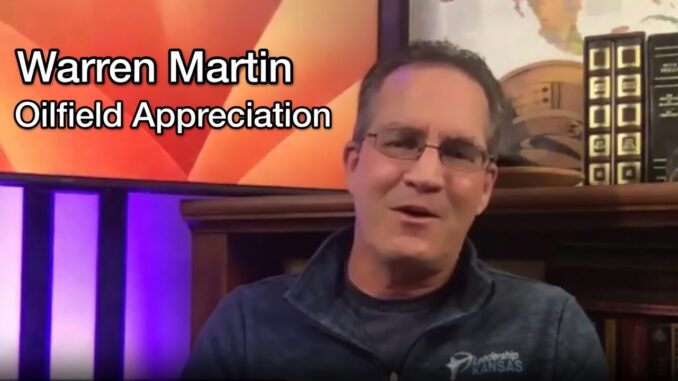

Host Jason Spiess sat down with Warren Martin, Executive Director of Kansas Strong, to discuss the vital role of the oil and gas industry, the importance of grassroots advocacy, and upcoming events celebrating the people who keep energy flowing.
The conversation opened with Martin outlining Kansas Strong’s busy spring schedule: school visits, radio interviews, corporate speaking engagements, and two major mid-year events for Kansas oil and gas associations.
He highlighted the KIOGA Mid-Year Meeting in Garden City and the EKOGA Mid-Year in Chanute, noting that Kansas Strong plays a prominent educational role at both.
A central theme was the Oilfield Workers Celebration events, designed specifically for the men and women doing the day-to-day work on rigs, pumping units, trucks, and in support roles—often overlooked compared to producers and executives.
These free gatherings offer a meal, drinks, over $4,000 in raffle prizes, and—most importantly—a motivational message that reframes the industry’s contributions.
Martin addressed the lingering “Oil Field Trash” sticker culture head-on. He argued that while the work is dirty and demanding, it delivers outsized value: providing more than 56% of the world’s energy and the petrochemical building blocks for 96% of the man-made objects people touch daily.
The celebrations aim to instill pride by showing workers how their labor betters communities, the state, the nation, and global human lives—countering decades of environmental narratives that have dominated public discourse.

Spiess and Martin reflected on the “context war” and persistent negative framing of the industry. They referenced the 37th anniversary of the Exxon Valdez spill (March 24, 1989), noting how media and pop culture (from Dawn dish soap commercials to movies like Mad Max) still emphasize the disaster while rarely highlighting the safety innovations, double-hull tankers, advanced remediation techniques, and environmental technologies that emerged from it.
The pair stressed that the oil and gas sector has invested heavily in remediation and is among the most regulated industries, often restoring sites to better-than-before conditions—yet these successes receive little attention.
The discussion broadened to innovation and humanity’s dependence on petroleum products. Martin recounted how early refiners once discarded volatile gasoline; today, virtually every molecule is used efficiently.


Martin drew parallels to the AI-driven energy demand surge, noting that tech leaders (even some former climate advocates like Bill Gates) are shifting focus from emissions metrics to practical energy production to support data centers, technology growth, and a growing global population.
Both speakers emphasized the need for internal education within the industry—from roughnecks to CEOs.
Martin warned of a coming “great shift change” as veteran workers retire, taking deep institutional knowledge with them after a decades-long gap in new talent caused by negative messaging.
Martin also urged everyone in the sector to understand not just their specific role but how it fits into the bigger picture of energy, products, poverty reduction, and human progress.
Spiess shared personal analogies from agriculture and small business, underscoring how society often takes foundational industries for granted once conveniences (grocery stores, light switches) replace direct awareness of their sources. Martin reinforced that real pride comes from feeling both appreciated and important—exactly what the Oilfield Workers Celebrations aim to deliver.

Looking ahead, the first Oilfield Workers Celebration is set for April 10, 2026, in Great Bend at the Kansas Oil and Gas Museum (5:30–8:30 p.m.).
The second will coincide with the EKOGA Mid-Year on May 7, 2026, in Chanute. Both are free for oilfield workers (field and office) and a guest; RSVPs are requested for planning. Details and registration are available at kansasstrong.com.
The interview closed on an optimistic note: with rising energy demands from AI and population growth, plus cultural touchpoints like the series Landman, there’s a timely opportunity to shift the narrative.


Martin and Spiess encouraged industry members to educate themselves deeply and then share that knowledge—connecting everyday interests (gaming systems, art supplies, clothing, transportation) back to the indispensable role of oil and natural gas.
As Martin put it, the goal isn’t just to defend the industry but to help workers see themselves as essential contributors to a better world—dirty hands included.
For more on Kansas Strong’s mission and events, visit kansasstrong.com.
The Crude Life Content Network
Primary Website
Follow on YouTube
Follow on Facebook
- The Crude Life Facebook Page
- Eagle Ford Texas Facebook Page
- Bakken.com Facebook Page
- Haynesville Facebook Page
- Marcellus Facebook Page
- Niobrarachalk Facebook Page
- PermianShale Facebook Page
Follow on LinkedIn
- The Crude Life LinkedIn
- The Founder of The Crude Life – Jason Spiess LinkedIn
The Crude Life has been a trusted brand pioneering energy content for 15 years — from the very first podcast in 2011 to today’s full-spectrum content company producing podcasts, video interviews, print features, radio news, social media campaigns, Substack editorials, live events and more.
Trusted Interviews. Industry Experts.


