
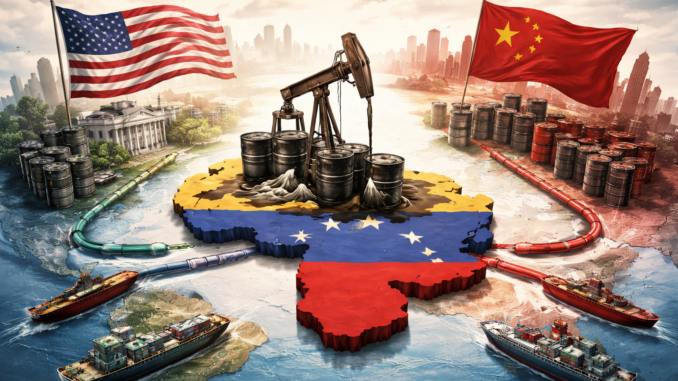
For years, Venezuela’s oil story has been framed as one of collapse: broken infrastructure, sanctions, corruption, and a state oil company hollowed out by politics. But in early 2026, that story shifted. Not because Venezuela suddenly changed—but because Washington did.
Two pieces of reporting tell the deeper story. Axios revealed the political theater unfolding between President Trump and ExxonMobil. Visual Capitalist showed the hard reality behind that theater: who actually buys Venezuela’s oil, and who controls its economic oxygen.
Together, they paint a picture of oil not as a commodity, but as a geopolitical steering wheel.
When Politics Met Petroleum
According to Axios, President Trump openly criticized ExxonMobil after CEO Darren Woods described Venezuela as “uninvestable.” Trump went further, saying he was “inclined to keep Exxon out” of U.S.-led plans to revive Venezuela’s oil industry.
That is a remarkable statement.
Exxon is not just another oil company. It is the largest Western oil corporation in the world. It is usually the company governments want at the table because of its capital, engineering power, and long-term project discipline. But Exxon is also famously conservative. It does not chase political experiments. It wants rule of law, stable contracts, and enforceable property rights.
Woods wasn’t making a political statement. He was stating a risk assessment:
Venezuela has expropriated foreign assets before.
Contracts have been rewritten overnight.
Legal protections remain uncertain.
Payment systems are unstable.
Governance is still unresolved.
From a business standpoint, “uninvestable” is not an insult. It is a balance-sheet conclusion.
Trump’s response, however, reframed the issue. He suggested U.S. companies would invest anyway. He hinted that investment might be structured through the U.S. government rather than Venezuelan institutions. And he implied that loyalty, not caution, would determine which companies get access.
That is not market economics.
That is political allocation of energy opportunity.
The Visual Capitalist Reality: Venezuela Already Has Two Masters
Now look at the Visual Capitalist data.
In 2023, Venezuela exported roughly 211 million barrels of crude oil. More than 90% of that oil went to just two countries: China and the United States.
This is not diversification.
This is dependency.
China has been Venezuela’s lifeline for years. Through oil-for-loans agreements, shipping networks, and opaque trading channels, China absorbed massive volumes when Western sanctions tightened. Much of that oil never appears clearly on balance sheets. It moves quietly through intermediaries.
The United States, despite sanctions and political hostility, remains uniquely positioned to use Venezuelan oil. Gulf Coast refineries are physically built to handle Venezuela’s heavy crude. That gives the U.S. something China does not have: immediate industrial compatibility.
So Venezuela’s oil world is not global.
It is bilateral.
And whoever controls access to those two doors controls Venezuela’s survival.
Why Exxon’s Absence Matters
If Trump sidelines Exxon, it sends a signal far beyond Venezuela.
It tells markets:
Investment is now political.
Risk discipline is negotiable.
Obedience may matter more than experience.
That is dangerous territory.
Exxon’s refusal is actually a stabilizing force. It says:
We will return when the rules are real.
We will invest when contracts are enforceable.
We will not gamble shareholder capital on political hope.
Removing that voice doesn’t make Venezuela more investable.
It makes investment more fragile.
It also creates space for smaller, more politically aligned operators who may accept higher risk for faster access. That can accelerate production in the short term—but it often destabilizes governance in the long term.
The Strategic Subtext: This Isn’t About Oil. It’s About Control.
Combine Axios and Visual Capitalist, and a new story emerges:
The U.S. isn’t just trying to revive Venezuela’s oil.
It’s trying to redirect it.
China currently dominates Venezuela’s exports.
Trump’s posture suggests a desire to pull that gravity back toward Washington.
Not through diplomacy.
Through allocation.
If the U.S. controls which companies can operate, which exports are licensed, and where revenue flows, it becomes the financial gatekeeper of Venezuela’s recovery.
That is not reconstruction.
That is realignment.
Energy Without Demonization
This isn’t about oil being good or bad.
Oil is infrastructure.
Oil is heat.
Oil is transport.
Oil is industrial oxygen.
The problem isn’t energy.
It’s who gets to decide who touches it.
Venezuela’s oil future now sits at the intersection of:
Political loyalty,
Corporate caution,
Geopolitical rivalry,
And economic survival.
Exxon’s hesitation represents institutional memory.
Trump’s push represents political urgency.
China’s dominance represents long-term positioning.
And Venezuela?
It remains caught between buyers, not in control of its own market.
The Quiet Question
Visual Capitalist shows us where the oil goes.
Axios shows us who gets to decide who moves it.
The question isn’t whether Venezuela is investable.
The question is whether investment itself is becoming a political weapon.
And once energy becomes a reward for alignment rather than a product of stability, the market stops being a market at all.

