
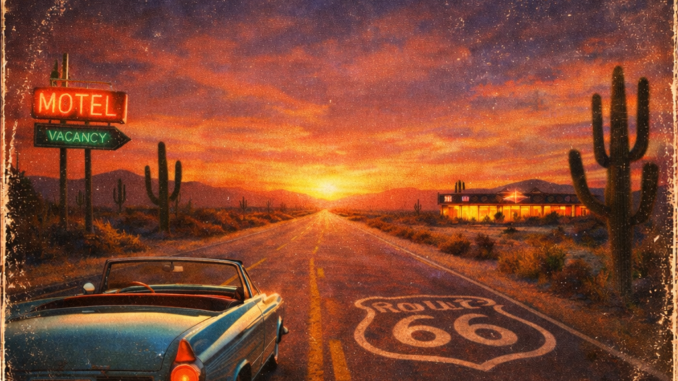

Route 66 Was Never Meant to Be Famous
When U.S. Route 66 was commissioned in 1926, it wasn’t designed to be remembered.
There were no grand dedications, no monuments planned, no expectation that the road would one day appear on postcards, license plates, coffee mugs, or tattoos. Route 66 was not a dream. It was a solution. A line drawn through geography to fix a problem that had nothing to do with romance and everything to do with movement.
America needed a road that worked.
In the early twentieth century, the country was expanding faster than its infrastructure. Railroads still dominated long-distance travel, but cars were no longer novelties. Trucks were replacing wagons. Farmers needed access to markets. Manufacturers needed reliable shipping routes. Oilfields were producing equipment that had to move across states, not just counties. Mail had to arrive on time. People had places to go.
Route 66 was commissioned to connect existing roads into something continuous and usable. It linked the Midwest to the Southwest and onward to the Pacific. It connected Chicago to Los Angeles not because it was scenic, but because it made logistical sense. The route stitched together towns that already existed, roads that were already there, and industries that were already operating — agriculture, manufacturing, mining, oil, and trade.
There was nothing poetic about it.
The early maps treated Route 66 like a utility. It wasn’t even the most direct route in many places. It zigzagged to accommodate terrain, rail connections, population centers, and political realities. Some sections were paved. Others were gravel or dirt. In bad weather, the road could become impassable. But it existed, and that was the point. It worked well enough to move people and things, which was all anyone asked of it.
No one in 1926 thought they were creating a cultural artifact.
And yet, almost immediately, people began to use Route 66 for reasons that had nothing to do with efficiency.
Families took it west looking for work. Farmers took it east with goods to sell. Salesmen took it town to town with samples in their trunks. Migrants fleeing dust and drought followed it toward possibility. Soldiers rode it between bases. Musicians used it to chase gigs. Travelers used it simply because it was there — a line that promised continuity in a country that often felt disconnected.
Route 66 became the road people took when they were leaving something behind.
That is where the legend began.
Not with tourism boards or advertising campaigns, but with repetition. The same road, driven again and again by different people with different reasons, until it accumulated meaning. Gas stations appeared because cars needed fuel. Motels appeared because people needed sleep. Diners appeared because travelers needed food. Neon appeared because businesses needed to be seen at night.
None of it was planned as culture. It was all reaction.
Route 66 didn’t create these things; it allowed them. It provided the thread that let individual decisions become a collective experience. Over time, those decisions stacked up. What began as infrastructure slowly transformed into memory.
That transformation was accidental.
The road didn’t advertise itself as an adventure. It simply didn’t stop. It crossed deserts where silence stretched for miles. It passed through towns where Main Street doubled as highway. It ran alongside rail lines, rivers, and pipelines. It moved through heat and cold, elevation and flatland, abundance and emptiness. It exposed travelers to scale — of land, of distance, of time.
And scale changes people.
Route 66 also revealed something fundamental about America: that function often precedes meaning. The country builds things to solve problems, and only later realizes what those solutions made possible. Roads enable movement. Movement enables stories. Stories eventually become identity.
By the time Route 66 appeared in songs, books, and films, it was already old. It had already done decades of quiet work. The culture arrived late, trailing behind the trucks, the families, and the fuel deliveries that had used the road long before anyone thought to celebrate it.
Even its eventual decommissioning followed this pattern.
When the Interstate Highway System replaced Route 66, the decision wasn’t personal. Interstates were faster, straighter, safer, and designed for modern traffic. They bypassed towns instead of running through them. They prioritized speed over connection. From a planning standpoint, the change made sense.
But something was lost.
The interstates did what they were designed to do — and nothing more. They moved vehicles efficiently, but they didn’t accumulate stories in the same way. They didn’t force stops. They didn’t invite improvisation. They didn’t reward curiosity.
Route 66 had done all of those things by accident.
That is why it survived in memory even after it disappeared from maps. The road wasn’t mourned because it was inefficient; it was remembered because it was human. It allowed mistakes, detours, breakdowns, and discoveries. It required engagement. It asked drivers to pay attention.
In that sense, Route 66 was never famous by intention. It became famous because it allowed people to experience America at a scale that matched their own lives — one tank of gas, one meal, one night at a time.
This book begins there because that distinction matters.
Route 66 is not important because it was old, or long, or iconic. It is important because it worked — and in working, it created space for everything else to happen. The diners, the neon, the music, the roadside oddities, the myths — all of it came later.
The road itself never asked for recognition.
It simply kept going.
And a hundred years later, that may be the most American thing about it.
Next is Chapter Two: It Connected More Than Cities — It Connected Industries
All Energy Has A Purpose and We Are All Energy!
The Crude Life republishes their articles, features and stories online and/or in print under Creative Commons license CC BY-NC-ND 4.0.
Everyday your story is being told by someone. Who is telling your story? Who are you telling your story to?
Email your sustainable story ideas, professional press releases or podcast submissions to thecontentcreationstudios(AT)gmail(DOT)com.
CLICK HERE FOR SPECIAL PARAMOUNT + DISCOUNT LINK


