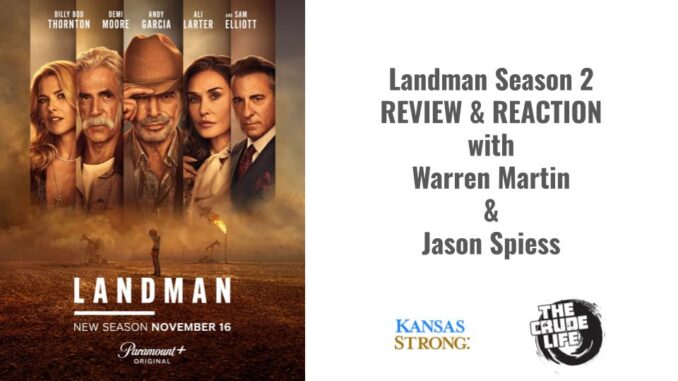

This episode of the Landman Season 2, Episode 7 Review & Reaction podcast plays like a “take-two” editorial meeting that accidentally turns into the real show: not a beat-by-beat recap, but a pressure-test of the series’ credibility—and what it’s teaching non-industry viewers through word choice.
Jason Spiess of The Crude Life and Warren Martin with Kansas Strong open with the immediate, lived-in reality of modern dependence on connectivity—cell service failures, logistical snags, and the speed at which “disconnected” becomes a real-world handicap. That small opening lands as more than small talk, because it tees up the bigger theme the episode returns to again and again: language is the hinge point between entertainment and public understanding. In that sense, the most valuable “recap” of Episode 7 isn’t the plot. It’s the impact.
Episode Seven becomes a case study in how Landman Season 2 has shifted from “industry texture” to “relationship engine.” The conversation centers on three tracks:
- oil-and-gas terminology and accuracy (wildcatting, blowout, “fracking” as a catch-all),
- the show’s boardroom/gambling vibe—where the “risk” is increasingly corporate and legal rather than geological, and
- social dynamics: favoritism, workplace romance, and how family chaos becomes the show’s main fuel.
Along the way, real-world reference points (Bakken “farming,” core libraries, proven vs. known reserves) are used to separate dramatic shorthand from operational reality—and to explain why those differences matter beyond the screen.
The strongest critique isn’t “they got it wrong”—it’s how they got it wrong, and why that matters
The sharpest analysis treats “blowout” and “wildcatter” the way the public treats “fracking”: as loaded words that become narrative shortcuts. Martin’s point that a blowout is an uncontrolled release of hydrocarbons—and that the episode’s “spraying water” explanation doesn’t line up—lands because it’s not nitpicking for ego. It’s about how audiences form mental models.
When a show swaps precision for vibe, it trains viewers to treat the entire industry as a casino: big bets, dumb luck, inevitable catastrophe. The podcast pushes back on that framing—not merely the plot mechanics—because this kind of shorthand doesn’t stay inside a TV season. It becomes dinner-table vocabulary. It becomes high school speech vocabulary. It becomes civic vocabulary.
Season 1, in their view, made a visible effort to show practical, everyday work in a way that allowed people in the business to say, “Yeah, that’s close.” Season 2, by contrast, leans harder into charged terminology as atmosphere—then builds emotional stakes on that atmosphere. The critique is simple: if the show wants to use industry language, it should use it responsibly, because the language itself is part of the story being sold.

Episode 7 may be “slow,” but it functions like a bridge episode that lays track for a corporate scandal arc
Episode 7 is compared to “The Fly” from Breaking Bad: not everybody’s favorite, but structurally important. The conversation keeps circling one big idea: the real gamble isn’t drilling—it’s executive behavior, leverage, and incentives.
Modern upstream, in this framing, is often closer to managed systems and probability than mythic wildcat chaos. The show, however, appears determined to dramatize risk in ways that point toward insurance games, financial engineering, and eventually a “tragedy” payoff—especially with the season finale title hanging out in the open: “Tragedy and Flies.” Even if the series never fully cashes that check, the reaction episode helps listeners see the architecture: the “oil plot” is a conduit for a bigger story about governance, compliance, and human weakness.
That’s where the proven vs. known reserves discussion becomes more than a classroom sidebar. It functions as a reminder that definitions shift—sometimes because of economics, sometimes because of law, sometimes because of politics—and those shifts shape everything from financing to headlines to public perception. In other words: words don’t just describe the industry. Words move the industry.
A difficult needle gets threaded: defending the industry’s purpose without pretending bad behavior doesn’t exist
Martin draws a blunt line between oil-and-gas value creation and cartel extraction. Spiess keeps that point grounded by immediately acknowledging the uncomfortable elements that exist “in every industry”: favoritism, flirtation intersecting with contracts, access gained through proximity, and the quiet ways organizations rationalize ethical gray zones until they can’t.
That’s why the “Charles to Charlie” moment becomes a useful signal flare. It’s a small lie that implies a larger posture—testing boundaries, establishing a pattern, seeing what gets challenged and what slides. The analysis frames it as a story about how deception starts, how it gets normalized, and what happens when a character like Neil/Nate—the “vanilla” stabilizer—refuses to let it pass without friction. That’s classic editorial storytelling: tiny detail, big implication.
Other topics of note
One of the most relatable detours is the company-vehicle discussion—how perks become invisible, how logos on doors turn personal errands into corporate liability, and how a single scene (kicking rocks, emphasizing the company emblem) can be read as foreshadowing. It’s a smart “industry reality” insert because it’s the kind of thing viewers don’t think about—until they do—and then they can’t unsee it.
The commentary on the show’s portrayal of women is also handled carefully. A concern is raised that the show risks making female characters look simplistic—“one-line answer” people—while Martin counters with lived experience: women in Kansas oil and gas are often among the most detailed, demanding, high-performing professionals in the business. That exchange critiques the writing choice without turning it into a culture-war segment, and it keeps the focus where it belongs: on realism and responsibility.
Finally, the family-dynamic section gives the show credit where it earns it. Even while Angela is labeled “nauseating” (and the acting is credited for pulling that off), the analysis recognizes the narrative function: chaos in the home reshapes everything, and Landman nails how one person moving into a household changes the emotional weather instantly. It’s also where the “Sam Elliott as emotional jar / sacrificial weight” theory feels plausible, because the series keeps placing small foreshadowing beats around his health and fatigue.
Conclusion
As a review, this reaction podcast succeeds because it refuses to let Landman Season 2 coast on vibes. Episode 7 is treated like a language audit: what the show says about the industry, what it implies about the people in it, and how those two things ripple outward when millions of non-industry viewers absorb the shorthand.
The result is less “recap” than “course correction”—and in that sense it delivers on the purpose stated near the end of the conversation: if this series is going to be one of the bigger platforms shaping the next generation’s perception of oil and gas, then somebody has to keep the terminology honest, the incentives visible, and the humanity intact.

CLICK HERE FOR SPECIAL PARAMOUNT + DISCOUNT LINK
Here’s the full schedule for Landman Season 2:
- Nov 16, 2025: Episode 1, “Death and a Sunset”
- Nov 23, 2025: Episode 2, “Sins of the Father”
- Nov 30, 2025: Episode 3, “Almost a Home”
- Dec 7, 2025: Episode 4, “Dancing Rainbows”
- Dec 14, 2025: Episode 5, “The Pirate Dinner”
- Dec 21, 2025: Episode 6, “Dark Night of the Soul”
- Dec 28, 2025: Episode 7, “Forever Is an Instant”
- Jan 4, 2026: Episode 8, “Handsome Touched Me”
- Jan 11, 2026: Episode 9, “Plans, Tears and Sirens”
- Jan 18, 2026: Episode 10, “Tragedy and Flies” (Season Finale)
All Energy Has A Purpose and We Are All Energy!
The Crude Life republishes their articles, features and stories online and/or in print under Creative Commons license CC BY-NC-ND 4.0.
Everyday your story is being told by someone. Who is telling your story? Who are you telling your story to?
Email your sustainable story ideas, professional press releases or podcast submissions to thecontentcreationstudios(AT)gmail(DOT)com.
CLICK HERE FOR SPECIAL PARAMOUNT + DISCOUNT LINK


