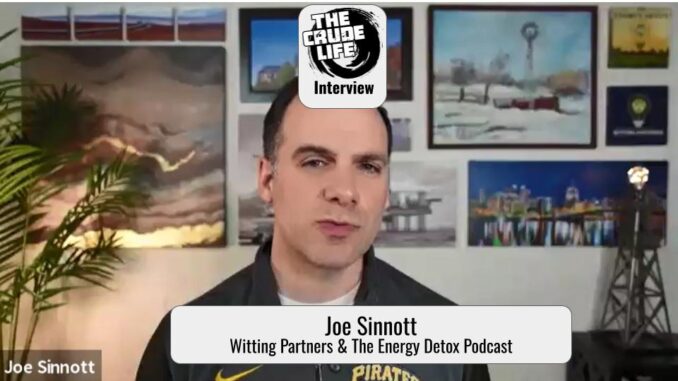

Holiday parties are supposed to be the easy win on the calendar: show up, shake a few hands, toast the year, disappear before the karaoke starts. But in this conversation, Jason Spiess, The Crude Life, and executive coach Joe Sinnott, Witting Partners, treat the season like what it really is for most professionals—an annual live-fire exercise in communication, perception, and long-game career strategy.
What starts as a playful run through “do’s and don’ts” turns into a surprisingly practical mini–leadership clinic: how to manage your words, your presence, your image, and your impulses when the room is loud, the guardrails are looser, and everybody’s watching (including the “extra set of eyes and ears”—spouses and guests).
Joe Sinnott is an executive coach based in the Pittsburgh area with deep proximity to the Marcellus and the broader energy professional ecosystem. His work, as he frames it, is “people helping people deal with people problems”—regardless of commodity prices, M&A cycles, or the political/regulatory weather.
Jason Spiess steers the conversation with a mix of holiday-season realism and blue-collar-to-boardroom instincts, using the holiday party as a metaphorical crossroads: it’s casual, but it’s also an unusually high-visibility moment where impressions form fast and last longer than they should.
The first segment centers on holiday party conduct—attendance, mingling, wardrobe choices, gossip traps, positivity, and “landmines” like flirting or crossing boundaries. The second half shifts into a year-in-review and what’s ahead for 2026, including Sinnott’s work across private workshops and his “Landman Leadership Workshop,” which uses the Paramount+ series Landman as an engaging lens for leadership and communication lessons inside oil and gas culture.
The close-out drifts into a sports-meets-leadership teaser: a future conversation about Steelers coach Mike Tomlin and the leadership conundrum of being consistently “good” in a world that only celebrates “great.”
Showing up isn’t about staying late—it’s about signaling maturity and control.
One of the simplest rules in the list is “Do attend,” and Sinnott reframes it with a leadership angle that applies year-round: you don’t need to be all-in on every event, but you do need to be present enough to contribute and be seen contributing. The real point is boundaries and intention. You can arrive, make a genuine connection or two, add value to the atmosphere, and exit without becoming the center of attention or the last one standing. That “show up and bow out” strategy is a quiet form of executive presence—especially for the type of hardwired high-performer who thinks everything must be 110% or nothing.
The best party survival skill is a question—because it puts a governor on your mouth.
The conversation’s most memorable coaching tool is also the most practical: when the room gets risky, ask a question. Sinnott’s logic is blunt and funny but dead accurate—anything that slows the flow of words from your mouth helps. A good question buys time, redirects attention, and keeps you from drifting into politics, gossip, or the kind of “diarrhea of the mouth” that feels harmless in the moment and expensive the next morning. Spiess adds a classic field-tested workaround—keep your hands occupied (his vote: cocktail wieners) to create a natural pause button. It’s comedy, but it’s also behavioral strategy: reduce your verbal momentum and you reduce your liability.
“Be positive” doesn’t mean fake it—it means prepare your tone and practice a pivot.
Spiess points out the modern risk: forced positivity can backfire when people are stressed, prices feel higher, and tolerance is lower. Sinnott answers with a subtle reframe: preparation isn’t inauthentic; it’s professionalism. If you know you’ll get asked “How are you doing?” and you know your default mode is cynical, plan three honest, grounded positives ahead of time so you don’t improvise something bitter. Then comes his favorite on-the-fly pivot tool: “What I like about it…” Even when the news is genuinely negative—price dips, consolidation, job-loss chatter—you can acknowledge reality without being dragged into the ditch. You’re not celebrating the problem; you’re identifying a potential upside, a lesson, or a useful angle. It’s a mental gearshift that keeps conversations productive and keeps your reputation out of the rumor mill.
Dress as strategy, not costume.
The “dress appropriately” segment goes beyond collars vs. ugly sweaters. Sinnott emphasizes discretion: if you deviate from your usual look, do it knowingly and understand how it will be interpreted—refreshing confidence versus attention-seeking. Spiess adds a sharp career move for energy professionals: the holiday party can be a low-risk stage to “dress for the job you want,” especially for someone trying to move from field to office, operations to management, or into a more visible role. The key is pairing the upgrade with humor, so you can own it without seeming like you’re auditioning.
Gossip is reputation debt with interest.
Sinnott is unequivocal here: “no good is gonna come from that,” especially in a mixed crowd where spouses or guests are listening differently and will relay what they hear. The point isn’t moral purity—it’s practicality. In a company ecosystem, being labeled “a gossip” is a sticky brand, and holiday parties are where that label forms fastest.
The “landmine” topic: boundaries and the long game.
When the list touches flirting and romantic moves, Spiess calls it what it is: a charged gray area, especially when alcohol is involved. Sinnott’s response is cautious and strategic: play the long game. If someone is tempted to cross that line at the party, it’s often more powerful to wait and approach it later, in a clearer context, rather than forcing a high-risk moment in a high-visibility setting.
Year-in-review: the energy backdrop changes; people problems don’t.
When Spiess asks what “changes” in coaching from year to year, Sinnott lands on his core thesis: regardless of prices, M&A, regulation, or data center chatter, the work is still communication, team temperature, clarity, confidence, and presence. That’s his 2025 in a sentence—and his 2026.
Landman Leadership Workshop: using pop culture to make tools deployable.
Sinnott explains his workshop concept: take scenes, characters, and themes from Landman and translate them into leadership skills—communication, decision-making, confidence under pressure, and keeping cool in precarious situations. His benchmark is practical deployment: tools only matter if people can use them in the moment, not flip through a book when the “cartel” is at the door. Spiess adds that Season 2 (and beyond) leans even harder into interpersonal dynamics—power struggles, old school vs. new school, leadership tension—making it even richer material for training.
A teaser worth keeping: Mike Tomlin and the leadership problem of the middle.
The closing sports detour is more than banter. Spiess frames a leadership case study: what happens when someone is consistently above .500 for nearly two decades, yet the culture still questions their value because they aren’t delivering the ultimate prize every year? They agree to revisit it as an executive coaching conversation—how leaders survive (or don’t) when they’re stuck in the “good but not celebrated” zone.
Conclusion
This episode works because it treats the holiday party like the real world: informal on the surface, intensely reputational underneath. Spiess brings the everyday realism—how people actually behave, how careers actually move, how impressions actually form. Sinnott brings coaching tools that aren’t fluffy: ask questions to control your mouth, prepare positivity so it stays authentic, use humor as a pressure valve, and play the long game when the moment is trying to bait you into a mistake.
By the time they’re talking Landman workshops and Mike Tomlin quotes, the through-line is clear: leadership isn’t a title or a speech—it’s how you show up when the room is relaxed and the stakes are quietly high. The standard is the standard, even when the playlist is Christmas music and your best move is grabbing another cocktail weenie.
All Energy Has A Purpose and We Are All Energy!
The Crude Life republishes their articles, features and stories online and/or in print under Creative Commons license CC BY-NC-ND 4.0.
Everyday your story is being told by someone. Who is telling your story? Who are you telling your story to?
Email your sustainable story ideas, professional press releases or podcast submissions to thecontentcreationstudios(AT)gmail(DOT)com.
CLICK HERE FOR SPECIAL PARAMOUNT + DISCOUNT LINK


