
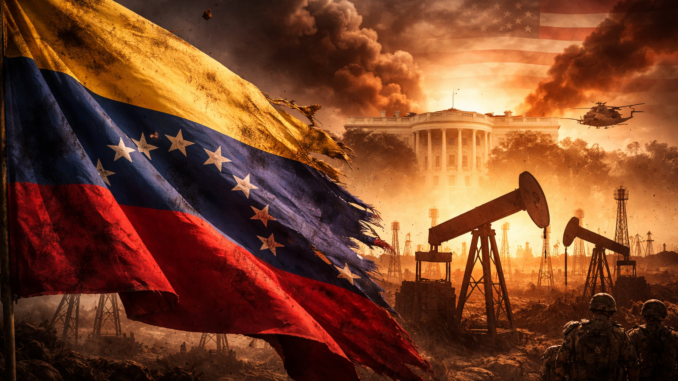
As U.S. military action in Venezuela reverberates through global energy markets, major news outlets are framing the unfolding “oil war” through sharply different lenses — markets, geopolitics, infrastructure reality, and long-term leverage. Taken together, these accounts reveal not just what’s happening in South America, but how energy power is being re-priced worldwide.
What Financial Times Is Saying
The Financial Times focuses squarely on market reaction and investor psychology. Its reporting notes that oil prices edged higher following U.S. strikes in Venezuela, driven less by immediate supply disruption and more by renewed uncertainty surrounding one of the world’s most resource-rich oil states.
The paper emphasizes that Venezuela currently contributes less than 1% of global oil production, meaning the short-term impact on supply is limited. However, it repeatedly underscores Venezuela’s outsized importance in reserve terms, holding roughly 17% of the world’s proven oil reserves. In that context, FT frames the conflict as a long-term strategic signal rather than a near-term supply shock.
FT also highlights that U.S. oil company shares rose, reflecting investor speculation that future access to Venezuelan oil — if political conditions stabilize — could represent a major upside opportunity. At the same time, OPEC+ is portrayed as unmoved, holding firm on existing production plans and signaling that the cartel does not view Venezuela as an immediate supply wildcard.
Bottom line: The Financial Times treats the oil war as a markets-first story, driven by expectations, capital flows, and long-range resource positioning rather than barrels lost today.
What CNN Is Saying
CNN’s coverage zeroes in on the practical reality on the ground. While acknowledging Venezuela’s enormous oil reserves, CNN repeatedly stresses that the country’s oil industry is broken, hollowed out by years of sanctions, mismanagement, and infrastructure decay.
Rather than focusing on oil prices, CNN frames the U.S. move as a logistical and political challenge. Analysts quoted by the network argue that even with regime change or U.S. oversight, Venezuela’s oil sector would require years of rebuilding and tens of billions of dollars before production could meaningfully increase.
CNN also emphasizes investor caution. U.S. energy companies, the network reports, remain wary after decades of nationalizations, contract uncertainty, and political risk. The message is clear: possessing reserves does not equal producing oil — and seizing oil assets does not automatically create supply.
Bottom line: CNN frames the oil war as a reconstruction problem, warning that bold rhetoric will collide with hard industrial reality.
What Reuters Is Saying
Reuters widens the lens beyond South America, positioning Venezuela as one theater in a much larger global energy confrontation. Its reporting ties U.S. action in Venezuela directly to Washington’s pressure campaign against Russian oil — particularly through tariff threats aimed at India for continuing to buy discounted Russian crude.
In Reuters’ telling, the oil war is not about Venezuela alone but about forcing realignments in global crude flows. By threatening steep tariffs, the U.S. is attempting to squeeze Russian revenue while simultaneously positioning Western-aligned oil sources — including a future Venezuelan supply — as alternatives.
Reuters highlights that India has not fully exited Russian oil purchases, placing it in what analysts describe as a strategic gray zone. This underscores the broader message: energy policy is now being wielded as trade enforcement and geopolitical leverage.
Bottom line: Reuters presents the conflict as energy geopolitics by other means, with Venezuela, Russia, and India all connected in a single pressure campaign.
What CBS News Is Saying
CBS News centers its coverage on scale and stakes. Its reporting repeatedly returns to Venezuela’s status as the holder of the world’s largest proven oil reserves — roughly 303 billion barrels — while stressing how far current production has fallen from historic highs.
CBS balances Trump administration statements about rebuilding Venezuela’s oil industry with sober assessments from analysts who say any revival would take years, massive capital, and political stability. Like CNN, CBS emphasizes that near-term oil price impacts are likely limited, even as the long-term implications remain enormous.
Where CBS stands out is in its focus on public understanding, framing the question as: What does Venezuela’s oil actually mean for U.S. consumers, global prices, and energy security?
Bottom line: CBS frames the oil war as a resource paradox — vast potential constrained by time, money, and political risk.
The Common Thread
Across outlets, one theme is unmistakable: this is not a traditional oil shock. No one is forecasting immediate supply collapse or runaway prices. Instead, the coverage reveals an energy system increasingly shaped by alignment, control, and future optionality.
Markets are reacting to possibility. Governments are acting on leverage. And the oil itself — vast, buried, and difficult to access — remains largely where it is.
In that sense, the oil war in South America is less about barrels today and more about who controls tomorrow’s energy chessboard.
All Energy Has A Purpose and We Are All Energy!
The Crude Life republishes their articles, features and stories online and/or in print under Creative Commons license CC BY-NC-ND 4.0.
Everyday your story is being told by someone. Who is telling your story? Who are you telling your story to?
Email your sustainable story ideas, professional press releases or podcast submissions to thecontentcreationstudios(AT)gmail(DOT)com.
CLICK HERE FOR SPECIAL PARAMOUNT + DISCOUNT LINK


