
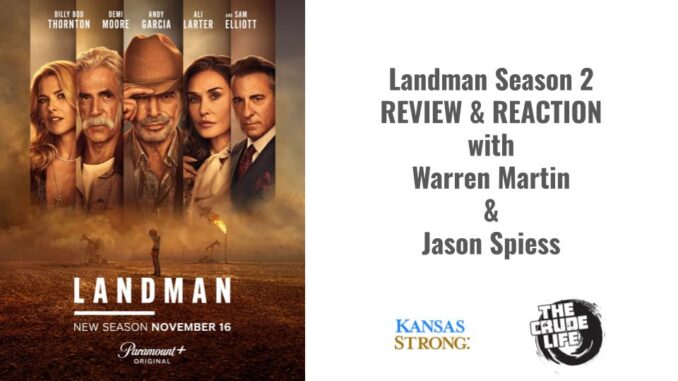

This episode review plays less like a “what happened in the patch” recap and more like a relationship-and-power decoder ring. Jason and Warren keep circling the same idea from different angles: Landman is shifting from oilfield spectacle into character mechanics—who controls whom, who’s bluffing, who’s cornered, and who’s quietly building leverage.
The episode’s real headline: “the script flips”
Warren’s strongest observation lands early: the show turns itself inside out. The “craziest” characters suddenly feel like the only ones functioning, while the people who should be the stabilizers are the ones acting unhinged. The pirate dinner—supposed to be the title moment—becomes mostly a setup device, a way to show an oddly “successful” Angela moment without letting her chaos dominate the whole runtime.
Jason agrees, but adds a producer’s lens: the dinner is less the event than the emotional temperature it creates—over-the-top pageantry that still lands in “happy family values,” with Sam Elliott’s character unexpectedly becoming a steadying center instead of a burden.
CLICK HERE FOR SPECIAL PARAMOUNT + DISCOUNT LINK

Is this season written “more for women”?
Jason plants this flag early and keeps returning to it: fewer oilfield set pieces, more interpersonal storylines, more emotional pacing. Warren pushes back a bit, especially around the trope of “young women invigorate old men,” which he calls out as something that can miss the mark for women viewers. Jason counters that Sam Elliott’s presence (and the neighbor’s obvious flirt-energy) is absolutely written to appeal to women—right down to the self-aware emphasis on the “Sam Elliott voice.”
Net-net: they don’t fully agree on the target demo, but they do agree the show is leaning harder on relationship dynamics than last season.
Best segment: “crisis to restoration” (Tommy & TL)
Warren’s phrase “crisis of restoration” is the most useful concept in the whole conversation. He frames Tommy and TL as headed toward an inevitable blow-up that paradoxically becomes the thing that repairs them—because love/hate sit close together and the pendulum swings until it snaps.
Jason riffs with his own parallel: the fine line between love and control, and then zooms out into narrative framing (the “half full / half empty / there’s 6 ounces” journalism analogy). It’s a good reminder that this review series isn’t just fandom—it’s media literacy with oilfield boots on.
CLICK HERE FOR SPECIAL PARAMOUNT + DISCOUNT LINK

Cooper + Ariana: respect, money, and the “meet the father” test
Warren points out the repeating mistake: Tommy does what Cooper did—throws money at Ariana—and it reads as disrespect, like she’s a charity case. That becomes a quiet but important character tell: Ariana wants agency more than rescue, and the men keep trying to “solve” her with cash.
Then Warren connects hard with the scene where Cooper meets Ariana’s father—because it mirrors how he handled three future sons-in-law: not permission to marry, permission to ask, because the daughter decides. That’s one of the most grounded, human moments of the whole review.
Jason adds an edge: the father’s “test” language can be interpreted as a control dynamic—Ariana testing whether Cooper will comply—hinting she could slide toward Angela-style manipulation if the writers choose that route.
The cartel deal: morality vs regulation vs reputation
This is where the review gets genuinely sharp. Jason’s take: Tommy’s primary driver isn’t just “cartel bad,” it’s government finding out—regulation anxiety outranking moral disgust.
Warren reframes it as Tommy being trapped by Cami’s impossible demand: protect her husband’s reputation and do business with a cartel-linked figure. Tommy tries to use “the government” as the excuse to avoid the deal, but Cami steamrolls him: you’ll do it anyway.
Then they tag-team Andy Garcia’s character (Galeano/Galliano—name fuzzy, vibe crystal clear): he doesn’t need to force anything; he just has to remind them they’re already indebted. Jason’s Garden of Eden metaphor (snake, forbidden fruit, Adam/Eve choice) is dramatic—but it fits the moral setup the show is building.
CLICK HERE FOR SPECIAL PARAMOUNT + DISCOUNT LINK
The most important “WTF” scene: captive insurance / shell company confusion
This is the sequence that clearly bothered both of them, and it’s also the most “ESG” adjacent part of series.
- Warren: what’s described doesn’t add up. If the money exists in a captive insurance structure and the well was damaged by a hurricane—that’s exactly when insurance money is supposed to be used. So either the money isn’t there, or the explanation is wrong, or someone’s lying.
- Jason: captive insurance itself is normal; the abuse is the issue—turning it into a tax shelter, slush fund/general fund, or liability shield, often with exaggerated risks and few/no real claims paid.
Their shared conclusion: the scene is either intentionally muddy (because TV) or it’s a breadcrumb that Cami’s husband wasn’t as “clean” as the story has implied—especially if the captive never really pays claims and the money has been repurposed.
CLICK HERE FOR SPECIAL PARAMOUNT + DISCOUNT LINK
Oilfield realism check: the sand truck incident
Warren gives the most “industry exact” correction of the episode: speed on lease roads and who sets it (landowner contracts, company CDL policies), plus the basic operational question—why is a sand truck hauling like that without a frack job or relevant equipment present? He’s not nitpicking; he’s showing where the show is choosing drama over logistics.
Jason laughs at the “I’ll put a 65 mph sign up tomorrow” line (and he’s right—it’s a killer line), but also uses it to underline a bigger theme: Tommy increasingly behaves like it’s his company, while Cami keeps reasserting ownership and accountability.
Warren drops a smart “Easter egg” reminder: Tommy once drove his own company into bankruptcy. That’s future ammunition Cami can use when she finally needs to pull rank.
Angela: Emmy-worthy, and also exhausting
Jason loves how real the character feels; Warren calls her shallow—because her “happiness” is really a demand that everyone orbit her mood. The nursing home “birthday” stunt becomes a perfect microcosm: joy as performance, attention as oxygen.
What makes this part work is they aren’t just dunking on a character—they’re diagnosing a type: the social cheerleader who equates “everyone’s happy” with “everyone’s focused on me.”
Final verdict
As a review episode, this is one of your stronger Warren/Jason discussions because it’s doing three things at once:
- Entertainment review (what landed, what flipped, what’s being set up),
- Industry plausibility audit (lease roads, sand trucks, regulators),
- Power-structure analysis (gender dynamics, reputation management, cartel leverage, captive insurance as a “gray zone” tool).
They close on the most important meta-point: Landman is a net positive for the oil and gas conversation simply because it gets people talking—then you can sort what’s real from what’s Hollywood.
CLICK HERE FOR SPECIAL PARAMOUNT + DISCOUNT LINK
All Energy Has A Purpose and We Are All Energy!
The Crude Life republishes their articles, features and stories online and/or in print under Creative Commons license CC BY-NC-ND 4.0.
Everyday your story is being told by someone. Who is telling your story? Who are you telling your story to?
Email your sustainable story ideas, professional press releases or podcast submissions to thecontentcreationstudios(AT)gmail(DOT)com.
CLICK HERE FOR SPECIAL PARAMOUNT + DISCOUNT LINK


