
For decades, Alberta’s underground story has been told in barrels and BTUs — pressure curves, porosity maps, water cuts, decline rates. Now, quietly, that same geology is being asked a different question: What else is dissolved down there?
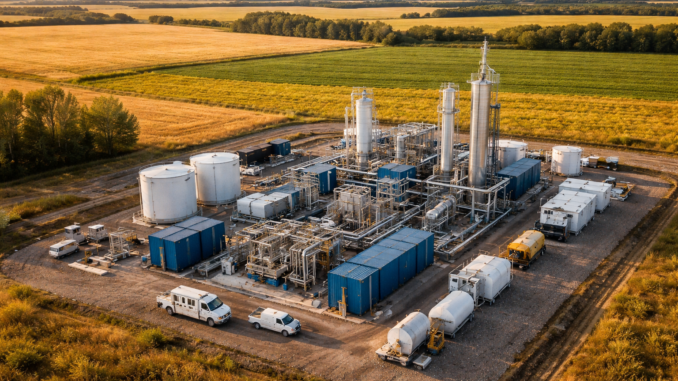
East of Olds, Alberta, a pilot facility operated by E3 Lithium has crossed a threshold that matters. Not symbolically. Practically.
The company’s Clearwater Project has produced battery-grade lithium carbonate using direct lithium extraction (DLE) — pulling lithium from oilfield brines, separating it, and reinjecting the remaining fluid back underground. Phase 1 began in September. Within three weeks, battery-grade material was produced.
That milestone matters — but not for the reason most headlines suggest.
The chemistry worked. The question now is whether the capital will.
Repurposing the Subsurface
DLE is often framed as a new mining revolution. In reality, it looks a lot more familiar to anyone who’s spent time around oilfields.
Brine is pumped from known aquifers. Lithium is extracted. Fluids are reinjected. Reservoir behavior is monitored. Pressure matters. Flow matters. The subsurface still decides what’s possible.
This isn’t a departure from Alberta’s energy past — it’s an extension of it.
Chris Doornbos, E3 Lithium’s CEO, has been careful not to oversell the moment. Producing battery-grade lithium at pilot scale, he says, is a proof point — not a guarantee.
The next phase will require drilling a dedicated production well and an injection well. That work is already familiar territory in the province. What isn’t familiar is the price tag.
A $2.5 Billion Question
The Clearwater Project’s estimated cost is roughly $2.5 billion. To date, E3 Lithium has received $27 million from the federal government and $5 million from the province through Emissions Reduction Alberta.
Helpful? Yes. Decisive? Not even close.
Doornbos is candid about the challenge ahead: assembling the financing package that can move the project from demonstration to decision.
To sharpen its focus, E3 recently announced it will sell non-core assets in Saskatchewan’s Estevan lithium district for approximately $4.29 million, redirecting capital toward Clearwater. The company says the next 12 months will determine whether it reaches a final investment decision, with a goal of being shovel-ready by early 2026 and commercial by 2028.
If successful, the facility would target 36,000 tonnes per year of lithium carbonate, create roughly 200 permanent jobs, and support hundreds more during construction.
That scale matters — but only if investors believe the risk profile is manageable.
Government as De-Risker, Not Builder
At the ribbon-cutting event for Phase 1, Alberta Energy Minister Brian Jean framed lithium as part of the province’s energy future, emphasizing the reuse of mature oil and gas infrastructure.
It’s a familiar strategy.
Government funding isn’t designed to build the plant — it’s designed to de-risk the story just enough for private capital to step in. The same playbook has been used for carbon capture, hydrogen, and advanced fuels.
Lithium now joins that list.
Environmental Promises, Environmental Questions
E3 Lithium says its approach minimizes land disturbance, uses little to no freshwater, and produces lithium ready for battery markets without needing overseas post-processing — particularly in China.
Those claims are appealing. They’re also provisional.
Academic researchers caution that DLE, while promising, has not yet been proven at full industrial scale. Subsurface extraction always carries uncertainties: pressure changes, groundwater flow alterations, long-term monitoring obligations.
As with carbon management and enhanced oil recovery before it, the real environmental story won’t be written during pilot projects — it will emerge over decades of operation.
The Real Test Ahead
Alberta doesn’t lack lithium. It doesn’t lack geology. It doesn’t lack technical expertise.
What it lacks — for now — is proof that direct lithium extraction can attract and sustain multi-billion-dollar investment without creating future liabilities that outlast today’s enthusiasm.
E3 Lithium has demonstrated the chemistry. The province has demonstrated political support. The next chapter belongs to capital markets — and to regulators tasked with ensuring that the subsurface remains as stable tomorrow as it is today.
For Alberta, lithium isn’t a pivot away from energy. It’s a test of whether the province can translate decades of oil and gas knowledge into a new role in the battery economy — without repeating the mistakes that made energy transitions so contentious in the first place.
The brine has spoken. Now the balance sheets have to answer.
Jason Spiess is an multi-award-winning journalist, entrepreneur, producer and content consultant. Spiess, who began working in the media at age 10, has over 35 years of media experience in broadcasting, journalism, reporting and principal ownership in media companies. Spiess is currently the host of several newsmagazine programs that air across a 22 radio stations and podcasts worldwide through podcast platforms, as well as a combined Substack and social media audience of over 500K followers. Connect with Spiess on LinkedIn or Follow his personal professional site Spiess On Earth
All Energy Has A Purpose and We Are All Energy!
The Crude Life republishes their articles, features and stories online and/or in print under Creative Commons license CC BY-NC-ND 4.0.
Everyday your story is being told by someone. Who is telling your story? Who are you telling your story to?
Email your sustainable story ideas, professional press releases or podcast submissions to thecontentcreationstudios(AT)gmail(DOT)com.
CLICK HERE FOR SPECIAL PARAMOUNT + DISCOUNT LINK


