
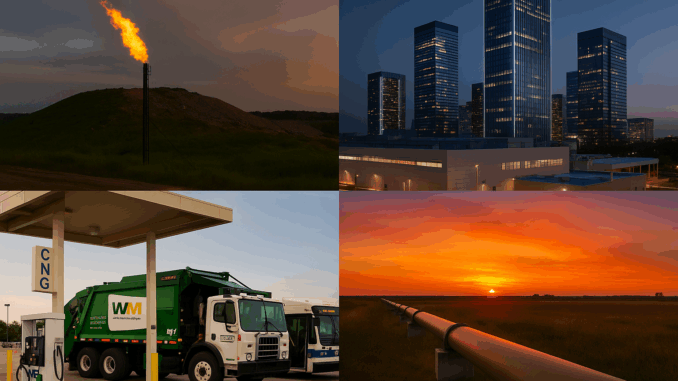
While headlines often chase the newest solar field or battery breakthrough, the week’s most consequential energy stories came from something far less glamorous: methane.
From the landfills of Iowa to the bus depots of Pennsylvania, this colorless gas — once treated as a nuisance — is quietly being re-engineered into a cornerstone of America’s cleaner energy economy.
In five very different states, methane showed its range. It powered new pipelines and data centers, fueled garbage trucks and public transit, and proved that the road to decarbonization may not be as binary as “fossil versus renewable.” Instead, it’s a continuum of innovation — one where legacy infrastructure and new technology intersect in surprising, pragmatic ways.
Here’s what that evolution looked like this week.
1. Eastern Iowa Landfill Turns Waste Into Power
A landfill outside Davenport is now converting methane from decomposing waste into pipeline-ready renewable natural gas (RNG). Operated by Waga Energy in partnership with the Scott County Waste Commission, the facility will inject upgraded gas into MidAmerican Energy’s system, generating over 60 GWh annually — enough to serve roughly 4,000 homes.
The plant is expected to prevent more than 15,000 tons of CO₂-equivalent emissions each year and operate for at least two decades, providing a model for “waste-to-value” circular energy projects across the Midwest.
Source: Radio Iowa
2. South Jersey’s First RNG Pipeline Connection
SJI (South Jersey Industries) and Opal Fuels have launched a renewable natural gas plant at the Atlantic County Utilities Authority landfill in Egg Harbor Township — the first RNG facility to inject directly into SJI’s pipeline network.
Processing 2,500 SCFM of landfill gas, the plant will deliver 650,000 MMBtu per year — equivalent to 4.6 million gallons of gasoline — into South Jersey Gas’s distribution system. A second project in Burlington County is already in planning, marking a scalable model for regional RNG growth.
Source: NJBIZ
3. Waste Management Opens $10 Million CNG Facility in Mississippi
Waste Management opened a $10 million compressed natural gas (CNG) fueling center in Lee County, Mississippi, to support a fleet of 30 regional collection trucks. The company aims to convert its entire fleet to natural gas by 2026.
Each CNG truck displaces about 8,000 gallons of diesel annually, cutting 14 metric tons of GHGs while producing nearly zero particulate emissions. It’s a tangible example of a circular system — collecting waste, capturing gas, and using it to power the trucks that collect the next load.
Source: SuperTalk Mississippi
4. Fermi America & Energy Transfer Partner on Gas-to-AI Power Campus
In Amarillo, Texas, Fermi America has reached an agreement with Energy Transfer to supply natural gas to its 5,236-acre Panhandle clean-energy campus. The site will interconnect to Energy Transfer’s pipeline by early 2026, enabling Fermi to generate 2 gigawatts of reliable power for its AI data-center clients.
CEO Toby Neugebauer framed natural gas as the foundational resource that makes the Panhandle one of the country’s top “clean-energy-ready” sites — bridging fossil reliability with renewable potential.
Source: KFDA News
5. Hazleton, Pennsylvania: The Diesel Era Ends
The Hazleton Public Transit system has officially retired its last diesel bus. Every vehicle in the fleet now runs on compressed natural gas, completing a multi-year transition toward lower emissions, quieter operation, and reduced fuel costs.
While details on fueling infrastructure weren’t disclosed, the move represents a symbolic and operational milestone — a small-city model of how natural gas can serve as a practical bridge to cleaner public transportation.
Source: Standard Speaker
🧩 The Bigger Picture: Methane’s Second Act
Across these five stories — Iowa, New Jersey, Mississippi, Texas, and Pennsylvania — the same theme emerges: methane is no longer just waste or a byproduct; it’s a transitional asset.
Whether captured, compressed, or converted, natural gas and its renewable derivatives are filling the reliability gap between fossil and renewable futures.
For utilities, RNG provides a plug-and-play drop-in fuel for existing infrastructure. For municipalities, it’s a visible sustainability win. For the tech and transport sectors, it’s the bridge fuel that keeps growth powered while the grid modernizes.
The takeaway: America’s “methane moment” isn’t about returning to the past — it’s about re-engineering what we already have to build what’s next.
Jason Spiess is an multi-award-winning journalist, entrepreneur, producer and content consultant. Spiess, who began working in the media at age 10, has over 35 years of media experience in broadcasting, journalism, reporting and principal ownership in media companies. Spiess is currently the host of several newsmagazine programs that air across a 22 radio stations and podcasts worldwide through podcast platforms, as well as a combined Substack and social media audience of over 500K followers. Connect with Spiess on LinkedIn
All Energy Has A Purpose and We Are All Energy!
Everyday your story is being told by someone. Who is telling your story? Who are you telling your story to?
Email your sustainable story ideas, professional press releases or podcast submissions to thecontentcreationstudios(AT)gmail(DOT)com.
CLICK HERE FOR SPECIAL PARAMOUNT + DISCOUNT LINK


