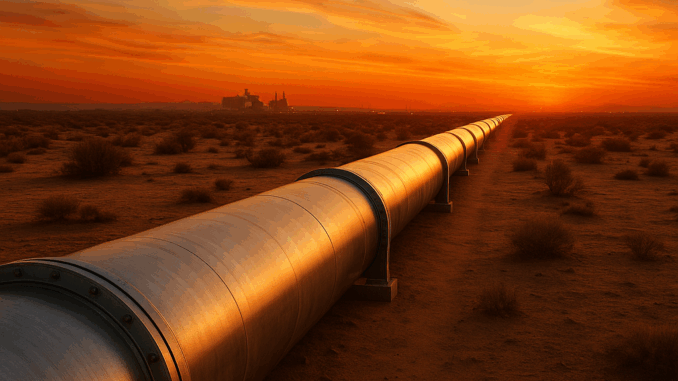
Kinder Morgan’s Mississippi Crossing Project is more than 200 miles of steel in the ground — it’s a test of how energy infrastructure and community dialogue can coexist in a polarized era of energy politics.
The company’s Vice President of Public Affairs, Allen Fore, says that while the pipeline’s economics and engineering are major investments, its success ultimately depends on relationships.
“Communication is really important,” Fore said. “We’ve been doing business in Mississippi for a long time and have thousands of landowners that are part of our systems.”
That emphasis on communication sets the tone for what’s become one of the Southeast’s largest pending energy projects — a $1.7 billion expansion designed to meet growing natural-gas demand across Mississippi, Alabama, and the broader Southeastern market.
The Mississippi Crossing Blueprint
Operated by Kinder Morgan subsidiary Tennessee Gas Pipeline Company (TGP), the Mississippi Crossing Project proposes roughly 206 miles of new pipeline running from Greenville, Mississippi eastward into Choctaw County, Alabama.
The project includes:
- A 42-inch mainline segment across the western portion of the route
- Three new compressor stations
- Four meter stations
- Three over-pressure protection facilities
When complete, the system will add up to 1.5 billion cubic feet per day of new natural-gas capacity into existing Southeast delivery networks such as Southern Natural Gas and Transco.
According to Kinder Morgan, the line’s in-service target is November 2028, pending federal approvals.
The Federal Energy Regulatory Commission (FERC) accepted the project’s formal application on June 30, 2025, assigning Docket Nos. CP25-514-000 and CP25-514-001.
The application followed nearly a year of pre-filing under PF25-2-000, during which Kinder Morgan held open houses, met with county officials, and began early field surveys.
On September 5, 2025, FERC issued its Notice of Intent to Prepare an Environmental Impact Statement (EIS) — officially launching the public-comment window that remains open through October 6, 2025 (5 p.m. ET).
FERC expects to release its draft EIS in January 2026, a final EIS by June 2026, and reach a federal decision deadline in September 2026.
That timeline puts Mississippi Crossing squarely in the national spotlight as one of the first major post-pandemic infrastructure builds to move through the full federal certificate process.
Pipelines, Property Lines, and People
In Neshoba County, where the route stretches across 18 miles and roughly 96 private tracts, Kinder Morgan has already completed survey work and started landowner outreach.
Fore says those interactions have been positive so far:
“It’s like a real-estate transaction,” he explained. “We’ll get a local appraiser here in the county and get a baseline offer.”
The company plans to negotiate 50-foot permanent easements, allowing crops, fencing, and most agricultural uses once the line is buried. No compressor stations or above-ground facilities are planned in the county.
Fore notes that during construction, local economies should see a bump from crews, lodging, rentals, and material demand — the kind of temporary but tangible economic activity rural communities notice.
“You’re going to get some business off of it — hotels, places to rent, equipment, supplies,” he said. “Anything related to construction will undoubtedly be local.”
Kinder Morgan emphasizes that its pipelines are monitored 24/7 through digital control systems and local field crews. Any pressure drop or irregular reading triggers an immediate response.
This focus on monitoring and preventive maintenance aligns with industry-wide advances in pipeline-integrity technology — including inline inspection tools, corrosion mapping, and smart sensors that deliver real-time data back to control centers.
The result, Fore argues, is a system where “any indication of a problem” can be addressed before it becomes an incident.
That kind of safety record matters not only to regulators but also to communities that have learned to scrutinize energy projects more closely in recent years.

Transparency by Design
Both Kinder Morgan and FERC have made public transparency a central part of the project’s rollout.
FERC’s online portal now hosts every filing under the Mississippi Crossing Pipeline Project, including environmental-review schedules, public-comment instructions, and maps of the proposed route.
Residents can visit the official page at ferc.gov/mississippi-crossing-pipeline-project or search Docket No. CP25-514 to follow the record in real time.
Kinder Morgan has also launched a dedicated project page featuring a fact sheet, FAQ, and virtual open house materials for anyone unable to attend in person.
“We want to be sure folks have information,” Fore said. “If they have questions, they can contact us directly.”
This level of openness — posting plans, contact numbers, and regulatory filings — reflects an evolving strategy within the industry: proactive transparency rather than defensive messaging.
The Broader Energy Equation
The Mississippi Crossing Project represents more than a new pipe in the ground. It’s a glimpse of how natural gas remains the backbone of U.S. energy reliability, even as policymakers debate decarbonization targets and renewable expansion.
The Southeast’s industrial growth and population gains have pushed power demand to record levels. Natural gas continues to supply nearly 40 percent of the region’s electricity, and utilities are looking for secure delivery routes insulated from Gulf-Coast hurricane disruptions or aging transmission corridors.
Projects like Mississippi Crossing give those utilities optionality — new supply lines that connect shale basins, storage hubs, and regional markets without the bottlenecks that plagued the early 2020s.
Fore’s approach recognizes that energy security now includes information security — keeping communities informed, regulators satisfied, and construction crews accountable.
The Mississippi Crossing Project’s next 12 months will test not only engineering schedules but also the public trust Kinder Morgan is working to build.
If the FERC review proceeds on time and the environmental study stays on track, construction could begin in late 2027, with gas flowing by late 2028.
Beyond timelines and throughput, the story here is cultural. The same tools that move molecules — sensors, surveys, SCADA systems — now move conversations. When a company invites landowners, regulators, and citizens into that process early, it doesn’t just build a pipeline. It builds continuity.
In Fore’s words, “Communication is really important.”
For a nation re-examining how it powers homes, factories, and futures, that may be the most important line of all.
Jason Spiess is an multi-award-winning journalist, entrepreneur, producer and content consultant. Spiess, who began working in the media at age 10, has over 35 years of media experience in broadcasting, journalism, reporting and principal ownership in media companies. Spiess is currently the host of several newsmagazine programs that air across a 22 radio stations and podcasts worldwide through podcast platforms, as well as a combined Substack and social media audience of over 500K followers. Connect with Spiess on LinkedIn or Follow his personal professional site Spiess On Earth
All Energy Has A Purpose and We Are All Energy!
Everyday your story is being told by someone. Who is telling your story? Who are you telling your story to?
Email your sustainable story ideas, professional press releases or podcast submissions to thecontentcreationstudios(AT)gmail(DOT)com.
CLICK HERE FOR SPECIAL PARAMOUNT + DISCOUNT LINK


