
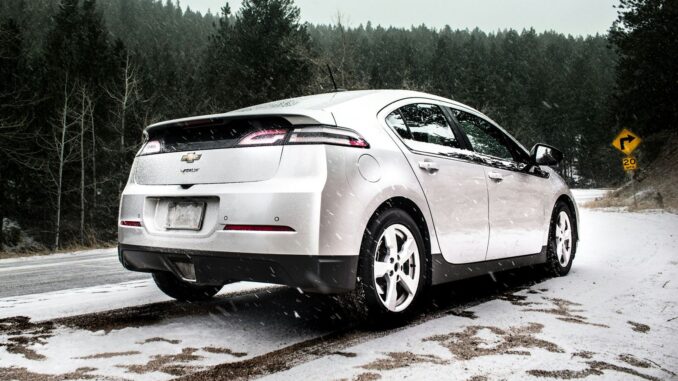
In a stark reflection of the challenges facing the electric vehicle (EV) transition in the United States, General Motors (GM) is limiting production of its revived Chevy Bolt—the company’s most affordable mass-market EV—while leaning heavily on its more profitable internal combustion engine (ICE) models. This move, highlighted in a March 9, 2026, report from Today in Detroit, comes against the backdrop of broader industry headwinds, including softened consumer demand for battery-electric vehicles, the elimination of key federal incentives, and relaxed emissions regulations under the current administration.
The Chevy Bolt was brought back “by popular demand” as the 2027 model, hitting dealerships in early 2026 with a starting price under $30,000 (around $28,995), a 260-mile range, updated LFP batteries, and faster charging capabilities. Positioned as America’s cheapest new EV at launch, it represented GM’s bid to capture the affordable segment in a market where average new-vehicle transaction prices exceed $50,000. Yet, despite initial enthusiasm, production at the Fairfax Assembly Plant in Kansas City, Kansas, has been constrained—operating on just one shift with plans for only a limited run of about 18 months. Reports indicate production could end as early as mid-2027, after which the facility will shift to building higher-demand gas-powered vehicles, such as the Buick Envision crossover relocated from China.
This scaling back underscores weak consumer demand for affordable EVs. The expiration of the $7,500 federal EV tax credit in late 2025 removed a critical price advantage, while barriers like charging infrastructure concerns, range anxiety, and higher upfront costs (even for entry-level models) have kept many buyers in the ICE lane. U.S. EV market share has dipped below 8% in recent months, with sales slumping significantly since the incentive changes. GM has cited these factors in explaining its adjustments, noting that consumer preferences continue to favor traditional gasoline-powered cars and trucks, particularly profitable full-size pickups and SUVs.
Compounding the operational shifts are the financial repercussions of GM’s earlier aggressive EV push. In late 2025 and early 2026, the company recorded massive write-downs tied to reevaluating and scaling back its EV investments. A $1.6 billion impairment charge hit in Q3 2025, followed by a far larger $6 billion special charge in Q4 2025 (part of a total ~$7.1–$7.6 billion in EV-related and restructuring items for the quarter, including ~$1.1 billion for China operations unrelated to EVs).
The $6 billion break down as follows:
- Approximately $1.8 billion in non-cash impairments on assets like EV manufacturing equipment, battery facilities (including Ultium joint ventures), and related infrastructure that lost value due to lower expected volumes.
- $4.2 billion in cash-related costs, primarily settlements and cancellations with suppliers who had ramped up for higher EV production that never materialized.
These one-time hits contributed to a Q4 2025 net loss of around $3.3 billion and dragged full-year 2025 net income sharply lower. GM has described the charges as necessary to “right-size” capacity for realistic demand, with actions including idling battery plants, delaying shifts at EV factories, discontinuing programs like BrightDrop electric vans, and repurposing facilities (e.g., Orion Assembly back to ICE trucks).
Despite the setbacks, GM maintains long-term optimism about EVs, with CEO Mary Barra reaffirming commitment to the technology through cost reductions, new battery innovations, and a flexible manufacturing footprint that allows pivoting between EVs, hybrids, and ICE as needed. The company expects EV losses to improve by $1–$1.5 billion in 2026 from lower volumes and capacity adjustments, while forecasting stronger overall profitability driven by its core ICE business. For 2026, GM anticipates “significantly” lower EV volumes but raised guidance for net income and adjusted earnings, signaling confidence that profitable gas-powered models will bridge the gap during the slower EV adoption phase.
GM’s experience with the Chevy Bolt illustrates a broader reality for legacy automakers: the EV transition is proving more protracted and costly than anticipated. While affordable options like the Bolt test the market’s appetite for battery electrics without heavy subsidies, the pivot to ICE highlights how quickly strategies can shift when demand and policy realities collide. As the industry navigates 2026, the balance between innovation in electrification and reliance on proven, profitable combustion vehicles will remain a defining challenge.