
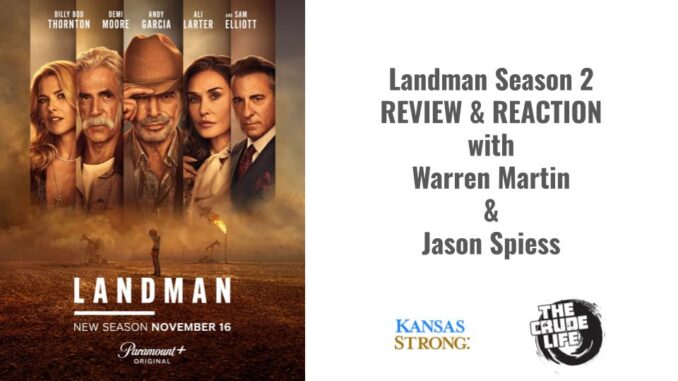

By the eighth episode of Season 2, Landman finally stops pretending it’s an oil-and-gas show.
There are rigs in the background, sure. A crew camp here, a heat reference there. But Episode 8 does something far more uncomfortable—and far more honest. It abandons the machinery and turns its lens inward, toward decision-making itself. Toward the human impulses that drive billion-dollar bets. Toward the thin line between conviction and gambling, integrity and litigation, loyalty and liquidation.
It is, without question, the most consequential episode of the series so far—not because of explosions or cliffhangers, but because it forces the audience to sit inside the rooms where real outcomes are decided.
And those rooms are not noisy.
They are quiet. Carpeted. Air-conditioned. Polite.
CLICK HERE FOR SPECIAL PARAMOUNT + DISCOUNT LINK
Integrity as a Liability
The episode’s emotional anchor comes from an unexpectedly simple line: my word is going to mean something.
Spoken by Cami—the widow now steering the company—it lands with a weight the rest of the room clearly does not share. In an industry accustomed to hedging language, conditional commitments, and exit ramps disguised as optimism, her insistence on honoring a promise feels almost subversive.
The lawyers respond exactly as they should.
Not with outrage. Not with morality. But with strategy.
Risk mitigation replaces loyalty as the guiding principle. Litigation becomes not a last resort but a business model. “Out-litigate them” is not presented as villainy—it’s presented as competence.
And that’s the point.
The episode doesn’t caricature attorneys as evil. It depicts them as effective. Their worldview is coherent. Rational. Entirely defensible within corporate logic. Which is precisely why it makes the audience uneasy.
Because when integrity becomes an inefficiency, something fundamental has shifted.
CLICK HERE FOR SPECIAL PARAMOUNT + DISCOUNT LINK

The Vanishing Moral Center
Nate—the show’s resident moral ballast—undergoes one of the quietest but most important transformations of the episode. He doesn’t change his behavior. He doesn’t betray anyone. He doesn’t escalate.
The audience does.
What once read as necessary restraint now feels like obstruction. What once grounded the chaos now dampens momentum. He becomes, in effect, “Captain Obvious”—saying the things no one wants to hear, precisely because they are true.
It’s a familiar phenomenon in real boardrooms: the ethical voice doesn’t disappear; it becomes inconvenient. And inconvenience, in a high-velocity capital environment, is indistinguishable from opposition.
The brilliance of the writing lies in how subtly this shift occurs. No speech. No moral reckoning. Just a collective turn of the head away from the person reminding everyone what they already know.
Sex, Power, and the Cost of Access
The workplace romance between the geologist and the attorney is not treated as scandal so much as transaction. Bedroom access accelerates boardroom access. Competence exists—but it’s not what opened the door.
What follows is not punishment but realization.
The geologist isn’t exposed as a fraud; he’s exposed as partial. His maps don’t lie—but they don’t tell the whole story either. Probabilities are presented as certainties. Complexity is compressed for persuasion. Emotion fills the gaps where data runs out.
And when accountability finally arrives, it doesn’t come from a superior—it comes from intimacy collapsing under scrutiny.
The episode resists moralizing the affair. Instead, it asks a harder question: how often do major decisions rest not on deception, but on incomplete understanding dressed up as confidence?
In oil and gas, that question is anything but fictional.
CLICK HERE FOR SPECIAL PARAMOUNT + DISCOUNT LINK

Gambling Without a Casino
Angela’s casino run is the episode’s most obvious metaphor—and its most flawed.
She wins big, fast, and repeatedly. The math doesn’t add up. The bankroll seems elastic. The risk feels theatrical rather than constrained.
But the symbolism is unmistakable.
Her emotional gamble pays off immediately. Meanwhile, a $400 million corporate gamble—made with solemn faces and professional language—hangs unresolved. The juxtaposition is deliberate. One risk is framed as reckless indulgence; the other as sober leadership.
Yet both are driven by emotion.
That tension—between how risk is presented and how it is experienced—runs through every storyline. The episode isn’t arguing that oil and gas isn’t a gamble. Even industry veterans have used that word for more than a century.
What it interrogates is who gets to gamble, with whose money, and under what moral cover.
Venture Capital in Cartel Clothing
Perhaps the episode’s most provocative move is its treatment of the cartel storyline—not as overt villainy, but as polished capital management.
Andy Garcia’s character doesn’t lurk in jungles or brandish weapons. He operates from high-rise offices. He speaks in calm, measured tones. He strips companies clean with the efficiency of a private equity firm executing a hostile acquisition.
This is not accidental.
The show carefully blurs the distinction between criminal capital and institutional capital—not by equating their morality, but by aligning their methods. Money moves. Assets are extracted. Liability is externalized. Executives walk away whole.
The oil industry is not portrayed as the cartel.
But venture capitalism is portrayed as disturbingly fluent in cartel logic.
And that discomfort lingers long after the scene ends.
Aging, Dignity, and a Custom Solution
The episode’s most controversial moment—the stripper-turned-physical-therapist—is also its most human.
On the surface, it’s crude. Intentionally so. But beneath the shock is a deeply realistic insight: people do not respond to care when it feels clinical. They respond when it feels personal.
Tommy doesn’t hire help; he hires motivation.
In elder care, this is not radical—it’s common. Movement matters. Engagement matters. Dignity matters. The method is less important than the outcome.
The show could have chosen a yoga instructor. It chose authenticity instead.
In doing so, it reinforces a core theme: the oilfield doesn’t solve problems with templates. It solves them with customization. Sometimes that makes polite society uncomfortable. Sometimes it works.
Often, it’s both.
CLICK HERE FOR SPECIAL PARAMOUNT + DISCOUNT LINK

Place. Time. Value.
If the episode has a thesis, it’s this: value only exists at the right place, at the right time.
That truth applies to wells, workers, landowners, investors—and people.
A deal can be perfect and still fail. A person can be qualified and still be wrong for the moment. A resource can exist and still be unreachable.
The industry lives and dies by this reality. Episode 8 doesn’t explain it with diagrams. It dramatizes it through human friction.
And that’s why it works.
The Quietest Episode, the Loudest Reckoning
There are no rigs roaring. No blowouts. No dramatic crane shots.
And yet this is the episode where Landman finally earns its name.
It understands that the most dangerous forces in the industry aren’t mechanical—they’re psychological. Pride. Fear. Loyalty. Grief. Ego. Hope.
By stripping away spectacle, the show reveals what’s actually at stake: not oil, but alignment.
And when alignment fails, no amount of capital can save you.
That’s not television drama.
That’s reality.
Landman Reviews & Reactions are by Warren Martin of Kansas Strong and Jason Spiess, founder, The Crude Life.

