
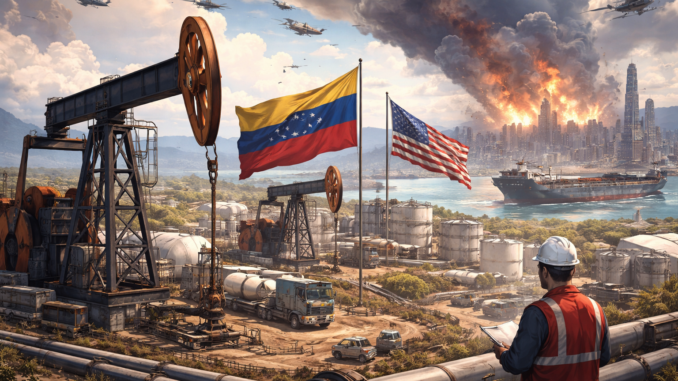

By the time cameras caught the “Happy Trump” lapel pin and the jokes about ballrooms, the serious part of the White House meeting had already taken shape: a president promising “total safety” and a fast track into Venezuela, and a room full of oil-and-gas decision-makers quietly calculating whether any of this can be made bankable—and survivable.
President Donald Trump’s Jan. 9, 2026 roundtable with two dozen major oil executives wasn’t a conventional energy-policy meeting. It was a deal-making session wrapped inside a foreign-policy event. In public remarks, Trump framed the U.S. military capture of Venezuela’s Nicolás Maduro as the moment that unlocked leverage. Then he outlined what amounts to a U.S.-managed restart of Venezuelan oil, with private capital rebuilding the system and Washington asserting control over access, security, and revenue pathways.
What follows is what the meeting really signaled—beyond the headlines—and the realities that will decide whether any “$100 billion” talk turns into steel in the ground.
What Trump offered the room: a deal architecture, not a press conference
The president’s central offer to industry had three pillars:
1) “Spend $100B—no taxpayer money”
Trump pushed for at least $100 billion in private investment to rebuild Venezuela’s “rotting” energy infrastructure. Multiple outlets reporting the meeting describe the figure as a core ask, paired with the idea that companies don’t need government cash—they need protection.
Reality check: $100B is not impossible in aggregate across majors, service companies, midstream, and trading—over time. But it’s not a “sign the check at the meeting” number. In modern upstream, capital tends to arrive in phases: technical assessment, pilots, brownfield recovery, then expansion—especially in a country with legal and political whiplash risk.
2) “Total safety, total security”
Trump repeatedly promised security guarantees to oil companies and their people. Reuters and others note he did not provide details publicly on how those guarantees would work in practice.
Reality check: Security is not a slogan—it’s a line item and an operating model. The moment you put hundreds or thousands of expats, contractors, rigs, and supply chains into a volatile environment, the security plan becomes as important as the drilling plan. If the U.S. posture is “no boots on the ground,” then the most likely architecture is a mix of vetted local forces, private security, controlled corridors, intelligence support, maritime presence, and strict movement protocols. That can be done—but it’s expensive, complicated, and politically sensitive.
3) “We decide who goes in—and we control the money”
The meeting messaging also pointed toward U.S. control over access and revenue flows, a concept that has shown up in reporting around the post-Maduro environment and how oil receipts would be handled.
Reality check: Controlling revenue is how you enforce compliance and fund stabilization, but it also introduces a new risk: companies can find themselves caught between commercial objectives and political conditions that can change on short notice.
Why the room didn’t cheer (even if the cameras caught smiles)
Energy executives are not allergic to risk. They are allergic to unpriceable risk.
And that’s the thread you can hear in the transcript you shared—especially once executives begin speaking and the conversation shifts from patriotic framing to “investable frameworks.”
Exxon’s blunt truth: Venezuela is “uninvestible” without durable legal protection
Coverage of the meeting notes Exxon’s view that Venezuela remains “uninvestible” unless the country reforms contracts and creates durable protections for capital.
That is not corporate drama. It’s scar tissue. Exxon—and others—have a long memory of expropriations and contract instability. If you’ve been burned twice, “third time’s the charm” only happens when protections are real, enforceable, and durable across governments.
ConocoPhillips: the $12B write-off is the subtext
Reporting also highlights ConocoPhillips acknowledging it has written off about $12 billion in claims tied to past seizures—then hearing the president essentially say the past is the past.
That exchange matters because it clarifies a major point: this is not a restitution meeting. It’s a reset pitch. Companies owed money may still pursue claims, but the political message is: if you want back in, start with a clean sheet and bet on future upside.
Chevron’s unique position: already in-country, already producing, and already staffed
Chevron is the only major U.S. oil company with ongoing operations in Venezuela, and that reality shaped the meeting’s operational tone. Reports cite Chevron’s footprint—thousands of employees tied to joint ventures—and the claim that it sees a pathway to raise production materially with the right permissions.
In fact, Reuters reported U.S. Energy Secretary Chris Wright citing Chevron’s view that Venezuelan production could rise ~50% within 18–24 months, depending on approvals.
Reality check: A 50% increase from existing JV output is plausible in the near term because the first gains in a struggling system often come from maintenance, integrity repairs, de-bottlenecking, and workovers—not heroic wildcatting. But scaling beyond that into a true national renaissance would require deep reinvestment across:
- upstream facilities and field services
- power supply reliability
- diluent and blending logistics (for heavy crude)
- pipelines, storage, terminals
- procurement and anti-corruption controls
- export routing, insurance, and security protocols
That’s when the bill gets very real.
The oil itself: Venezuela’s “biggest reserves” aren’t the whole story
Nobody in the room needs a lecture on Venezuela’s resource base. Venezuela holds the world’s largest proved oil reserves—about 303 billion barrels (roughly 17% of global proved reserves) per OPEC reference reporting.
But “reserves” aren’t “deliverable barrels.” Deliverable barrels require:
- stable governance and enforceable contracts
- technical competence and equipment
- capex certainty over years
- export pathways that survive sanctions and politics
Reuters also notes Venezuela once produced ~3.5 million bpd (1970s), far above today’s levels, underscoring the scale of what’s been lost—and what it would take to rebuild.
The biggest practical hurdle: bankability under political supervision
If you want the “realities” of the meeting spelled out, this is the center of the bullseye:
Companies will want guarantees that outlive headlines
Reuters reported that companies want “serious guarantees” before putting significant capital at risk, and that talks with executives had been underway.
“Guarantees” can mean a lot of things in practice:
- contract sanctity (stabilization clauses, arbitration venues)
- security arrangements and evacuation protocols
- sanctions clarity (what’s allowed, for how long, and under what triggers)
- revenue mechanisms (how money is collected, held, distributed)
- insurance viability (war risk, political risk, kidnap/ransom, business interruption)
- exportability (who can buy, where it can ship, who can finance)
If any of those remain ambiguous, capital slows down. Not because executives are timid, but because public companies have boards, fiduciary duties, and compliance regimes that can’t sign off on vibes.
“We’ll control the cash flow” cuts both ways
A U.S.-supervised revenue channel can be a stabilizer, but it can also be perceived as political risk embedded into the cash register. If a future policy shift changes who gets paid, in what order, or under what conditions, you’ve created a new version of “resource nationalism”—just administered from somewhere else.
The geopolitical overlay: this wasn’t only about barrels
The meeting repeatedly connected Venezuela to larger strategic aims: keep China and Russia out; prevent adversary footholds; use energy to reshape hemispheric dynamics. That framing matches broader reporting that the administration is weighing how to revive crude output while maintaining leverage.
And it’s directly downstream of the week’s defining event: Maduro’s capture and legal processing in the U.S. system, as covered by PBS and AP’s reporting and publication of charging documents.
Reality check: When energy becomes a strategic instrument, business decisions start living inside national-security decisions. That can accelerate approvals—but it can also introduce sudden constraints that have nothing to do with geology or refining margins.
What to watch next: the indicators that tell you this is real
If you’re tracking whether this meeting becomes reality, ignore the speeches and watch for these tangible signals:
- Legal framework announcements
Look for language on arbitration venues, contract protections, hydrocarbon law updates, and fiscal terms that can survive political cycles. - Sanctions/licensing clarity
If the administration intends strict oversight, the market will need explicit guidance on what’s permitted, what’s prohibited, and what triggers changes. - Technical assessment teams mobilize
Exxon and others telegraphed the first step: get teams on the ground to assess the real condition of assets and the operating environment. - Insurance and shipping normalize
A credible security posture shows up in insurance pricing and shipping willingness. When underwriters loosen, the world believes the corridor is stable. - Early brownfield wins
If Chevron or partners demonstrate measurable production improvements within months via repairs and debottlenecking, confidence rises quickly. - Who gets selected
Trump’s posture implies the U.S. will be selective about “which companies go in.” The roster—and the terms—will reveal whether this is an open investment environment or a curated strategic consortium.
The Crude Life takeaway: this meeting was a collision of “deal energy” and “oilfield reality”
The energy summit was not an industry pep rally. It was a high-stakes opening bid: the White House signaling it wants to reboot Venezuela’s oil system under a security-and-revenue architecture that keeps Washington in the driver’s seat, while asking private companies to front the capital.
Oil executives didn’t push back on the idea that Venezuela can produce. They pushed—quietly and professionally—on the one thing that matters more than reserves: durable rules.
Because in the real world, the deciding question isn’t “How big is Venezuela’s oil?”
It’s: Can the legal terms, security posture, export logistics, and revenue handling be made stable enough that a board can authorize billions—and keep authorizing it—after the cameras leave?
That’s the reality the meeting.
Jason Spiess is an multi-award-winning journalist, entrepreneur, producer and content consultant. Spiess, who began working in the media at age 10, has over 40 years of media experience in broadcasting, journalism, reporting and principal ownership in media companies. Connect with Spiess on LinkedIn or Follow his personal professional site Spiess On Earth
All Energy Has A Purpose and We Are All Energy!
The Crude Life republishes their articles, features and stories online and/or in print under Creative Commons license CC BY-NC-ND 4.0.
Everyday your story is being told by someone. Who is telling your story? Who are you telling your story to?
Email your sustainable story ideas, professional press releases or podcast submissions to thecontentcreationstudios(AT)gmail(DOT)com.
CLICK HERE FOR SPECIAL PARAMOUNT + DISCOUNT LINK

Discussion

