
WARNING: SPOILERS ahead for Landman season 2, episode 6.
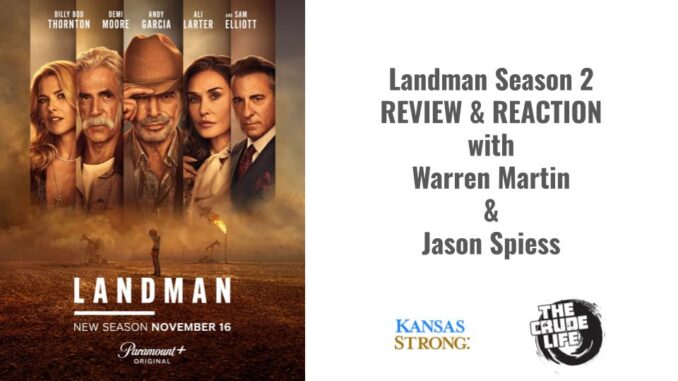
Jason Spiess and Warren Martin, Kansas Strong, aren’t just recapping plot beats—they’re diagnosing a genre migration in real time: Landman is sliding away from “oilfield mechanics” and into “family drama with an oil patch backdrop,” and the hosts treat that shift like both a creative choice and a public-perception event.
From the opening minutes, Spiess frames it as a kind of “Siskel and Ebert” moment: the oil and gas industry is still the setting, but increasingly it’s B-roll—while the family dialogue, personal motives, and social cues are what’s driving the episodes. Warren agrees and sharpens the critique: last season gave them plenty of material to talk about crews, drilling, and how things actually work; this season mostly gives them money, deals, and power plays.
That tension—what the show used to be versus what it is now—becomes the spine of the reaction episode.
The episode’s surprise MVP: trade shows, swag, and the “real economy” of networking
The funniest—and oddly most insightful—stretch of the podcast is the extended riff on trade shows and swag. Spiess goes full field reporter, arguing that oil and gas trade shows have “the best swag on the planet,” and uses a Bakken-era memory of kids treating exhibitor freebies like Halloween candy to make the point: this industry understands physical marketing and long-game recall better than most.
Warren plays it smart: he doesn’t just laugh along—he explains why swag works as a business strategy. It’s not trinkets; it’s durable brand presence for a customer who might not need your product for a year. Then the conversation turns into something bigger: annual budgeting cycles and how “if you want a 2026 sale, you had to make it in 2025.”
That’s the kind of practical industry truth Landman rarely shows, but the reaction podcast does.
The bit peaks with a joking-but-not-joking brainstorm: “Sustainable Swag” as an ESG-worthy angle. It’s comedic, but it also lands as a real observation—oil and gas doesn’t just market; it markets persistently, and the hosts understand how procurement memory is built.
CLICK HERE FOR SPECIAL PARAMOUNT + DISCOUNT LINK
The “pin-up booth” scene: critique without turning preachy
The Lucas Oil booth moment becomes one of the most thoughtful segments. Spiess reads the scene as a “sunset” for old-school trade show aesthetics—less garage pin-up culture, more modern professional optics—while Warren pushes back from lived experience: the women he meets in booths are knowledgeable salespeople who have to know their stuff, and the show’s portrayal flattens that reality.
What works here is tone. They don’t moralize. They treat it like two observers comparing the “Houston/Dallas myth” to what’s typical at regional expos—and they end up in a nuanced place: yes, sex appeal exists in marketing everywhere; but in many oilfield events, competence is the actual currency.
That’s a solid correction for listeners who might take Landman as documentary-adjacent truth.
Automation and “the future is coal”: a real disagreement, finally
The best podcast chemistry shows up when they disagree sharply—because they disagree like professionals. Spiess drops the line: “the future is coal for oil and gas,” meaning fewer workers, more robotics, and a familiar arc of mechanization plus regulatory pressure.
Warren rejects the comparison and lays out a practical divide: majors can justify automation when wells are $2–6 million and volumes are huge; independents in Kansas drilling $250k–$500k wells can’t absorb that kind of upfront cost.
That distinction—majors versus independents—gives the episode its most grounded “industry explainer” moment. Warren then adds a second insight that’s even better: technology trickles down via secondhand markets.
Equipment gets replaced in the Permian, then migrates to smaller producers later. That’s an old-school, physical-world version of innovation diffusion, and it reframes the “automation panic” into something more gradual and uneven.
CLICK HERE FOR SPECIAL PARAMOUNT + DISCOUNT LINK
The lawyer triangle and the show’s credibility gap
When they pivot to the lawyer/science/fix-it triangle, the hosts get at something Landman keeps flirting with: the show wants to teach the public “how the shell game works” while also being a relationship drama. Spiess is right to flag the risk: when a mainstream show “educates” through dialogue, audiences tend to treat it as truth—even if it’s simplified or dramatized.
Warren’s critique is surgical: the lawyer claims she needs education from a scientist, but the scenes don’t actually deliver technical substance—yet she hands major operational authority to a romantic interest anyway.
They both treat this as implausible in real oilfield operations (especially offshore), and they connect it to the larger theme of “right hand doesn’t know what the left hand’s doing”—a real corporate failure mode the show is exaggerating for drama.
The cartel thread: Sopranos energy with boardroom consequences
Spiess spots the cartel Easter egg and runs with it: less risk, easier laundering, oil as a safer profit center than drugs. Warren doesn’t reject the thread so much as translate the vibe—Andy Garcia’s character plays the “old-time gangster godfather” archetype: generosity that creates obligation.
“Here’s $20,” but everyone knows it’s a debt. Warren’s reading is compelling because it’s about power behavior, not plot specifics.
They even catch potential misdirection (who the “sharks smell blood” warning was aimed at), and that’s a nice touch—two hosts willing to admit they may need to rewatch a line and reconsider who the threat is actually targeting.
Angela, “Diamonds are in Dallas,” and boomtown economics
This is where the reaction show becomes sneakily sociological. Spiess uses “Diamonds are in Dallas” as a real oil patch truth: conspicuous consumption in boom regions often flows outward to destination cities, not inward to small-town boutiques.
He even shares a Bakken economic-development anecdote about getting pushed out of the room for saying the quiet part out loud: high-end retail on Main Street often serves marketing fantasies more than consumer reality.
Warren backs it up with Midland’s boom/bust variability and a smart framing: boomtown amenities grow around daily necessities; status spending often gets performed by traveling and coming back with stories.
That’s a tight little mini-lesson in energy community economics—exactly the kind of thing you’d want from a reaction podcast that’s supposed to connect fiction to real life.
And then, in a perfect character-driven detail, they highlight Angela giving Cooper the “ring that stank of failure” as an underappreciated line—one that reveals her psychology and selfish opportunism in a single beat.
Both hosts agree: if a character makes you nauseated, the actor is probably doing their job extremely well.

Final verdict
This episode is less a recap and more a “two-lens audit” of Landman: one lens is industry realism (trade shows, budgets, independents vs majors, how hiring actually works), the other is narrative literacy (power, hypocrisy, character arcs, and how TV “educates” people through drama).
If you want a reaction show that simply tells you what happened in the episode, this one wanders—into swag economics, boomtown retail, cartel archetypes, and college football.
But if you want a reaction show that treats Landman as a cultural artifact shaping how people think about energy, business, and communities, this episode delivers—because Spiess and Martin keep doing the same thing: pulling the scene apart, then rebuilding it with real-world logic.
If Landman is becoming “a family drama where oil is the wallpaper,” this reaction show remains what the series used to be: a grounded conversation about the people, systems, and incentives that make the energy world feel real.
All Energy Has A Purpose and We Are All Energy!
The Crude Life republishes their articles, features and stories online and/or in print under Creative Commons license CC BY-NC-ND 4.0.
Everyday your story is being told by someone. Who is telling your story? Who are you telling your story to?
Email your sustainable story ideas, professional press releases or podcast submissions to thecontentcreationstudios(AT)gmail(DOT)com.
CLICK HERE FOR SPECIAL PARAMOUNT + DISCOUNT LINK


