
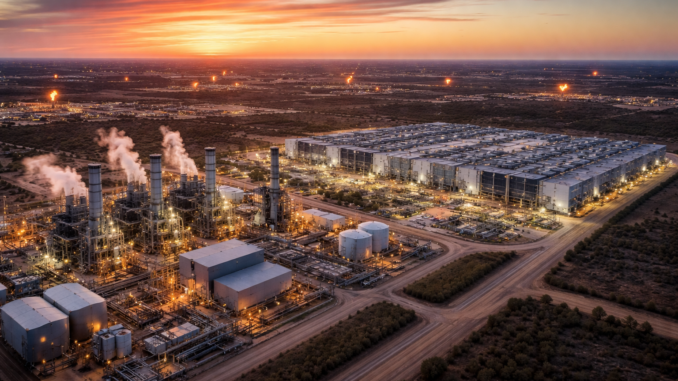
For more than a decade, the Permian Basin has been defined by abundance—and imbalance. Oil production surged ahead of infrastructure. Natural gas became a byproduct looking for a buyer. Prices collapsed at times, flaring spiked, and midstream buildout raced to catch up.
Now, Chevron is proposing something different: instead of moving gas to power markets, move the power market to the gas.
According to industry reporting, Chevron is planning a behind-the-meter natural gas power complex in the Permian Basin, purpose-built to serve a large, co-located data center. Initial capacity is expected to reach roughly 2.5 gigawatts, with the option to scale toward 5 gigawatts for a single hyperscale customer. Targeted in-service timing is around 2027, pending a final investment decision in 2026.
This isn’t just a power plant. It’s a signal that the oil and gas industry may be entering a new phase—one where molecules, megawatts, and microchips converge on the same acreage.
A Structural Shift, Not a Side Project
Behind-the-meter power isn’t new. What is new is the scale and intent.
Chevron’s plan effectively collapses three value chains into one site:
- Upstream gas production
- On-site power generation
- Direct sale of electricity to a data center
By bypassing the public grid, Chevron avoids interconnection delays, congestion risk, and many regulatory bottlenecks that have slowed traditional power development. For the data center customer, it offers firm, predictable baseload power in an era when grid access is increasingly constrained.
For Chevron, it transforms associated gas from a price-exposed commodity into a contracted demand anchor.

Why the Permian, and Why Now
The Permian Basin remains one of the most prolific hydrocarbon regions in the world—but gas economics have often lagged oil.
Pipeline constraints have periodically pushed gas prices toward zero or negative territory. Flaring has become both a regulatory and reputational challenge. The basin has needed local, high-volume, steady demand.
Data centers fit that need almost perfectly.
AI and cloud computing workloads require:
- Continuous, high-load power
- Redundancy and reliability
- Long-term energy certainty
Natural gas-fired generation provides exactly that—and when located at the source, it eliminates transportation friction altogether.
From Fuel Supplier to Power Merchant
Chevron’s move also reflects a broader evolution in how energy companies think about markets.
Historically, oil and gas producers sold molecules and let others handle electrons. This project blurs that line. Chevron isn’t just supplying fuel—it’s selling power as a product, tailored to a specific industrial user.
That distinction matters.
Electricity contracts tied to data centers can span decades, offering revenue stability that commodity markets rarely provide. In effect, Chevron is converting geological certainty into digital-economy infrastructure.
The AI–Energy Feedback Loop
This project also lands at the intersection of two powerful trends:
- Rising AI compute demand
- Rising scrutiny of energy reliability
Grid operators across the U.S. are warning about capacity shortfalls. Hyperscalers are discovering that securing land is easier than securing power. As a result, tech companies are increasingly open to self-supply models, especially when they don’t require navigating utility queues.
For oil and gas producers, that creates an opportunity: become the energy backbone of the digital economy—on their own terms.
What This Means for the Industry
Chevron’s Permian power complex may be the first of its kind at this scale, but it is unlikely to be the last.
If successful, the model could:
- Reduce flaring by monetizing associated gas
- Stabilize in-basin gas demand
- Encourage new forms of upstream–downstream integration
- Reframe natural gas as infrastructure, not just fuel
It also raises new questions about permitting, emissions accounting, and how “behind-the-meter” projects fit into state and federal oversight frameworks—topics the industry and regulators are only beginning to grapple with.
The Crude Life Takeaway
For years, the conversation around the Permian has focused on constraints—pipelines, prices, flaring limits, public perception.
Chevron’s data-center power strategy flips that narrative.
Instead of asking where the gas can go, the question becomes: Who can come to the gas?
In a world hungry for both energy and computation, the answer may reshape not just the Permian—but the future relationship between oil, gas, and the digital economy.
Jason Spiess is an multi-award-winning journalist, entrepreneur, producer and content consultant. Spiess, who began working in the media at age 10, has over 40 years of media experience in broadcasting, journalism, reporting and principal ownership in media companies. Connect with Spiess on LinkedIn or Follow his personal professional site Spiess On Earth
All Energy Has A Purpose and We Are All Energy!
The Crude Life republishes their articles, features and stories online and/or in print under Creative Commons license CC BY-NC-ND 4.0.
Everyday your story is being told by someone. Who is telling your story? Who are you telling your story to?
Email your sustainable story ideas, professional press releases or podcast submissions to thecontentcreationstudios(AT)gmail(DOT)com.
CLICK HERE FOR SPECIAL PARAMOUNT + DISCOUNT LINK


