
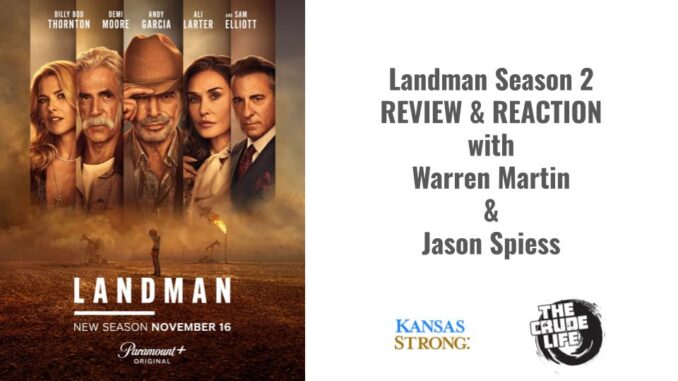

Jason Spiess and Warren Martin sound like two guys who meant to take Sunday off and somehow ended up working anyway—and that energy pretty much sets the tone for this podcast breakdown of Landman Season 2, Episode 2.
Podcast Reaction & Review: The Crude Life with Jason Spiess & Warren Martin (Kansas Strong)
Paramount+ may think it made a prestige oilfield drama, but on this week’s episode of The Crude Life, Jason Spiess and Warren Martin of Kansas Strong make the case that Landman is quietly becoming something else: a mirror.
Not a perfect mirror, not a legal brief, not a training manual. But a mirror that reflects back the tensions inside today’s oil and gas world—independents versus corporates, entitlement versus grit, easy money versus hard lessons, and the quiet human drama that happens out on location and back home at the kitchen table.
Recorded on a Sunday night with laundry in the background and football just wrapped up, Spiess opens the podcast with a three-word review of Episode 2:
“Confused. Concerned. Delighted.”
Over the next hour, he and Martin unpack all three.
CLICK HERE FOR SPECIAL PARAMOUNT + DISCOUNT LINK
Overview of Guests & Topics
The episode centers on Landman Season 2, Episode 2, picking up from their review of the season opener. Where Episode 1 felt to Martin “like it was going in no direction,” both men agree Episode 2 finally gets back to:
- The oil and gas storylines
- The people inside the industry
- The real-world pressures that don’t always make it onto a Hollywood set
Along the way, they hit several big themes:
- The tension between independent producers and corporate America
- The myth of “easy money” in oil and gas finance
- Entitlement culture, from company trucks to legal access
- Litigation as a weapon in the industry
- How Landman is humanizing the oilfield with surprising warmth and humor
- And the show’s more controversial choices—especially around a nursing home party scene that lands very differently for each of them
Independents vs. Corporate America: This Season’s Real Showdown
Spiess locks in on one of Demi Moore’s early lines: the company being framed as the “largest independent oil producer.” That phrase becomes his north star for the episode.
He reads it as intentional—very intentional.
On one hand, the company is powerful enough to feel almost corporate: private security, jet-setting, high-stakes boardroom drama. On the other, it still trades on the “independent” image—the mom-and-pop mystique that plays well in a world that mistrusts mega-corporations.
Martin, who represents a lot of independents through Kansas Strong, agrees that the show is setting up a season-long collision course: independent producers, large and small, versus corporate America.
That battle is threaded through multiple storylines:
- The “largest independent” trying to walk the line between private and public
- The young, independent-minded female attorney facing off against a roomful of corporate lawyers
- The cartel’s money moving through different entities, hinting that capital—legal or illegal—doesn’t really care which banner it hides behind
The two men see Landman using this tension to dramatize something the industry lives every day: independents trying to compete in a world where scale, access, and legal firepower tilt the playing field toward the biggest players in the room.
“Easy Money” Is a Trap – And the Show (Mostly) Gets That Right
If there’s a phrase that defines Spiess’s notes for this episode, it’s “easy money.”
Cooper’s overnight rise—from scraping to suddenly running an $8 million rig package with six successful wells—is revealed to be built on a deeply lopsided contract. Martin walks listeners through the realism and the absurdity:
- The 75/25 revenue split Cooper brags about?
That can be a legit structure: roughly 25% to royalties and landowners, 75% to the working interest and investors. - But Cooper’s actual contract?
He gets nothing until every cent is paid back—and then his investors skim 18% on top.
Martin emphasizes what the show mostly skips: that drilling the well is just the beginning. After that comes:
- Operations
- Tank batteries
- Hiring field staff
- Ongoing costs that require real cash flow, now, not someday
Martin is bothered by how someone savvy enough to assemble leases and navigate permitting could be so naïve about who financed his company. Spiess notes that the financing angle—stacked deals, confusing structures, 2008-style money games—is very real in the independent world. The twist that Andy Garcia’s cartel character is behind the money, and possibly threading through multiple companies, adds a crime-drama layer on top of an already believable warning:
If the deal sounds too good to be true—especially in oil and gas—it probably is.
Landman Is Quietly Humanizing the Oilfield
If Episode 1 was “character chaos,” Episode 2, in Jason and Warren’s read, becomes a thank-you note opportunity for the industry.
Spiess pays particular attention to how the show opens:
- Upbeat, catchy music
- B-roll of oilfield crews working
- Men talking about health food and everyday life
- Fun and camaraderie on a dangerous rig
Instead of horror-movie music, flaring imagery, and disaster framing, Landman starts the episode with a feel-good, human-centered portrayal of the people who work in the field. For someone who’s worked in media since age 10, Spiess argues this framing matters—a lot.
Warren agrees. He highlights that the background images and B-roll feel real and respectful:
- Hardworking crews
- Genuine camp conversations
- A more balanced portrayal than the usual “wild, reckless roughnecks only” stereotype
They both note that West Texas itself gets a bit shortchanged—too many run-down visuals and not enough of Midland, Odessa, Lubbock as thriving communities built by oil and gas. But on balance, they see the show as lifting up the image of the people who make the industry run, rather than demonizing them.
Face-to-face moments seal the point. Spiess spends time on Tommy driving back to meet Cooper in person at the Patch Café. In West Texas, he reminds listeners, that’s not a trivial thing. Distances are long, traffic is heavy, and rigs are hours from town. If you drop everything and show up face-to-face, that means something.
Martin backs that up: in West Texas, real conversations—hard ones—are done eye-to-eye, not by text or phone. That’s a cultural truth the show nails, and it’s one more way Landman humanizes the patch.
The Radio Rant & Real-World Energy Policy
One of Martin’s sharpest analyses comes from a simple scene: Tommy arguing with the radio.
The talk segment lays out a familiar political idea—push oil companies to pump more, drop gasoline prices, give consumers extra spending power, and hope inflation cools. Martin dismantles this in real time:
- Costs aren’t what they were pre-2020—everything from pipe and aluminum to labor is more expensive.
- Majors might squeak by at lower prices; marginal and independent producers get hammered.
- Diesel, not gasoline, is the real inflation driver—and diesel remains stubbornly high.
It’s a rare moment where the show’s fictional radio chatter tees up a very real, technical critique of current energy policy.
Litigation, Contracts & “Whack-a-Mole”
The boardroom scene between the young female attorney (Kayla Wallace as Rebecca Falcone) and the wall of opposing lawyers hits close to home for both men.
Martin calls the oil and gas business a “highly litigious industry” where:
- Tiny contract phrases
- Title nuances
- Small wording shifts
…can flip liability from one party to another. The show’s “whack-a-mole” analogy—corporate giants bleeding smaller players through endless litigation—feels, to them, uncomfortably true to life.
Spiess reads the moment as a recruitment play: corporate America admiring Rebecca’s toughness and all but handing her a business card saying, “When you’re tired of playing whack-a-mole alone (in the independent world), join the team (corporate world).”
Entitlement & Access: The Invisible Advantage
Spiess spends a chunk of time on entitlement—not the loud, social-media version, but the quiet kind:
- Using the company truck for a competing startup’s work
- Having the lead corporate attorney drop everything from a $400 million matter to dig into your son’s financing
- Calling in favors “as a friend” rather than formally
To average viewers, those may look like throwaway scenes. To independents and mom-and-pop operators, Spiess argues, this is exactly the kind of structural advantage that can make or break a business—access, networks, and invisible help that doesn’t show up on a balance sheet.
Angela, Ansley & the Nursing Home Scene
Here, the two men strongly diverge.
Spiess is fascinated by Angela and Ansley—West Texas trouble in high heels. He sees them as sharply written, well acted, almost Emmy-worthy characters who embody:
- Entitlement
- Spin
- Self-justification
- And the ability to start with something altruistic, realize they’re wrong, talk themselves into being right, then gaslight the room and move on
Martin, on the other hand, is deeply bothered by the nursing home party sequence, more so than the earlier strip club scenes from Season 1. Having worked closely with nursing homes and assisted living facilities, he points out:
- Activities are vetted by staff
- Drug and alcohol interactions are serious, not punchlines
- The scene, to him, felt disrespectful to staff who are already overworked and doing their best
Spiess ultimately concedes he hadn’t thought through that angle and understands Martin’s reaction, especially given both of their personal experiences working with seniors.
Sam Elliott’s Character: Worker, Cynic, Scientist?
Sam Elliott’s wheelchair-bound patriarch gets limited screen time in Episode 2, but both men think he’s being positioned for something bigger.
- Martin reads him as a rig hand or pumper who broke his back and now looks warily at “owners” who’ve left the worker ranks.
- Spiess hears the way he talks about sunsets, particles, and the atmosphere and suspects a self-taught, science-minded problem solver—maybe not a formal geologist, but someone whose mind will matter when Cooper’s wells need more than money to survive.
They agree on one thing: Sam Elliott’s character is clearly being saved for a more pivotal role—likely tied to Cooper’s operations rather than Tommy’s corporate world.
Conclusion
By the end of the podcast, both Jason Spiess and Warren Martin land in roughly the same place:
- Episode 1 felt like a character dump with no clear direction.
- Episode 2 finally feels like the real start of Season 2—where the storylines lock in, the oil and gas issues come back to the forefront, and the audience is invited to wrestle with uncomfortable truths.
They’re still wary of certain narrative choices—how blowouts are treated almost like a party gag, how some entitlement dynamics are downplayed, and how nursing homes are portrayed—but they also see a rare thing happening on a major streaming platform:
A show that lets oilfield workers be human, not props.
A drama that isn’t afraid to show contract language, litigation strategy, financing pitfalls, and policy debates as part of the story.
And a soap opera that, as Spiess jokes, “is supposed to clean my opera”—even if it leaves a stain or two.
Their final verdict?
They’re back on board for Season 2. Curious. Cautious. But definitely tuning in next week—especially now that Andy Garcia’s cartel kingpin has fully stepped onto the stage.
If you work in oil and gas—or you just want to understand the pressures inside America’s most argued-over industry—this podcast episode is worth your time.
It’s not just TV critique. It’s two industry veterans using Hollywood fiction as a launchpad to talk about how things really work in the patch.
Sneak peak of Episode 3 below!
- Billy Bob Thornton as Tommy Norris, a combination of a petroleum landman and an operations VP at M-Tex Oil, later president
- Demi Moore as Cami Miller
- Ali Larter as Angela Norris, Tommy’s ex-wife, and Cooper and Ainsley’s mother
- Jacob Lofland as Cooper Norris, Tommy and Angela’s son, and Ainsley’s brother who works for his dad as a roustabout
- Michelle Randolph as Ainsley Norris, Tommy and Angela’s strong-willed daughter, and Cooper’s sister
- Paulina Chavez as Ariana Medina, Elvio’s widowed wife and Cooper’s love interest
- Kayla Wallace as Rebecca Falcone, a causation lawyer
- Mark Collie as Sheriff Walt Joeberg
- James Jordan as Dale Bradley, a petroleum engineer
- Andy Garcia as Gallino (cartel boss)
- Sam Elliott as T. L. Norris, Tommy’s father
- Colm Feore as Nathan, an oil company attorney and administrator

