
Every city, from Jakarta to Joliet, faces a paradox: the more modern a community becomes, the more waste it produces — and the more power it demands. Landfills are filling faster than we can build them, while grids strain under the surge of electric vehicles, data centers, and extreme weather.
For decades, municipal waste and power generation lived in separate worlds. Trash was something to be buried; electricity, something to be imported from distant plants. That siloed model worked when fuel was cheap and space was plentiful. But in today’s urban and industrial reality — one defined by circular economies, microgrids, and decentralized infrastructure — waste and energy are starting to merge into a single, powerful equation.
That’s where Independence Energy Company (IEC) enters the story.
The Rise of the ePod™
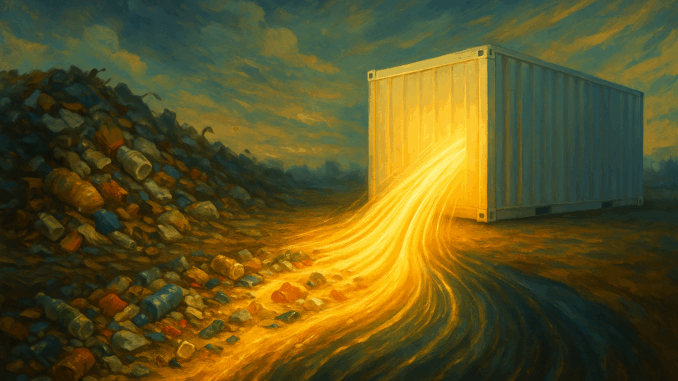
IEC’s flagship technology, the ePod™, is a modular gasification system that transforms everyday municipal solid waste (MSW) into clean, dispatchable electricity. Each unit — roughly the size of a shipping container — can process about 30 tons of waste per day and produce up to 4 megawatts (MW) of continuous power.
That’s enough to run a small town, hospital campus, or industrial complex. But what makes it revolutionary isn’t just its output — it’s the speed, footprint, and flexibility of deployment.
“We can go from concept to commissioning in months, not years,” says one of IEC’s engineers. “You don’t need a 200-acre site, a billion-dollar bond, or five years of regulatory limbo. The ePod is modular — plug-and-generate.”
The system combines gasification, emission scrubbing, and energy conversion in a compact, containerized platform. Its modular design means multiple units can be stacked or networked for higher capacity — ideal for scaling communities, resorts, industrial parks, or remote grids.
Engineering Elegance: Turning Waste into Syngas
At the heart of the ePod is a controlled gasification process — a thermochemical transformation where organic waste is heated in a low-oxygen environment. Instead of burning the material, the system converts it into a synthetic gas (syngas) composed mainly of hydrogen, carbon monoxide, and small amounts of methane.
That gas becomes fuel for high-efficiency generators, creating clean, dispatchable electricity with minimal emissions. The byproducts — typically inert ash and biochar — can be reused in construction or soil conditioning, closing the loop on what was once pure waste.
Unlike incineration, which releases combustion gases and toxins, IEC’s process isolates pollutants early in the cycle. The result is a power system that not only meets environmental compliance standards but exceeds them — and does so without relying on imported fuel or fragile supply chains.
In simple terms: the ePod eats garbage and produces power.
Deployment in a Box
Traditional waste-to-energy plants are massive, expensive, and politically complex. They require long permitting timelines, large tracts of land, and public approval processes that can drag for years.
IEC’s approach flips that model on its head.
Each ePod unit is a containerized, self-contained module equipped with its own gasification chamber, emission scrubber, turbine connection, and control system. Units are delivered pre-assembled and installed with minimal site prep — often on concrete pads near existing waste facilities, microgrids, or industrial zones.
The system can be configured for grid-connected or island mode operation, meaning it can feed power to a local grid or operate independently during outages. This feature is particularly attractive for data centers, resorts, military installations, and developing regions where reliability is critical.
Deployment time? Measured in months.
Compare that with the average 5-7 years it takes to build and permit a centralized waste-to-energy plant or small modular reactor. IEC’s modularity creates what energy analysts call “fractal scalability” — the ability to replicate power generation nodes quickly, like solar panels or server racks.
The Markets That Need It Most
IEC’s early adopters are a diverse mix:
- Municipalities looking to reduce landfill volume and stabilize local energy prices.
- Hotels and resorts in remote or island environments with limited grid access.
- Industrial parks and logistics hubs seeking on-site energy independence.
- Data centers and tech campuses pursuing resilient, carbon-neutral microgrids.
In developing economies, where landfill management and power reliability often collide, IEC’s model can become a catalyst for energy sovereignty — converting what was once a municipal burden into a municipal asset.
One installation in the Caribbean will be able to turn 80% of local waste into energy, reducing the need for diesel generation and creating new skilled jobs in operations and maintenance.
That’s more than sustainability — it’s local empowerment.
Circular Economics in Motion
What makes IEC’s system particularly innovative is its compatibility with circular economic models.
The process creates three revenue streams:
- Tipping fees from waste intake (municipalities paying for disposal).
- Electricity sales from generated power.
- Byproduct utilization (biochar, heat recovery, and ash reuse).
This multi-revenue design can turn waste management into a profit center instead of a cost center. Municipalities that once paid to ship trash hundreds of miles to landfills can now monetize that waste locally — while reducing their carbon footprint and creating energy security.
In the broader decarbonization narrative, IEC’s system provides a pragmatic bridge between renewable goals and industrial realism. It doesn’t rely on rare minerals, battery supply chains, or volatile weather conditions. Instead, it uses something every community has too much of — garbage — and turns it into something every community needs — power.
Environmental and Social Impacts
Modern waste management is as much a social issue as it is a technical one. Landfills emit methane, groundwater contamination threatens rural water systems, and recycling markets fluctuate with geopolitics.
IEC’s solution addresses all three.
By diverting waste streams at the source, the ePod reduces landfill methane, eliminates long-haul trucking, and minimizes contamination risks. Its closed-loop emission controls and ash stabilization systems ensure compliance with even the strictest environmental standards.
In rural or disaster-affected regions, ePod installations can serve as emergency power and sanitation hubs — processing debris and waste while restoring local electricity.
In a world where “resilience” is becoming the new sustainability, IEC’s model checks both boxes.
IEC’s team designed the ePod to be operator-friendly and self-monitoring, with advanced fire suppression, emissions scrubbing, and heat recovery systems.
A real-time dashboard tracks gas composition, energy output, and emissions data, providing full transparency for regulators or investors. The modules also feature automated shutdown and restart protocols — crucial for unmanned or remote sites.
These design choices make the technology attractive not only for private buyers but also for government and military applications, where reliability and safety are non-negotiable.
The deeper innovation behind IEC’s platform isn’t just the gasifier — it’s the philosophy of distributed, autonomous infrastructure.
The 20th century built centralized grids, pipelines, and plants. The 21st century is building networks of self-contained systems — from data servers to solar farms to microgrids.
IEC’s ePod fits seamlessly into that architecture. It can power a factory off-grid, supplement a regional utility during peak hours, or integrate with other renewables to stabilize voltage and frequency.
In essence, the company has created a universal adapter between the world’s waste streams and its energy demand curves.
Public–Private Partnerships and Future Potential
Like most breakthrough infrastructure ideas, IEC’s path forward likely runs through public–private partnerships (PPPs). Cities and counties can provide the waste stream; private investors or developers can provide the capital and technical support.
Because ePod systems are modular, funding can be phased — a city might start with one 4-MW unit, then add more as demand grows. The smaller upfront cost and quick ROI make it an attractive fit for municipal energy transition grants, ESG-aligned funds, and climate resilience portfolios.
Expect to see IEC’s technology featured in DOE pilot programs, Army Corps resilience initiatives, and circular economy accelerators over the coming years.
No new energy technology escapes its share of challenges.
Gasification, while proven, still faces public perception hurdles, especially in communities wary of “burning waste.” Education will be key — distinguishing controlled gasification from incineration and proving the emissions data in real-world pilots.
Supply-chain consistency for diverse waste inputs is another variable. Municipal solid waste differs dramatically by region, and pre-sorting systems must be standardized to optimize performance.
Still, as IEC scales, each ePod installation becomes a data node — teaching the system how to handle different waste compositions and climates, eventually improving the model globally.
A Symbol of the Next Industrial Age
There’s something poetically circular about IEC’s innovation: the very byproducts of modern life — packaging, plastics, organic leftovers — become the feedstock for the next era of power.
It’s the kind of pragmatic ingenuity that defined previous industrial revolutions — taking waste and inefficiency and re-engineering them into productivity.
Where solar and wind transformed light and air into energy, IEC’s gasification pods transform society’s own excess into independence.
That’s why the name “Independence Energy Company” feels more like a manifesto than a brand.
The Road Ahead
The path to global adoption will depend on three forces: policy alignment, investor confidence, and municipal demand.
If IEC can continue demonstrating reliability, safety, and scalability, it could join the ranks of early modular disruptors like Bloom Energy, Tesla’s Powerwall, or GE’s containerized turbines — not replacing existing infrastructure, but re-defining how we think about it.
In a future where energy security and waste management converge, IEC’s ePod may well become as familiar a sight as the shipping container it’s built within — a literal power plant in a box, turning yesterday’s trash into tomorrow’s energy independence.
Innovation isn’t always about invention; sometimes it’s about re-imagination.
Independence Energy Company didn’t just build a better gasifier — it built a bridge between waste and power, local need and global sustainability.
In a world struggling to balance growth and climate goals, that bridge might just be the most valuable infrastructure of all.
For more information visit www.iec.energy or call 701.781.0021
Jason Spiess is an multi-award-winning journalist, entrepreneur, producer and content consultant. Spiess, who began working in the media at age 10, has over 35 years of media experience in broadcasting, journalism, reporting and principal ownership in media companies. Spiess is currently the host of several newsmagazine programs that air across a 22 radio stations and podcasts worldwide through podcast platforms, as well as a combined Substack and social media audience of over 500K followers. Connect with Spiess on LinkedIn or Follow his personal professional site Spiess On Earth
All Energy Has A Purpose and We Are All Energy!
Everyday your story is being told by someone. Who is telling your story? Who are you telling your story to?
Email your sustainable story ideas, professional press releases or podcast submissions to thecontentcreationstudios(AT)gmail(DOT)com.
CLICK HERE FOR SPECIAL PARAMOUNT + DISCOUNT LINK


