
When farmland meets the expanding footprint of industrial-scale solar, the collision is more than just environmental—it’s cultural, economic, and deeply political. On the latest Energy Realities podcast, hosts Irina Slav, David Blackmon, Stuart Turley, and Tammy Nemeth sit down with veteran energy journalist and filmmaker Robert Bryce to discuss his new short documentary, Sunblock: The Global Fight to Save Farmland from Big Solar.
The conversation moves briskly from Texas prairies to UK walking paths, touching on tax policy, global land use battles, and the unexpected ecological consequences of covering prime agricultural soil with glass and steel.
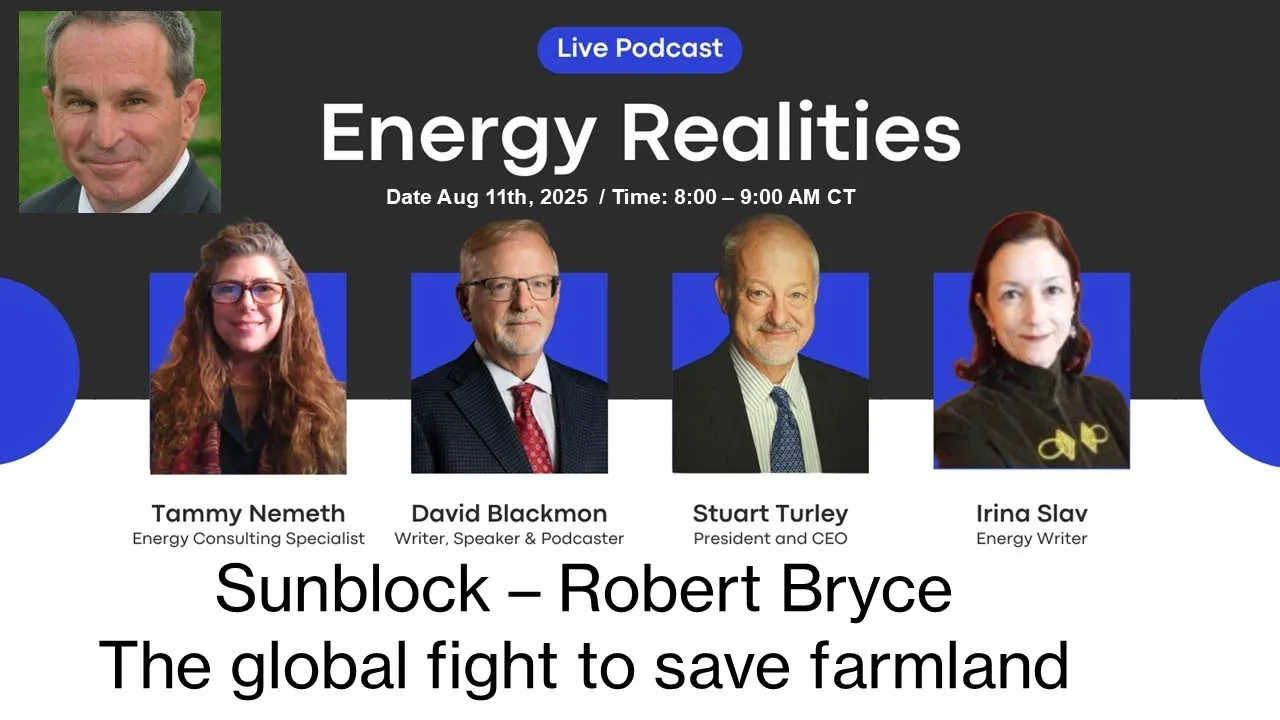
Hosts
-
Irina Slav – Bulgaria-based energy journalist known for plain-spoken assessments of policy and markets.
-
David Blackmon – Texas-based oil and gas veteran and energy commentator, quick to connect policy with political realities.
-
Stuart Turley – Oklahoma-based analyst and broadcaster, sharp on industry economics and technology.
-
Tammy Nemeth – UK-based historian and energy analyst, bringing European policy and cultural context.
Guest
-
Robert Bryce – Author, journalist, and documentary filmmaker with a focus on the intersection of energy, environment, and policy. His previous films (Juice and Juice: Power, Politics & The Grid) set the stage for Sunblock, which was produced with his daughter in just two weeks to capture the rapidly unfolding solar land grab in Texas and beyond.
Three Main Takeaways
1. Prime Farmland vs. Big Solar: An Unequal Fight
Bryce details how vast stretches of Texas’ Blackland Prairie—some of the most fertile soil in the U.S.—are being converted into solar farms, often to satisfy corporate green marketing campaigns. Projects like Blevins Solar (3.5 square miles) are backed by major corporations such as Meta, Microsoft, Fujifilm, and Bristol Myers Squibb, who tout their virtue while displacing food production.
Context: Countries like Bulgaria, Italy, and Alberta have enacted farmland protections, but Texas’ laissez-faire approach leaves local agriculture vulnerable.
2. The Hidden Ecological Costs
Beyond aesthetics, the panel unpacks underreported impacts: altered water runoff, soil erosion, blocked wildlife corridors, and “wildlife deserts” that disrupt raptor hunting and increase roadkill. Promises of “agrivoltaics” and sheep grazing are dismissed as largely impractical once the hurricane fencing goes up.
Context: Similar ecological trade-offs exist for wind and high-voltage transmission projects, suggesting the “green” label often obscures a substantial environmental footprint.
3. Policy, Subsidies, and the Virtue-Signaling Economy
From U.S. tax credits under the IRA to ESG pressures on institutional investors, the discussion reveals how financial incentives—not climate impact—drive much of the solar boom. The panel likens corporate solar buying to “medieval indulgences,” offering PR cover while data centers continue running on gas, coal, and nuclear.
Context: Many projects exploit subsidies without guaranteed grid connection; some may never produce a kilowatt for public consumption.
Other Noteworthy Points
-
Global Backlash: Bryce’s Global Renewable Rejection Database tracks accelerating community pushback against solar, wind, battery, and transmission projects.
-
Regulatory Gaps: In Texas and elsewhere, there’s little to no bonding for reclamation of solar sites or wind farms—unlike oil and gas wells.
-
Absentee Landowners: Many leases are signed by owners who don’t live near the projects, creating rural resentment and deepening the urban–rural divide.
-
End-of-Life Waste Crisis: Solar panels, turbines, and batteries lack viable large-scale recycling pathways; the likely future is landfilling or export to developing countries for unsafe dismantling.
-
Deregulation Legacy: The Enron-era treatment of electricity as a commodity rather than an essential service is blamed for policy missteps in integrating intermittent renewables.
Closing Thoughts
Sunblock is both a local story—anchored in central Texas—and a global warning about the costs of unchecked industrial renewables. The Energy Realities roundtable underscores a theme familiar to anyone covering all forms of energy: scale matters, trade-offs are real, and narratives are often cleaner than the technologies they celebrate.
Bryce’s work is a reminder that energy transitions are not just about carbon—they’re about land, food, community consent, and who gets to decide what “green” really means.


